Also called: fake art scam · art authentication fraud · forged painting scam · art provenance fraud · fake fine art certificate scam
Art forgery fraud sells a painting, print or sculpture as authentic, as the real work of a named artist, when the piece itself is forged, the attribution is false, or the documentation proving its history is fabricated. A Palm Beach dealer offered an undercover FBI agent a $495 fake Basquiat for $12 million, and a 165-year-old New York gallery sold roughly $80 million in forged paintings over 17 years before it closed.
What it is
A seller, a gallery, a private dealer, or a single online listing, offers a painting, print or
sculpture as the authentic work of a named artist, often a well-known or deceased one, when the piece
itself is forged, the attribution is false, or the paperwork proving where it came from is fabricated.
This is distinct from this site’s sports-memorabilia-fraud page in a specific way: fine art
authentication usually depends on connoisseurship, forensic material analysis, or an artist’s own
foundation and catalogue, not a single printed certificate, so the fabrication here more often targets
provenance documents, a story of where the piece has been and who owned it, rather than a signature
alone. It is also distinct from counterfeit-goods-scam, which covers mass-produced fake branded
merchandise; here, each piece is usually a one-of-a-kind object, and a single sale can run into the
millions of dollars.
The three federal cases documented on this page span 1994 to 2023 and show the same core deception at
very different scales: a decades-old, internationally respected gallery, a Palm Beach storefront
dealer, and a lone operator selling through auction houses and eBay.
How it actually works
The approach
A gallery with a real storefront and a real history, a private dealer, or an online listing offers a
piece attributed to a known artist, sometimes priced near genuine market value specifically so the
price itself raises no suspicion.
Fabricated authentication
Genuine authentication is replaced with something that only looks like it: a certificate naming a
self-invented authenticator title, a forged provenance letter from someone conveniently deceased, or a
reproduction’s printed disclaimer quietly removed before resale.
Where it could have stopped
In the cases on this page, the paperwork itself was never checked against an independent source: a dealer’s self-issued appraiser title was never verified with any real appraisal body, and a buyer’s inherited provenance letter was never checked against the person it claimed. A title or a letter is only as good as the outside party who can confirm it, and in every case here, no outside party was ever asked.
An invented origin story
The seller supplies the piece’s backstory: an anonymous private collection, a deceased relative’s
estate, a bill of sale naming someone who never sold anything, built to explain why a previously unknown
work is surfacing now.
Trust built on a real business and a real reputation
The fraud runs inside an operation with genuine inventory and, in these cases, genuine community
standing: a 165-year-old gallery with real sales alongside the fakes, or a dealer cultivating
philanthropic and social ties that make buyers and their own circle vouch for him.
The high-value sale
Once trust exists, a single significant piece, attributed to a sought-after or blue-chip artist, is
sold for tens of thousands to millions of dollars, priced to match what a genuine work by that artist
would actually command.
Payment collected, moved onward
The buyer wires or transfers payment, which is deposited into the seller’s account, then commingled
with other funds and wired out again to additional accounts, including others the seller controls.
Exposure, sometimes decades later
A rival expert, a forensic materials test, an unrelated law enforcement sting using an undercover buyer,
or a buyer’s own belated due diligence catches what the original sale missed: a painting’s materials
that did not exist when the artist was alive, a provenance letter traced to a person who never wrote
it, or a dealer who cannot answer a question a genuine owner could.
Why it works
Authentication for an unknown or rediscovered work is genuinely hard, which makes a confident fake
story easy to accept. A piece surfacing from “a private collection” after decades out of public view
is a real, ordinary occurrence in the art world, which is exactly why it is such a convenient lie: the
buyer has no way to independently confirm a story about where a work has been.
A title that sounds official is treated as proof, when it is just a title. One dealer documented
here signed his own sales as a “Certified International Fine Art Appraiser,” a credential he invented
and awarded to himself; nothing stopped him from printing it, and nothing in the transaction forced a
buyer to check whether it meant anything.
A long, genuine track record lowers scrutiny on the next sale. A business operating for decades,
or a dealer with years of smaller, real transactions, earns a presumption of legitimacy that makes the
next, biggest sale easier to believe, precisely because the buyer is relying on the seller’s past rather
than on the piece in front of them.
The asset itself has no fixed, checkable price. Unlike a stock or a bond, a painting’s value is an
opinion reached by experts and the market together, which means an invented six or seven-figure price
for a forged piece looks no different, on paper, from a genuine one.
Social and philanthropic standing substitutes for financial diligence. A dealer with real community
ties, charitable giving, a synagogue relationship, a circle of friends who vouch for him, as documented
in one case here, borrows trust from that standing in a way no amount of paperwork alone could provide.
Where it comes from
Overwhelmingly a domestic US problem, run through legitimate-looking businesses rather than from
overseas.
The largest documented case ran inside one of New York’s oldest galleries. M. Knoedler & Co.,
founded in 1846, sold almost 40 forged Abstract Expressionist paintings between 1994 and 2011 before
closing that November, a scandal that reached roughly $80 million and separately produced individual
lawsuit settlements as large as $17 million for a single fake Pollock.
It is not confined to blue-chip galleries. Eric Spoutz ran a smaller, lower-overhead version of the
same fraud for roughly a decade from 2006 through 2015, forging provenance documents for works he
attributed to artists including Picasso, de Kooning and Joan Mitchell and selling them through eBay and
auction houses rather than a gallery storefront.
It has also reached ordinary storefront dealers selling to tourists and local buyers. Daniel
Bouaziz’s Palm Beach galleries sold cheap reproductions, some bought for a few hundred dollars, as
million-dollar originals as recently as 2021, showing the same methods working at a different, more
accessible price point.
Enforcement is federal criminal prosecution, usually wire fraud and money laundering, brought after
years of sales, and sometimes, as in Bouaziz’s case, after an undercover agent is offered a piece
directly.
Real cases
2023 US Sentenced
Daniel Elie Bouaziz, a French and Israeli citizen who owned Danieli Fine Art and Galerie Danieli on Worth Avenue in Palm Beach, Florida, sold cheap reproductions as original, hand-signed works by Andy Warhol, Jean-Michel Basquiat and other artists, individual sales running $75,000 to $240,000, while stamping his own invented "Certified International Fine Art Appraiser" title onto fraudulent certificates. An undercover FBI agent was separately offered a Basquiat he had bought for $495 for $12 million, as part of a larger deal valued at $22 million. Indicted on 17 counts of wire fraud and money laundering in July 2022, he pleaded guilty in February 2023 to a single money-laundering count and was sentenced that May to 27 months in federal prison, a $15,000 fine, and three years of supervised release.
Read the case file ·
3 sources
2017 US Sentenced $1.4m
Eric Spoutz, a Michigan art dealer who sold works through eBay and auction houses under his own name and aliases including "Robert Chad Smith" and "John Goodman," ran a decade-long scheme from at least 2006 through 2015 that forged provenance documents, receipts, bills of sale, and letters purportedly from deceased collectors and attorneys, to sell fake works he attributed to artists including Pablo Picasso, Willem de Kooning, Marc Chagall, Franz Kline and Joan Mitchell. He pleaded guilty in June 2016 to one count of wire fraud and was sentenced in February 2017 in Manhattan federal court to 41 months in prison, forfeiture of the $1.45 million he made from the scheme, and $154,100 in restitution.
Read the case file ·
2 sources
2017 US Sentenced $81.0m
Glafira Rosales, a Long Island art dealer, supplied almost 40 forged Abstract Expressionist paintings, painted in a Queens garage by Chinese immigrant Pei-Shen Qian for under $9,000 each, to M. Knoedler & Co. and the Julian Weissman gallery between 1994 and 2011, falsely attributed to artists including Jackson Pollock, Mark Rothko and Willem de Kooning. The scheme brought in roughly $80 million before it collapsed and forced the 165-year-old Knoedler, one of New York's oldest galleries, to close in November 2011. Rosales pleaded guilty in September 2013 to conspiracy, wire fraud, money laundering and filing false tax returns. A federal judge sentenced her in January 2017 to the 82 days she had already served, nine months of house detention and three years of probation, crediting her cooperation and citing abuse she said she suffered from her partner and co-conspirator; she was later ordered to pay $81 million in restitution.
Read the case file ·
3 sources
Red flags
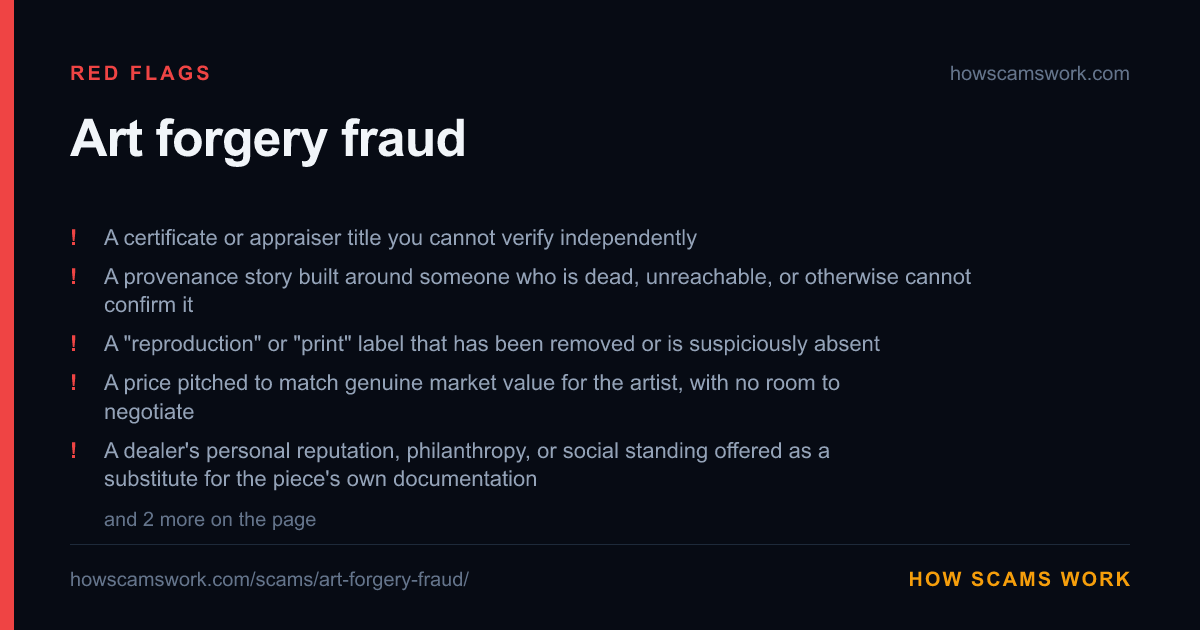
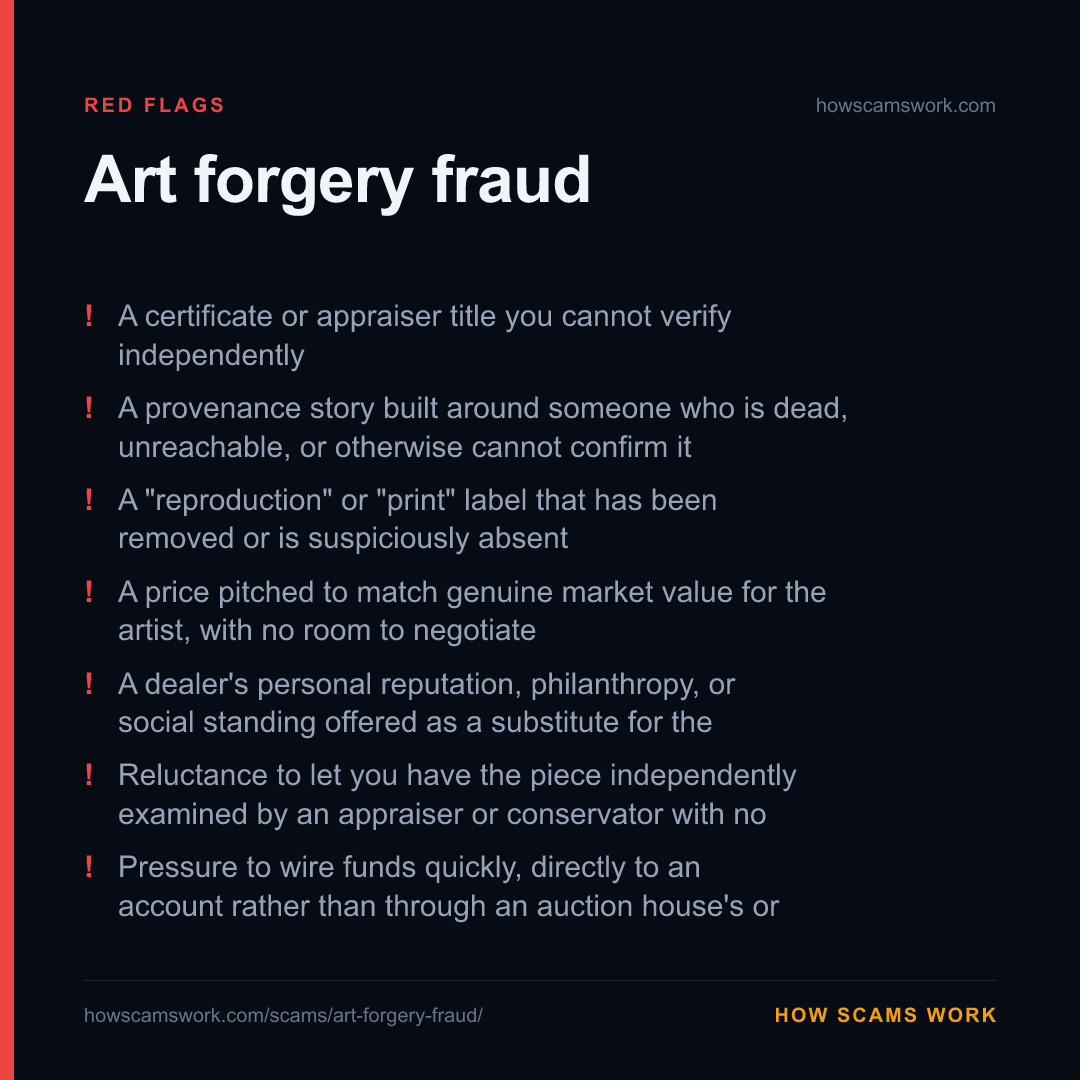
- A certificate or appraiser title you cannot verify independently. Check the issuing body or authenticator’s credentials yourself; do not trust a stamp or letterhead just because it looks official.
- A provenance story built around someone who is dead, unreachable, or otherwise cannot confirm it. A convenient inheritance or an anonymous “private collection” is a real pattern in the genuine art market, and exactly why it gets used as cover for a fake one.
- A “reproduction” or “print” label that has been removed or is suspiciously absent. Ask directly whether a piece is an original, a limited edition print, or a reproduction, and get the answer in writing.
- A price pitched to match genuine market value for the artist, with no room to negotiate. A forger pricing to the real market, not below it, avoids the one signal most buyers are trained to notice.
- A dealer’s personal reputation, philanthropy, or social standing offered as a substitute for the piece’s own documentation. Community trust says nothing about whether a specific painting is genuine.
- Reluctance to let you have the piece independently examined by an appraiser or conservator with no relationship to the seller.
- Pressure to wire funds quickly, directly to an account rather than through an auction house’s or dealer’s standard escrow process.
If it’s happening to you
- Stop any pending payment immediately. Do not wire additional funds until the piece and its paperwork have been independently verified.
- If you paid by wire and it was recent, contact your bank right away and ask about a wire recall. It only works while the funds are still sitting in the receiving account; the first hours matter most.
- If you paid by credit card, dispute the charge.
- Get the piece examined by an independent appraiser, conservator, or authenticator with no financial relationship to the seller. For a well-known artist, check whether their estate, foundation, or a recognised catalogue raisonné committee can comment.
- Try to verify any named provenance source directly, using contact information you find yourself, not information the seller supplied.
- Report it to the FBI’s Internet Crime Complaint Center at IC3.gov, and to the FTC at ReportFraud.ftc.gov. See where to report for other countries.
- Keep every invoice, certificate, email, and shipping record. If the seller is later prosecuted, documented losses are what connect your case to a broader investigation and any eventual restitution or forfeiture order.
Where the money goes
Straight into accounts the seller controls, then spread further to make it harder to trace.
There is no overseas laundering network in the cases on this page; money moves from a buyer’s wire or
transfer directly to the seller. What the documented cases show instead is commingling and onward
transfers between the seller’s own accounts: Daniel Bouaziz deposited a buyer’s $200,000 down payment
into one account, then had it wired, commingled with other funds, into additional accounts he
controlled, a pattern that is itself what the resulting money laundering charges, rather than wire fraud
charges alone, were built on.
Recovery after the fact is slow and partial. Glafira Rosales was ordered to pay $81 million in
restitution, on top of forfeiting all her assets except her retirement account; by the time of her 2017
sentencing she was renting a room and working as a dishwasher. Eric Spoutz forfeited the $1.45 million
he made from his scheme and was ordered to pay $154,100 in restitution. Daniel Bouaziz had returned
$246,000 to his 11 identified victims by the time of his 2023 sentencing, with a restitution hearing to
determine the rest held separately. Criminal restitution and forfeiture orders of this kind are
collected, when they are collected at all, over years, not months.
By the numbers
No published dataset breaks this scheme out as its own category yet, so there is no chart to show.
The data page explains which agency categories exist and why some schemes are
invisible in official statistics.
Every factual claim above traces to one of these. Statistics are reported losses; see
methodology for what that does and does not measure.