Also called: fake autograph scam · counterfeit sports memorabilia · memorabilia authentication fraud · fake certificate of authenticity scam
A sports memorabilia scam sells an autograph, a jersey or a "game-used" item as authentic when the signature, the certificate, the provenance, or the item itself is fabricated. The FBI's Operation Bullpen investigators estimated that half to nine out of ten pieces of signed memorabilia in circulation were forged, and a single Chicago prosecution in 2017 ordered $23.5 million in restitution to just 26 victims of one dealer.
What it is
A seller offers an autographed photo, a bat, a jersey, a trading card or a trophy as game-used or
personally signed by a named athlete, often with a certificate of authenticity attached. The item is
either entirely fake, carries a forged signature on a genuine but unrelated object, or is misdescribed,
a “game-issued” jersey sold as “game-used,” a replica sold as an original.
This is distinct from this site’s counterfeit-goods-scam page, which covers fake branded merchandise,
counterfeit sneakers, handbags, electronics, manufactured to imitate a trademarked product. Here the
physical object can be entirely genuine; the lie is about who touched it: who signed it, who wore it,
who owned it before you. That lie is harder to catch than a counterfeit logo, because it depends on a
provenance story and a certificate rather than on the object itself.
The FBI’s “Operation Bullpen” investigation, which ran from 1999 to 2006, put a number on the scale
of the problem: investigators estimated that 50 to 90 percent of autographed sports memorabilia then
in circulation was forged. The four federal cases documented on this page, spanning 2017 to 2025, show
the same underlying tactics still at work decades later.
How it actually works
The pitch
A listing on an online marketplace, a social media post, a charity auction lot, or a direct approach to
a dealer or collector offers a signed, game-used, or historically significant item, sometimes at a
price that looks like a bargain, sometimes priced right at genuine market value specifically so the
price itself raises no suspicion.
The certificate
A certificate of authenticity accompanies the item, naming an authenticator and sometimes carrying a
matching hologram sticker. In the federal cases on this page, certificates and the authentication they
claimed were themselves fabricated, copied, or issued by an authenticator who never actually examined
the item.
Where it could have stopped
The FBI’s own guidance on this scheme is specific: contact the named authenticator directly, by the phone number and address printed on the certificate, before paying, and never accept a photocopy. A certificate that cannot be verified independently with the person or company who supposedly issued it is not evidence of anything.
A fabricated history
For an older or higher-value item, the seller supplies a story about where it came from, sometimes
recruiting a co-conspirator to pose as the original owner or an independent witness confirming the
item’s history to a buyer or appraiser.
Trust built on genuine sales first
Operators sometimes pay for a real signing session, hundreds of items at once, then quietly add
forgeries to the batch once the real items sell out, continuing to claim the same session as the
source. A track record of real, verifiable small sales makes the next, bigger sale easier to believe.
The grail item
Once trust exists, the single most valuable piece, a bat claimed used in a specific World Series game,
a trophy pledged as loan collateral, a jersey tied to one famous date, commands a price far above an
ordinary autograph, sometimes tens or hundreds of thousands of dollars from one buyer.
Payment collected, little or nothing delivered
The buyer pays, often by wire, cash app, or an account the seller controls, and receives either a far
cheaper substitute, a damaged or mismatched item, or nothing at all.
Exposure, sometimes years later
The fraud surfaces when a rival authenticator, a suspicious buyer, or an unrelated law enforcement
investigation examines an item closely enough to catch an inconsistency, a bat an inch short of the one
actually used, a dent or a missing screw that does not match the real trophy, a signature with no
natural variation across repeated sales.
Why it works
The proof is a piece of paper, and paper is easy to fake. A certificate of authenticity looks
official and is treated as settled proof by most buyers, but nothing stops a forger from printing their
own, naming a real or invented authenticator, and attaching a copied or recreated hologram.
Real provenance for old items is genuinely hard to verify. A buyer has no independent way to confirm
that a 70-year-old bat was used in one specific game, which is exactly the kind of claim this scheme
exploits: the harder a fact is to check, the easier it is to invent.
A track record of real deliveries builds trust for the one big lie. Several of the operators
documented here ran years of ordinary, low-value sales, some of them genuine, before the highest-value
items changed hands, and genuine early transactions make the buyer’s guard come down for the sale that
matters most.
The item itself is often real, which disarms the obvious check. Unlike a counterfeit product, the
bat, jersey, or photograph in these schemes is frequently an authentic piece of sporting equipment or
memorabilia; only the signature, the history, or the claimed game is fake, so an inspection of the
object alone can miss the actual lie.
Emotional attachment to a specific athlete overrides financial caution. A fan of a particular
player, especially a retired or deceased one who can no longer be asked to confirm anything directly,
is buying a connection to that person, not just an object, which makes a flattering story more welcome
than a skeptical question.
Where it comes from
Overwhelmingly a domestic US industry problem, run in the open rather than from overseas.
The federal investigation that named the scale of this problem is two decades old. The FBI and IRS’s
Operation Bullpen, running from 1999 to 2006, raided forgery operations across a dozen states, shut down
18 forgery rings, and produced more than 60 convictions. Investigators who worked the case put the
industry’s fake-memorabilia share at 50 to 90 percent.
It has not gone away; it has moved partly online. The four federal cases on this page run from
Joshua Shores’s 2008 to 2013 counterfeit-jersey operation through Daniel Damato’s 2022 to 2024 fake
Willie Mays items, each using online marketplaces, PayPal, and direct sales rather than trade shows
alone.
The response has been industry self-policing more than new law. Major League Baseball launched its
own Authentication Program after Operation Bullpen; authentication companies now use tamper-resistant
holograms, photo-matching against historical images, and autopen-detection techniques, measures the
ESPN reporting on this page describes forgers continuing to adapt around.
Enforcement is federal criminal prosecution, usually wire or mail fraud, brought years after a
scheme starts, once enough victims or enough dollar volume draws investigators’ attention; three of the
four cases documented here ran for five years or more before charges were filed.
Real cases
2025 US Convicted $150,000
Daniel Damato, a sports memorabilia dealer in Concord, California, sold a baseball bat he falsely claimed Willie Mays used in the 1954 World Series for $100,000, and a jersey he falsely claimed Mays wore in a game for $50,000. Prosecutors say the bat was actually a "factory error" bat about an inch shorter than the bats Mays used, and that after the first buyer paid, Damato never sent the item. He was charged with wire fraud in October 2025, and after an FBI search of his home in October 2024, prosecutors say he contacted at least one potential witness in an attempt to obstruct the investigation. He pleaded guilty on December 8, 2025 to one count of wire fraud and admitted to the obstruction attempt. A sentencing hearing was scheduled for March 23, 2026 before US District Judge Araceli Martínez-Olguín, facing a maximum of 20 years in prison and a $250,000 fine.
Read the case file ·
3 sources
2021 US Sentenced
Douglas Edward Duren bought unsigned sports equipment, movie posters, books and photographs, forged the signatures of athletes and celebrities onto them, and sold the items as authentic through three websites he ran for nine years, from 2010 through 2019, moving the operation from Maryland to Atlanta along the way. He also posed as an advertising agency employee to place TV commercials for the websites and failed to pay one Alabama station $80,000 for the airtime. He pleaded guilty to wire fraud and aggravated identity theft and was sentenced in August 2021 in federal court in Birmingham, Alabama, to 40 months in prison.
Read the case file ·
2 sources
2017 US Sentenced $23.6m
John Rogers, a North Little Rock, Arkansas sports memorabilia dealer who owned Sports Card Plus and Rogers Photo Archive LLC, pledged a fake Heisman Trophy as collateral for a $100,000 loan and sold other forged items, including phony Mickey Mantle baseball cards, a fake Mantle silverware set, and phony Scottie Pippen trophies. He pleaded guilty to wire fraud in March 2017 and, after continuing to sell fakes while free on bond, was sentenced in December 2017 in federal court in Chicago to 12 years in prison and ordered to pay $23,552,370 in restitution to at least 26 victims.
Read the case file ·
3 sources
2017 US Sentenced $2.5m
Joshua Shores, a Maryland businessman who ran several internet sports memorabilia businesses in Pennsylvania and Maryland, bought counterfeit sports jerseys in bulk, added fraudulent autographs, and resold them as authentic through more than 80 bank accounts and multiple PayPal and Amazon seller accounts between 2008 and 2013. He pleaded guilty to one count of wire fraud and was sentenced in April 2017 in federal court in the Middle District of Pennsylvania to five years in prison, $500,000 in restitution, a $5,000 fine, and forfeiture of $140,000 in assets.
Read the case file ·
1 source
Red flags
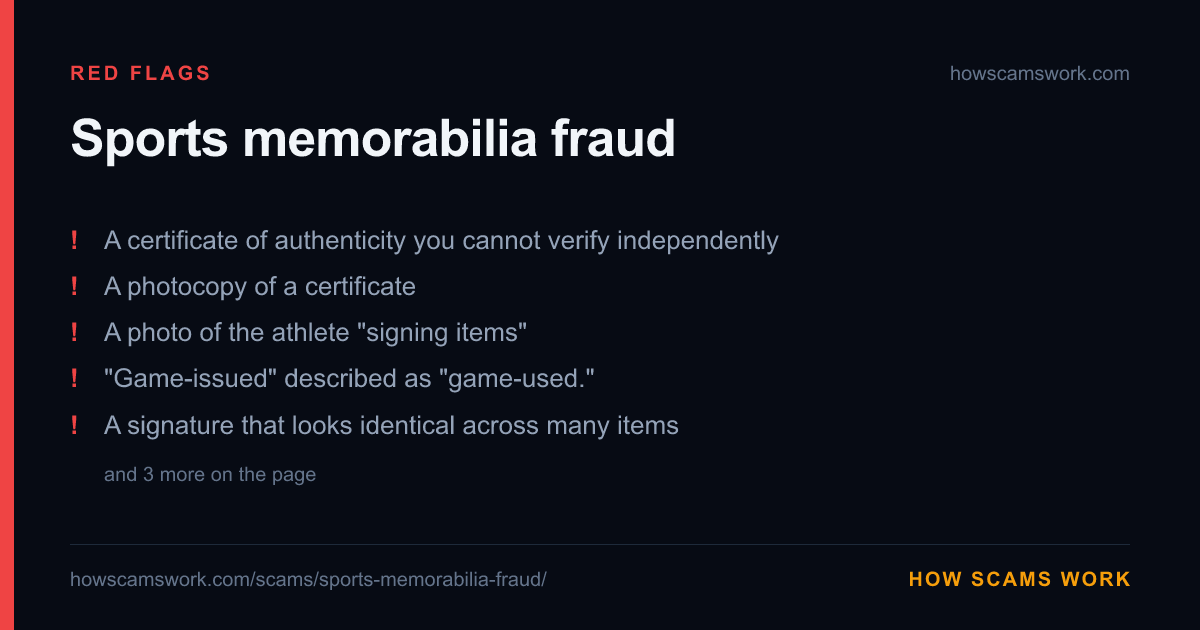
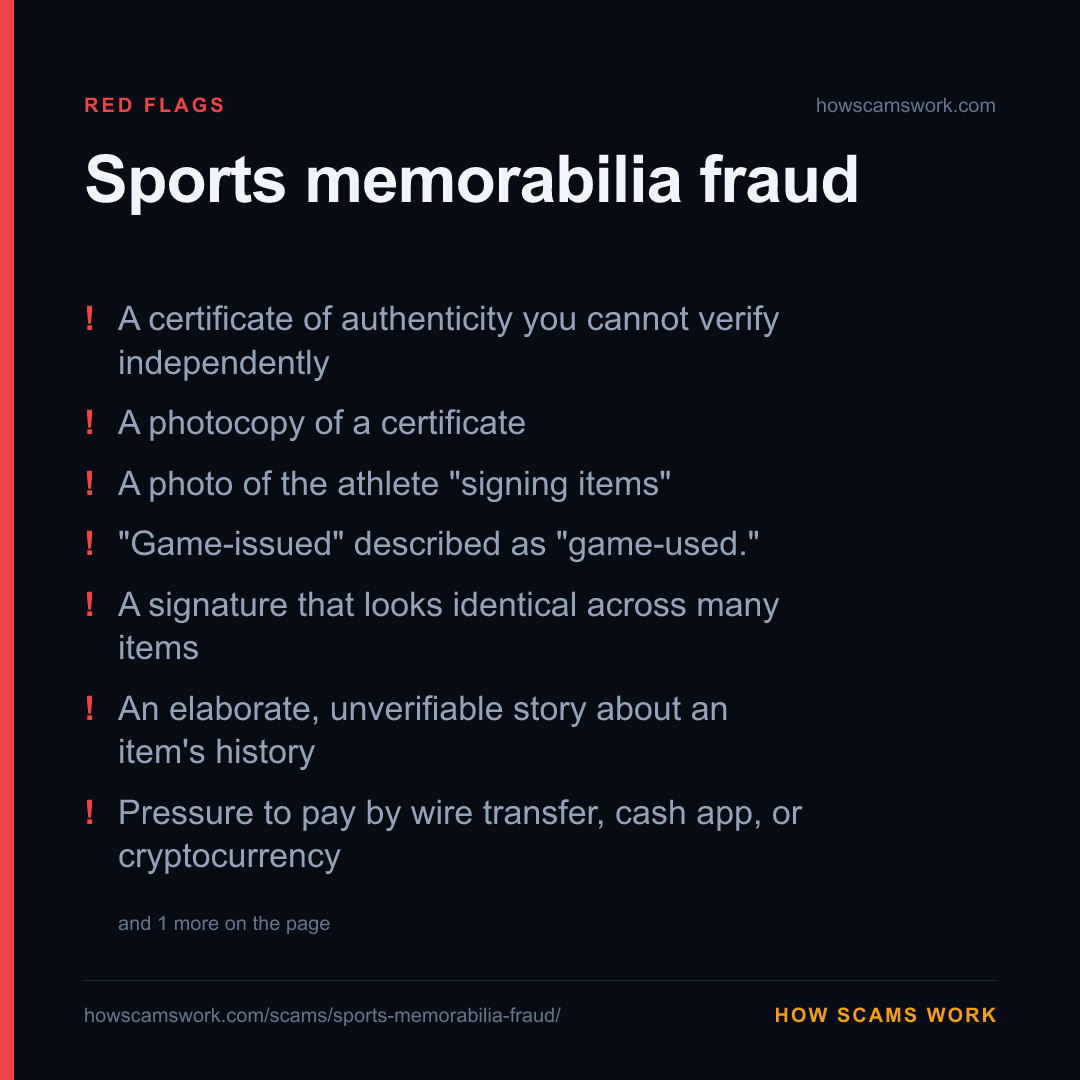
- A certificate of authenticity you cannot verify independently. Contact the named authenticator directly using contact details you find yourself, not ones printed on the certificate alone.
- A photocopy of a certificate, rather than the original.
- A photo of the athlete “signing items” offered as proof that your specific item came from that session. It proves the session happened, nothing about your item.
- “Game-issued” described as “game-used.” An item given to a player but never worn in competition is worth far less, and the two terms are sometimes blurred on purpose.
- A signature that looks identical across many items, which can indicate an autopen rather than a hand signature, something a legitimate seller should disclose, not hide.
- An elaborate, unverifiable story about an item’s history, especially for a vintage item or an athlete who is deceased and cannot confirm anything.
- Pressure to pay by wire transfer, cash app, or cryptocurrency rather than a credit card, which removes your ability to dispute the charge later.
- A seller with no verifiable business history, no Better Business Bureau profile, and no results when searched against a scam-report database.
If it’s happening to you
- Stop any pending payment immediately. If you have not yet paid, do not, until you have independently verified the certificate and the seller.
- If you paid by credit card, dispute the charge now. A chargeback does not require the seller’s cooperation and is the most effective recovery option available for a card payment.
- Contact the authenticator named on the certificate yourself, using a phone number or address you find independently, not one printed on the document, to confirm the certificate is genuine and actually matches your item.
- Get the item examined by a reputable third-party authentication service before assuming a refund is impossible; a professional opinion in writing strengthens any dispute or report.
- Report it to the FBI’s Internet Crime Complaint Center at IC3.gov, and to the Better Business Bureau’s Scam Tracker at BBB.org/ScamTracker, and to the FTC at ReportFraud.ftc.gov. See where to report for other countries.
- If the item claims a specific team or league connection, contact that team or league directly; several maintain their own authentication programs and can confirm whether an item matches their records.
- Keep every message, listing screenshot, and shipping record. If the seller is later investigated, documented losses are what connect your case to a broader prosecution and any eventual restitution.
Where the money goes
Straight into accounts the seller controls, often spread across many of them.
There is no cross-border laundering chain in the cases on this page; the money moves from a buyer’s card,
bank transfer, or payment app directly to the seller. What several of the cases do show is structuring
across a large number of accounts: Joshua Shores opened more than 80 bank accounts over the life of his
scheme, using multiple PayPal and Amazon seller accounts to receive payments and buy counterfeit jerseys
in bulk from China. Spreading proceeds this way makes it harder for any single payment processor or bank
to flag the volume, and makes a single account closure or marketplace ban far less damaging to the
operator than it would be if everything ran through one account.
Recovery after the fact is slow and partial. John Rogers was ordered to pay $23,552,370 in restitution to
at least 26 victims; Joshua Shores was ordered to pay $500,000 in restitution and forfeit $140,000 in
assets against a $2.5 million scheme. Restitution orders of this kind are collected, when they are
collected at all, over years, not months.
By the numbers
No published dataset breaks this scheme out as its own category yet, so there is no chart to show.
The data page explains which agency categories exist and why some schemes are
invisible in official statistics.
Every factual claim above traces to one of these. Statistics are reported losses; see
methodology for what that does and does not measure.