Also called: HUBZone fraud · 8(a) program fraud · disadvantaged business certification fraud · front company set-aside fraud · SBA contracting fraud
HUBZone and 8(a) fraud happens when a company falsely certifies that its office sits in a federally designated distressed area, or installs a disadvantaged figurehead owner it doesn't actually let run the business, to win federal contracts set aside for small, disadvantaged businesses. A Utah company falsified employee addresses to win a $99 million HUBZone contract, then fraudulently used the 8(a) program to collect more than $200 million more over nine years.
What it is
The federal government sets aside a share of its contracting dollars, by law at least 23 percent of
spending government-wide, for small businesses that meet one of several eligibility tests. Two of those
tests sit at the center of this page. The HUBZone program reserves work for small businesses whose
principal office sits in a federally designated historically underutilized business zone and whose
workforce is substantially local to it. The 8(a) program reserves work for small businesses at least
51 percent owned and controlled by someone who is socially and economically disadvantaged. HUBZone and
8(a) set-aside fraud is what happens when a company that could never pass either test certifies itself
anyway.
A Canton, Ohio contractor faked a lease to claim its office sat inside a HUBZone when it didn’t, then
collected federal construction work for seven years before a $6.7 million repayment order caught up
with him. A Utah company falsified its own employees’ driver’s licenses and voter registrations to fake
HUBZone eligibility for a $99 million military-base contract, then separately faked its way into the
8(a) program and collected more than $200 million more over nine years. And a Virginia security firm
installed an employee as a figurehead “owner,” chosen specifically for her ethnicity and disadvantaged
background, while its real owner kept forging her signature for eight years.
How it actually works
Two federal programs built to steer contracts toward distressed areas and disadvantaged owners
The HUBZone program is meant to increase investment and employment in historically underutilized
business zones, areas that can include Native American reservations and sites near a closed military
base. The 8(a) program is meant to give businesses owned by people who have personally experienced
discrimination access to sole-source and competitive federal contracts. Both rely on a certification
process that checks an applicant’s own paperwork rather than independently verifying it.
A company fakes its address, or its employees’ addresses, to pass the HUBZone test
To qualify for HUBZone status, a firm’s principal office has to sit inside a designated zone and at least
35 percent of its employees have to live inside one too. William Richardson and TAB Construction Company
submitted a fake lease to tell the SBA their principal office was at a Canton, Ohio address inside a
HUBZone, when their real office was elsewhere. Odyssey International took the employee-residency route
instead, having workers falsify their home addresses on driver’s licenses and voter registrations, and
quietly paying employees who didn’t qualify through a separate shell company so the SBA’s review would
never see them.
The 8(a) test isn’t about geography, it’s about who actually owns and runs the business. Keith Hedman
picked an employee, Dawn Hamilton, to serve as his company’s listed owner specifically “based on her
Portuguese heritage and history of social disadvantage,” the exact profile the program exists to help,
while he kept real control of its finances and contracting decisions.
Where it could have stopped
The Government Accountability Office has tested this certification process directly. In one proactive test, GAO built four bogus companies and applied for 8(a) certification on their behalf; the SBA’s own controls, including third-party credit-bureau checks, correctly caught three of them. But GAO got the fourth certified anyway, using fabricated documentation and owner information, a result GAO attributed partly to the program having no requirement for any face-to-face contact with applicants.
A new front company gets created when the old one ages out
8(a) certification lasts up to nine years and depends on the qualifying owner staying in place. When
Hedman’s original company’s disadvantaged owner left in 2003 and the company lost its eligibility, he
didn’t stop bidding; he simply formed a second company and found a new figurehead to qualify it, a pattern
GAO separately documented in a different case where a company that had already graduated out of the 8(a)
program kept winning set-aside work by routing it through a series of still-certified companies as
pass-throughs.
A federal official can be bribed to keep the work flowing
Hedman paid $50,000 and a percentage of new business to Derek Matthews, a former Federal Protective
Service regional director who had daily oversight of security programs at roughly 9,000 federal
buildings, in exchange for help steering contracts to his front company.
The front company keeps winning, often for years
Once certified, nothing in the process automatically re-checks whether a company’s office has moved or
its real owner has changed. TAB Construction held HUBZone-set-aside work from the US Army Corps of
Engineers, the Coast Guard and the National Park Service across seven years, from 2005 to 2012. Odyssey
International’s fraudulent 8(a) certification alone brought in more than $200 million over roughly nine
years, on top of the single $99 million HUBZone contract its separate falsified certification won.
An investigation, often spanning multiple agencies, eventually unravels it
Because a single falsified certification can win contracts from several different federal purchasers at
once, these cases tend to draw joint investigations: the Odyssey case involved the FBI, the US Army, the
US Air Force, IRS Criminal Investigation and the SBA; the Hedman case involved NASA’s, the SBA’s, the
GSA’s and DHS’s own Inspectors General together. By the time any of them concluded, each scheme had
already been running for years.
Why it works
Certification runs on the applicant’s own paperwork. The SBA’s HUBZone and 8(a) reviews depend
heavily on documents, leases, payroll records, ownership filings, that the applicant itself supplies.
GAO’s own proactive test showed that even functioning verification steps can still be beaten with
fabricated documentation.
A one-time check doesn’t catch a relationship that changes later. HUBZone recertification happens
only periodically, and GAO found in 2018 that the SBA could not fully document that it was even following
its own risk-based review process for recertifications. Nothing routinely re-checks whether a
company’s real office has moved, or whether its figurehead owner still has any actual authority, between
certification cycles.
A willing or convincing figurehead isn’t hard to find. Dawn Hamilton was a real employee with a real
background that genuinely qualified the company on paper; what made it fraud was invisible from the
outside, that Hedman, not she, was making every real decision.
Losing eligibility doesn’t end the incentive to keep bidding. When a qualifying owner leaves or a
company times out of the 8(a) program after nine years, the easiest path for an operator who built a
business around set-aside work is a new company and a new figurehead, not a return to open competition.
Bribery removes the one safeguard built to catch the rest. Once a contracting official is being paid,
as Derek Matthews was, the person positioned to notice an ineligible bidder becomes the person steering
work to it instead.
Where it comes from
Entirely domestic. Every documented case on this page is a US company or individual defrauding a US
federal set-aside program; none involves a foreign scammer or cross-border targeting of a victim.
It runs through the ordinary machinery of federal contracting, not criminal networks: registered
companies, leases, payroll records, SBA certification files and, in one case, a federal security
official’s own position.
Scale ranges from a single falsified application to a company operating as a going concern for nearly a
decade. TAB Construction’s fraud produced a specific, bounded $6.7 million repayment order. Odyssey
International’s reached two separate programs and more than $300 million in contracts combined. GAO’s
own 2010 review, independent of any single prosecution, found $325 million in 8(a) contracts across the
program as a whole had gone to firms that were not actually eligible.
Enforcement is criminal, investigated jointly by the SBA’s Office of Inspector General and whichever
federal agencies’ own contracts were involved, and often reaches every named individual around a front
company, not just the person who conceived it: the figurehead owner in Hedman’s scheme, and the former
CFO and COO in Odyssey’s, were each separately charged, even though both documented cases describe a
single person as the one who actually controlled the fraud.
Real cases
2022 US Sentenced $99.0m
Odyssey International Inc. and its president and owner, Whitney McBride, 41, of Queen Creek, Arizona, bid in 2011 on a $99 million federal contract at Fort Drum, New York, set aside under the SBA's HUBZone program, knowing the company did not qualify. Odyssey had employees falsify their home addresses on driver's licenses and voter registrations to make it appear 35 percent of its workforce lived in a HUBZone, temporarily placed HUBZone residents who did not actually work for the company onto its payroll, and used a shell company to pay non-qualifying employees off Odyssey's own books so the SBA would not see them. The Justice Department's release also states that Odyssey "fraudulently gained admission" to the SBA's separate 8(a) program and obtained more than $200 million in contracts through it over about nine years. A federal jury convicted McBride and Odyssey on all counts June 1, 2022. McBride was sentenced November 18, 2022 to 30 months in federal prison, 36 months of supervised release, and forfeiture of $2,271,841.16 from seven bank accounts; Odyssey was fined $5 million. Former chief financial officer Kin Shing Paul Lee, who had pleaded guilty, was sentenced in January 2023 to one year in prison. Former chief operating officer Michael Tingey, who had also pleaded guilty and testified against McBride at trial, was sentenced February 23, 2023 to two years of probation. The Tenth Circuit Court of Appeals affirmed the convictions in March 2024.
Read the case file ·
6 sources
2015 US Sentenced $6.7m
William Richardson III, also known as "Buster" Richardson, and his company, TAB Construction Company of Canton, Ohio, submitted a HUBZone application to the Small Business Administration in August 2000 falsely stating that TAB's principal office was located at 1010 Walnut Avenue NE in Canton, an address within a designated HUBZone area. TAB's actual principal office was at 4534 Vliet Street SW, which was not in a HUBZone; Richardson and TAB backed the false claim with supporting documents, including a fake lease, and told the SBA the Vliet Street location was only equipment storage. Based on those representations, the SBA certified TAB as HUBZone eligible, and between 2005 and 2012 the company received contracts from the US Army Corps of Engineers, the US Coast Guard and the National Park Service under that certification. Richardson pleaded guilty to one count of wire fraud, and the Justice Department announced on September 15, 2015 that he had been sentenced to one year in prison and ordered to repay $6.7 million.
Read the case file ·
1 source
2013 US Sentenced $31.0m
Keith Hedman, 53, of Arlington, Virginia, ran an Arlington security contracting firm that lost its eligibility for the Small Business Administration's 8(a) program when its disadvantaged owner left in 2003. Rather than give up the preference, Hedman created a second company and selected an employee, Dawn Hamilton, 48, of Brownsville, Maryland, to serve as its figurehead owner "based on her Portuguese heritage and history of social disadvantage," according to the Justice Department. The new company obtained 8(a) status in 2004 on the false claim that Hamilton had founded and controlled it. From 2004 through February 2012, Hedman, not Hamilton, actually directed the company's finances, staffing and contracting, forging Hamilton's signature on SBA filings she had never seen. He also paid $50,000 and a cut of new business to Derek Matthews, a former Federal Protective Service regional director, to steer contracts to the company. The scheme as a whole involved contracts valued at more than $153 million, of which the front company obtained more than $31 million; its conspirators improperly kept more than $6.1 million of that. Hedman was sentenced June 21, 2013 to 72 months in prison and ordered to forfeit approximately $6.1 million. Hamilton was sentenced June 28, 2013 to 48 months, three years of supervised release, forfeiture of approximately $1.2 million and a $1 million fine.
Read the case file ·
2 sources
Red flags
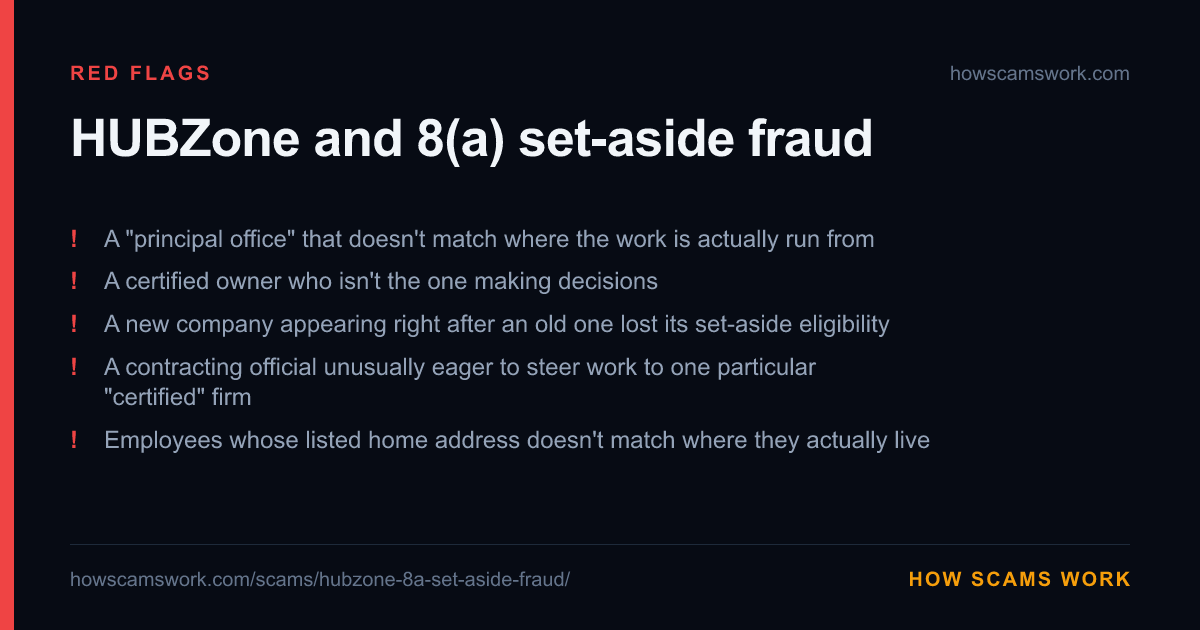
- A “principal office” that doesn’t match where the work is actually run from. A HUBZone-certified company’s real office, not a storage unit or a lease of convenience, has to sit inside the qualifying zone.
- A certified owner who isn’t the one making decisions. An 8(a) company’s listed disadvantaged owner is supposed to direct its finances and contracting, not sign documents someone else wrote.
- A new company appearing right after an old one lost its set-aside eligibility, especially one with the same people, office or client list as the company that aged out or lost its qualifying owner.
- A contracting official unusually eager to steer work to one particular “certified” firm, or uninterested in verifying a certification a competitor has challenged.
- Employees whose listed home address doesn’t match where they actually live, a detail investigators in more than one documented case traced back through driver’s license and voter registration records.
If it’s happening to you
This page describes fraud against federal contracting programs, so the useful actions differ depending on
who you are.
- If you are being recruited to serve as a certified “owner” of a company you won’t actually run,
understand that you can face felony charges and years in prison alongside the person who recruited you,
as Dawn Hamilton did, even though the government’s own account of her case describes someone else as
having made every real decision.
- If you are a legitimate HUBZone or 8(a) firm competing against a company you believe doesn’t actually
qualify, you can file a status protest with the contracting officer or the SBA, which has its own
process for investigating eligibility challenges separate from a criminal referral.
- If you are a contracting official asked to overlook a documentation gap, or offered anything of
value in connection with a set-aside award, that is a bribery solicitation, not a favor; report it
immediately to your agency’s Inspector General.
- If you suspect a specific company, owner, or contracting official, report it to the Small Business
Administration’s Office of Inspector General. See where to report for the exact
contact details and for agencies in other countries.
Where the money goes
Mostly into the front company’s own accounts, with a smaller share carved out for whoever lent their
name, and sometimes a further cut for a bribed official.
The federal agency pays the certified company directly for work performed under the set-aside contract,
exactly as it would pay any legitimate winner. From there, the documented cases on this page split the
money two ways. Where a figurehead owner is involved, as in Dawn Hamilton’s case, the person who actually
controls the company keeps the overwhelming majority of the proceeds; Hamilton’s own forfeiture order,
about $1.2 million, was a fraction of the more than $31 million the front company obtained. Where a
government official is bribed, a further slice gets carved out specifically for that purpose, $50,000 and
a percentage of new business, in Keith Hedman’s arrangement with Derek Matthews.
There is no offshore layer or cryptocurrency conversion in any case on this page. The contracts, payroll
records and bribes all move through the ordinary US banking and corporate system, which is also why
federal investigators were eventually able to trace all of it once an investigation actually began.
By the numbers
No published dataset breaks this scheme out as its own category yet, so there is no chart to show.
The data page explains which agency categories exist and why some schemes are
invisible in official statistics.
Every factual claim above traces to one of these. Statistics are reported losses; see
methodology for what that does and does not measure.
Common questions
How is this different from the site's veteran-owned small business (rent-a-vet) fraud?
The front-company mechanism is the same, but the eligibility test being faked is different. Rent-a-vet fraud fakes a veteran's ownership and control of a company. HUBZone fraud fakes where a company's office sits and where its employees live, the test William Richardson and TAB Construction defeated with a forged lease. 8(a) fraud fakes that a socially and economically disadvantaged individual, not someone else, actually owns and controls the company, the test Keith Hedman defeated by installing Dawn Hamilton as a figurehead.
What exactly does a company have to prove to be HUBZone certified?
Four things, according to the Justice Department's own description of the program: the firm must qualify as a small business, be at least 51 percent owned and controlled by US citizens, have its principal office located in a designated HUBZone area, and have at least 35 percent of its employees residing in a designated HUBZone area. The SBA relies on the applicant's own supporting documents to verify all four.
Does the figurehead owner in an 8(a) front company face charges too?
Yes. Dawn Hamilton was sentenced to 48 months in prison for serving as a figurehead owner, even though the Justice Department's own account describes Keith Hedman, not her, as the one who actually ran the company, directed its finances, and forged her signature on government filings.
How is this different from a legitimate 8(a) joint venture or mentor-protege arrangement?
A lawful 8(a) joint venture or mentor-protege relationship still requires the certified disadvantaged business to control day-to-day management and receive a defined share of the work and profit. What makes the cases on this page fraud is that the qualifying owner's control was fake on paper from the start: Dawn Hamilton signed annual reviews falsely claiming she ran a company Keith Hedman actually controlled, and TAB Construction's HUBZone address was never TAB's real office at all.
Who actually catches this kind of fraud?
Mainly the SBA's own Office of Inspector General, working alongside whichever agency's purchases were involved, the Defense Criminal Investigative Service, the GSA and DHS Inspectors General, the US Army's Criminal Investigation Division, NASA's Office of Inspector General and the FBI have all investigated cases on this page. The Government Accountability Office has also tested the certification process directly: in one proactive test, it got one of four bogus companies it created certified for the 8(a) program using fabricated documentation.
I think a company I know is a HUBZone or 8(a) front. What should I do?
Report it to the Small Business Administration's Office of Inspector General, which investigates HUBZone and 8(a) certification fraud. See <a href="/report/">where to report</a> for the exact contact details and for agencies in other countries.