Also called: rent-a-vet scheme · SDVOSB fraud · VOSB certification fraud · veteran contracting fraud
Veteran-owned small business set-aside fraud happens when a company a veteran doesn't actually run pays that veteran to sign as the owner, so it can win federal contracts reserved for veteran-run firms. Two Pittsburgh contractors who were never veterans ran this for 11 years before a 2024 sentencing ordered them to repay $403,142.
What it is
The federal government sets aside a share of its contracting dollars, by law at least 3 percent of
contract spending government-wide, exclusively for small businesses that are at least 51 percent owned
and controlled by a service-disabled veteran. Veteran-owned small business set-aside fraud is what
happens when the veteran named on that paperwork doesn’t actually own or run the company at all. A
company that could never win the contract on its own pays, recruits or simply steals the identity of a
disabled veteran to sign as the owner, wins work that was never meant for it, and keeps the profit a real
veteran-run business was supposed to get.
The scheme has a nickname inside federal contracting circles: rent-a-vet. Two Pittsburgh
contractors who had never served in the military ran one for 11 years, winning 67 contracts set
aside for service-disabled veterans, 50 of them worth $1 million or more, before a 2024 sentencing
ordered them to repay $403,142. A Texas man didn’t bother recruiting a willing participant at all: he
used his own father’s stolen identity as a disabled veteran to win $2,722,870 in contracts and was
sentenced to 69 months in federal prison.
How it actually works
A federal set-aside meant to steer contracts to disabled veterans
Congress requires federal agencies to set aside a share of contracting dollars for small businesses that
are majority-owned and controlled by veterans with a service-connected disability. The Department of
Veterans Affairs runs the largest version of this program, awarding sole-source and competitive
set-aside contracts worth hundreds of millions of dollars a year that only a certified Service-Disabled
Veteran-Owned Small Business (SDVOSB) can win.
A company the veteran doesn’t actually run becomes the “veteran-owned” front
The simplest version pays a real, consenting veteran to sign documents claiming they own and operate a
company. DiGorio and Kessler paid a service-disabled veteran to falsely represent himself as the primary
owner and operator of their two construction companies, ADDVETCO and Hi-Def, and to falsely attest to
that ownership on the paperwork filed with the VA.
Sometimes the “veteran” never agreed to anything
A more aggressive version skips recruitment entirely. Sean Page used the stolen name and Social
Security number of a service-disabled veteran, described by an investigator as the defendant’s own
father, to create a fraudulent SDVOSB and solicit contracts under that identity, without needing the
veteran’s cooperation at all.
Or an eligible company lends its name to one that isn’t eligible
A third version is the “pass-through.” In Anchorage, Dale Johnson let Donald Garner use Johnson’s own
certified company, ADALECO, to bid on and win SDVOSB set-aside contracts Garner’s own company could
never have qualified for. ADALECO was expected to perform the work, but Garner’s company actually
controlled the contract and kept most of the profit, paying Johnson a kickback for the use of his name.
Where it could have stopped
For most of this program’s history, the government-wide SDVOSB program ran almost entirely on self-certification. A 2012 Government Accountability Office report found the Small Business Administration did not verify firms’ eligibility status or require supporting documentation at all, and that even the VA’s own more-thorough verification process, created by a 2010 law, had not yet reached 60 percent of the firms listed as eligible. Self-certification for federal set-asides did not end government-wide until an SBA rule took effect January 1, 2024.
A contracting official can be bribed to keep the work flowing
In the Anchorage case, the fraud reached inside the government itself. Garner paid VA contracting
officer Richard Vaughan more than $29,000 in cash bribes between 2015 and 2017. In exchange, Vaughan
steered a $700,000 snow removal set-aside contract to Garner’s front and approved invoices for work that
was either unnecessary or never actually performed, costing the government an estimated $347,000.
The front company keeps winning, often for years
Once a company clears certification, nothing in the process re-checks who is actually running it unless
someone looks. DiGorio and Kessler’s companies collected 67 set-aside contracts over 11 years. A
separate, unrelated Nebraska contractor’s front company won 45 set-aside contracts worth roughly $23.5
million before investigators determined it was a front for his other businesses the whole time.
Years pass before an audit, a protest or an investigation unravels it
The Alaska scheme ran from 2014 to 2017 before the FBI and VA Office of Inspector General opened their
investigation in 2016, and the defendants weren’t sentenced until January 2022. Otero’s and A&D’s
scheme was first flagged in a 2015 civil False Claims Act suit; the criminal case wasn’t resolved until a
2019 sentencing, four years later.
Why it works
A certification is a one-time check on a relationship that can change the next day. Even under the
VA’s older, more thorough verification process, a firm was checked at the time it applied and then left
alone for a multi-year “eligibility term.” Nothing in that model catches a veteran who was removed from
day-to-day control the moment the certificate was issued.
Self-certification asked companies to grade their own homework. Outside the VA’s own contracts, a
business simply declared itself an SDVOSB on a federal bid, no document, no review, no government
agency checking the claim before the contract was awarded. That didn’t change government-wide until
January 2024.
A willing, even unwitting, veteran is easy to find. Sean Page didn’t need to persuade anyone; he
used his father’s identity without consent. In cases where a real veteran is recruited, a modest cut of
a seven-figure set-aside contract is a persuasive offer, and the rules asking that veteran to prove they
actually control daily operations are easy to say yes to on paper and ignore in practice.
The “ownership and control” test is the hardest part of this fraud to police from the outside.
Andrew Otero’s joint venture partner, veteran Roger Ramsey, was a real service-disabled veteran with a
real ownership stake on paper. What made it fraud was that Ramsey worked full-time at a different company
and did not actually manage the SDVOSB contracts filed under his name, a fact that isn’t visible on the
certification paperwork itself.
Insider corruption removes the one safeguard left. Once a contracting official is being paid, as
Richard Vaughan was, the government’s own person responsible for catching a bad set-aside award becomes
the person approving it instead.
Where it comes from
Entirely domestic. Every documented case on this page is a US company or individual defrauding a US
federal set-aside program; none involves a foreign scammer or cross-border targeting of a victim.
It runs through the ordinary machinery of government contracting, not criminal networks:
corporations, joint ventures, contracting officers and the VA’s and SBA’s own certification databases,
VetBiz and now SBA’s VetCert system.
Scale ranges from a single front company to a years-long contracting relationship. Some documented
cases involve one fraudulent certification used for a handful of contracts; others, like DiGorio and
Kessler’s 67 contracts over 11 years or the Nebraska contractor’s 45 contracts worth $23.5 million, show
a front company operating as a going concern for most of a decade before anyone caught it.
Enforcement is criminal, run jointly by the VA and SBA Inspectors General and the FBI, often
alongside civil False Claims Act settlements. Under a legal doctrine called the “presumed loss” rule, a
willful SDVOSB misrepresentation is treated as causing harm equal to the entire amount the government
paid on the contract, not just the fraudster’s profit, which is why even a company’s legitimate
construction or snow-removal work performed under a fraudulent certification can still result in a
multi-million-dollar judgment.
Real cases
2024 US Sentenced $403,142
Edward DiGorio Jr., 66, and Edward Kessler, 69, formerly of Pittsburgh, owned two construction companies, ADDVETCO, Inc. and Hi-Def Contracting, Inc., formed to bid on and win "set-aside" contracts the Department of Veterans Affairs reserves for small businesses certified as Service-Disabled Veteran-Owned Small Businesses (SDVOSBs). Neither man had served in the military or was service-disabled. They paid a service-disabled veteran to falsely represent himself as the primary owner and operator of the two companies and to falsely attest to that ownership on documents submitted to the VA. Over 11 years, the companies were awarded 67 set-aside contracts, 50 of them worth $1 million or more. Both men were sentenced on August 13, 2024, to one year of probation, including 100 hours of community service, a $50,000 fine, and $403,142 in restitution to the Department of Veterans Affairs.
Read the case file ·
1 source
2022 US Sentenced $347,000
Donald Garner, 50, owner of Veteran Ability, and Richard Vaughan, 74, a contract officer representative at the Anchorage VA, ran a bribery and fraud scheme between 2014 and 2017. Garner directed his bookkeeper, Yalonda Moore, to deliver more than $29,000 in bribe payments to Vaughan, who in exchange steered a $700,000 SDVOSB snow-removal set-aside contract to Garner's company and approved invoices for work that was either unnecessary or never performed, causing the government an estimated $347,000 in losses. Separately, Dale Johnson, 50, owner of ADALECO General LLC, let Garner use ADALECO's name and SDVOSB certification to bid on and obtain set-aside contracts, including the snow-removal contract, that Garner's own company was not eligible for; Garner's company actually controlled the work and profit while paying Johnson a $54,302 kickback. All three, along with Moore, who obstructed the investigation by tipping off Garner, were sentenced in Anchorage federal court on January 18, 2022. Garner and Vaughan each received one year and one day in prison, three years of supervised release, and were ordered to pay $347,000 in restitution. Johnson received five years' probation and was ordered to pay $54,302 in restitution. Moore received three years' probation.
Read the case file ·
1 source
2019 US Sentenced $11.0m
Andrew Otero and his company, A&D General Contracting Inc., of San Diego, formed a joint venture with Action Telecom Inc., a company that had registered as a Service-Disabled Veteran-Owned Small Business by giving a controlling interest to employee Roger Ramsey, a real service-disabled veteran. The government alleged Action Telecom claimed to receive 51 percent of the joint venture's profit while actually collecting only 2 percent, with A&D taking the other 98 percent, and that Ramsey did not exercise managerial or operational control over the contracts, since he was employed full-time at a different company throughout. The joint venture used this arrangement to obtain $11 million (reported elsewhere as $11.8 million) in Department of Veterans Affairs and Army Corps of Engineers contracts set aside for SDVOSBs. A federal jury convicted Otero and A&D of fraud and conspiracy in November 2018. On June 28, 2019, US District Judge John A. Houston sentenced Otero to 18 months in custody and a $400,000 fine, and ordered A&D to pay a $1.5 million fine and $334,561 in forfeiture. Otero and A&D separately agreed to pay $3.2 million to resolve civil False Claims Act allegations.
Read the case file ·
2 sources
2016 US Sentenced $1.3m
Sean Page, 45, of Frisco, Texas, fraudulently obtained 14 federal service contracts worth $2,722,870 by using the stolen name and Social Security number of a service-disabled veteran, described by an investigating special agent as the defendant's own disabled father, to create a fraudulent Service-Disabled Veteran-Owned Small Business. Page submitted fraudulent invoices on those contracts and was paid $1,270,304. He was indicted on December 9, 2015, found guilty by a jury on February 12, 2016, of theft of government property and two counts of aggravated identity theft, and sentenced on August 11, 2016, by US District Judge Marcia A. Crone to 69 months in federal prison.
Read the case file ·
1 source
Red flags
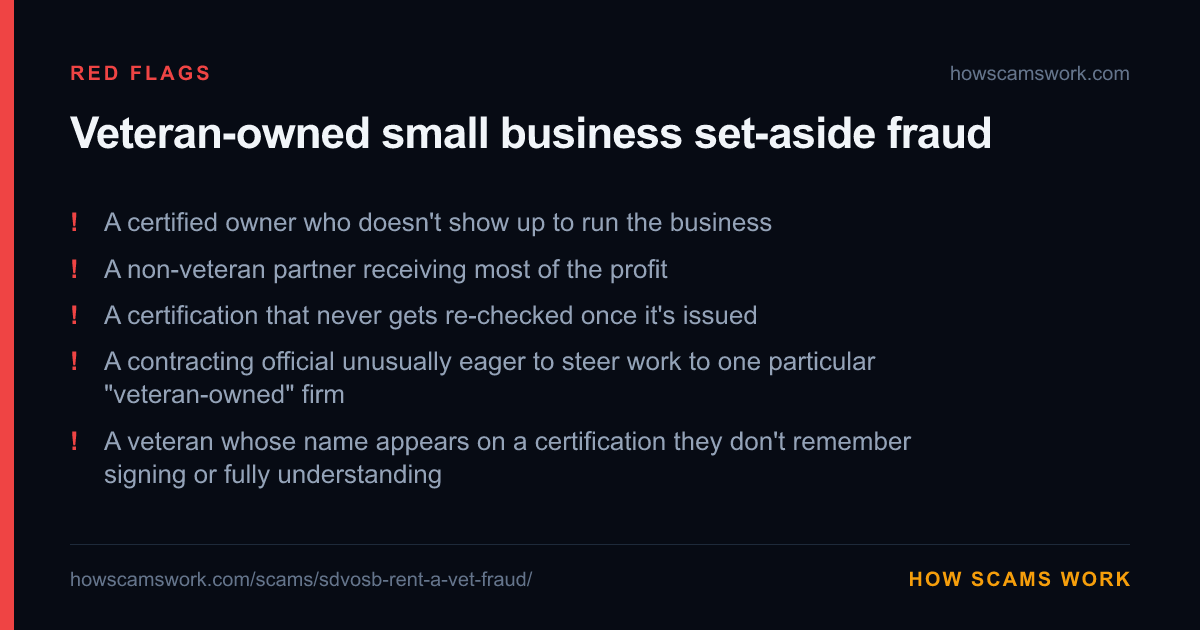
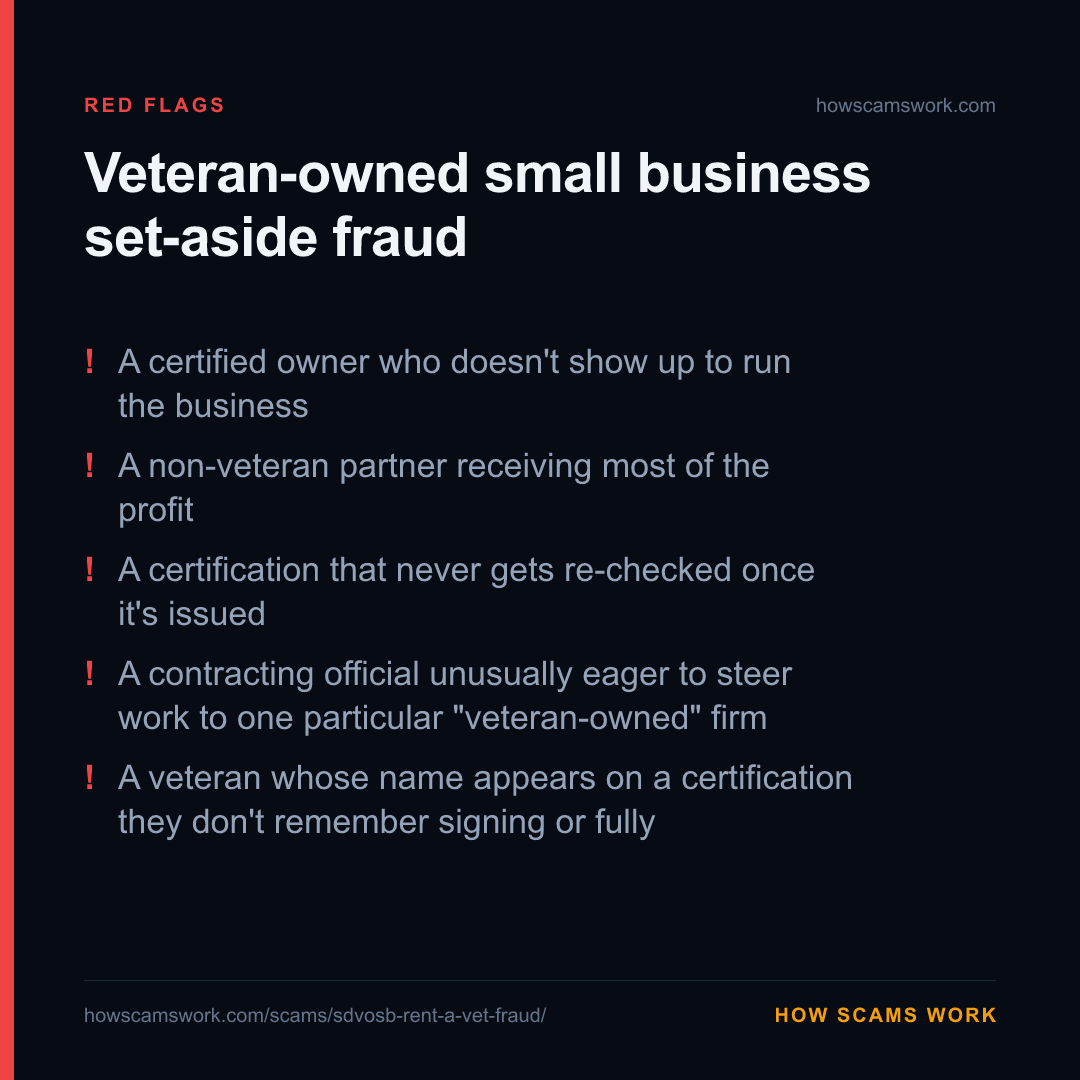
- A certified owner who doesn’t show up to run the business. A service-disabled veteran listed as the primary owner should be the one making day-to-day decisions, not someone working full-time at a different job.
- A non-veteran partner receiving most of the profit. In a lawful joint venture, the qualifying veteran’s company must receive at least 51 percent of the profit from a set-aside contract.
- A certification that never gets re-checked once it’s issued. Ownership and control can change after a firm is certified, and nothing in the process catches that automatically.
- A contracting official unusually eager to steer work to one particular “veteran-owned” firm, or approving invoices for work a site visit would show was never done.
- A veteran whose name appears on a certification they don’t remember signing or fully understanding.
If it’s happening to you
This page describes fraud against a federal contracting program, so the useful actions differ depending
on who you are.
- If you are a veteran being asked to sign ownership or control documents for a business you won’t
actually run, understand that you can face criminal liability alongside the person who recruited
you, even for what feels like a modest arrangement. Read exactly what you’re certifying before you
sign it.
- If you suspect your own identity was used without your knowledge, as happened to the veteran in
the Texas case, contact the VA Office of Inspector General directly; a fraudulent certification filed
in your name can affect your own eligibility for legitimate future contracts.
- If you are a legitimate SDVOSB or VOSB competing against a company you believe is a front, you
can file a size or status protest with the contracting officer or the SBA, which has its own process
for investigating eligibility challenges separate from a criminal referral.
- If you are a contracting official asked to overlook a documentation gap or offered anything of
value in connection with a set-aside award, that is a bribery solicitation, not a favor; report it
immediately to your agency’s Inspector General.
- If you suspect a specific company, veteran, or contracting official, report it to the VA Office
of Inspector General’s hotline or the SBA Office of Inspector General. See
where to report for the exact contact details and for agencies in other
countries.
Where the money goes
Mostly straight into the front company’s own accounts, with a smaller cut carved out for whoever lent
their name or their office to the scheme.
The federal agency pays the certified SDVOSB directly for work performed under the contract, exactly as
it would pay any legitimate set-aside winner. From there, the money typically splits in one of two ways
documented on this page. In a recruited-figurehead scheme like DiGorio and Kessler’s, the non-veteran
operators keep the overwhelming majority of the profit and pay the fronting veteran comparatively
little. In a pass-through scheme like Anchorage’s, the ineligible company that actually does the work
keeps the lion’s share while paying the eligible company a kickback, $54,302 in Dale Johnson’s case, for
the use of its certification. Where a government insider is involved, a further slice gets paid out as
a bribe, $29,000 to contracting officer Richard Vaughan over three years.
There is no offshore layer or cryptocurrency conversion in any case on this page. The contracts, the
invoices and the bribes all move through the ordinary US banking and corporate system, which is also why
federal investigators can trace them once they start looking; the harder problem, every case here shows,
is knowing to look at all before years of contracts have already been paid.
By the numbers
No published dataset breaks this scheme out as its own category yet, so there is no chart to show.
The data page explains which agency categories exist and why some schemes are
invisible in official statistics.
Every factual claim above traces to one of these. Statistics are reported losses; see
methodology for what that does and does not measure.