Also called: federal crop insurance fraud · crop yield underreporting scheme · multi-peril crop insurance fraud · RMA crop insurance fraud
Crop insurance fraud happens when a farmer underreports a harvest, misrepresents what or when a field was planted, or recruits a buyer to falsify sales records, so a federally reinsured insurer pays out on a loss that never actually happened. A Bravo reality-TV rancher, Steve McBee Sr., was ordered to repay $4,022,124 for exactly this; a Kentucky farmer was ordered to repay $1,686,002.
What it is
A farmer buys federal crop insurance to cover a real risk: hail, drought, flood, a market price that
collapses before harvest. The policy is sold by a private company, but that company’s payout is
reinsured by the US Department of Agriculture’s Risk Management Agency, which means the federal
government ultimately absorbs most of the loss on a large claim. Crop insurance fraud is what happens
when the “loss” itself is invented: a harvest quietly undersold under someone else’s name, a planting
date rewritten on a form, a packing house’s own sales ledger altered to make a normal year look like a
disaster.
The program pays on the policyholder’s own numbers. A Kentucky farmer sold his crops under other
people’s names for seven years and collected $1,686,002 he was not entitled to. A Bravo reality
TV rancher was ordered to repay $4,022,124 after three different ways of misreporting his own
harvest over three straight years. In both cases, and in the others on this page, the fraud was not a
hack or an impersonation. It was simply misreporting a number nobody outside the farm was positioned to
check in real time.
How it actually works
A public-private program, paid on the policyholder’s own word
Federal crop insurance is sold and serviced by private Approved Insurance Providers, Rain and Hail and
NAU Country Insurance among them, but USDA’s Risk Management Agency sets the rates, subsidizes the
premiums and reinsures the insurer against large losses. The payout depends on the policyholder’s own
reported planted acreage, production history and claimed yield.
A payout is calculated by comparing what a farmer actually produced or sold against what their policy
guarantees based on their own production history. Nobody at the insurer watches the harvest happen; the
comparison is only as good as the records the farmer, and sometimes the farmer’s own buyer, hands over.
The actual harvest gets made to look smaller than it was
The most direct version: sell the real crop, just not under your own name. Robert Hunt sold his crops
under other people’s names and underreported his true production for seven straight years. Jatinderjeet
Sihota went a step further and recruited the buyer itself, a fruit packing company, to alter the records
of how much her farm had actually sold through it.
Where it could have stopped
A 2005 Government Accountability Office review found that USDA’s Farm Service Agency already conducts field inspections on suspicious claims, but that RMA routinely gave those inspectors too little detail on what, specifically, looked wrong with a claim to actually investigate it. GAO recommended RMA tell its own field inspectors what they are supposed to be looking for; USDA agreed and said it implemented the fix the following year.
Or the calendar gets rewritten instead
A policy typically only covers the first crop planted on a given parcel in a year. Steve McBee Sr.
misrepresented soybeans as his fields’ first 2019 crop when wheat had already been harvested there that
season, and separately gave a different insurer false 2020 planting dates after his own corn went into
the ground later than the policy’s final eligible date.
A private insurer approves the claim it is itself reinsured against
The Approved Insurance Provider pays the claim from the paperwork in front of it. Because USDA’s Federal
Crop Insurance Corporation reinsures that payout, the insurer’s own exposure on a large, fraudulent claim
is capped, and the loss that doesn’t get caught lands, eventually, on the federal program.
The payment lands in the farm’s own accounts
Once paid, the money looks like any other farm receipt. McBee’s operation was separately reported
carrying roughly $70 million in debt; prosecutors in a different case said diverted funds covered
ordinary farm expenses alongside a family trip to Disney World.
The same thin verification can cover more than one program at once
Tanner Seuntjens’s $175,000 crop insurance underreporting was only one count in a case that also
included more than $1.5 million stolen from a pandemic-era livestock aid program using forged signatures,
and a separate bank fraud, all resting on the same basic exploit: paperwork nobody independently checked
before paying out.
Years pass before an audit, a tip or a co-conspirator’s plea unravels it
Hunt’s scheme ran seven years before he was charged. Sihota and Hackett’s ran from 2012 to 2016 but
Sihota was not charged until 2024, eight years after the fraud ended, with Hackett’s own sentencing,
originally set for 2022, still pending years later. By the time any of these cases reach a courtroom, the
harvest in question is long since sold, eaten or gone.
Why it works
Nobody watches a field the way a cashier watches a register. A harvest happens once a year, over
weeks, across acreage no insurer visits in person as a matter of routine. The only numbers anyone outside
the farm ever sees are the ones the farmer, or the farmer’s buyer, chooses to report.
The payout depends on a comparison, not an observation. An insurer is not verifying “did this crop
fail”; it is comparing a reported result against a reported history, both of which the same party can
shape. Move either number and the gap between them, the thing that triggers payment, moves too.
A cooperating buyer defeats the one outside check that exists. A grain elevator or packing house’s
own purchase records are often the closest thing to independent verification a crop insurance claim gets.
Recruit that buyer, as Sihota recruited Hackett, and even that check confirms the lie instead of catching
it.
Oversight runs on inspections GAO itself found thin. The Agricultural Risk Protection Act of 2000 was
supposed to strengthen field inspections of suspicious claims, but the government’s own 2005 audit found
RMA was not giving its own inspectors enough detail to use that tool effectively, a gap USDA said it
fixed in 2006, years after most of the fraud now being prosecuted had already happened.
And the lag between harvest and audit is measured in years, not days. Every documented case on this
page involves conduct that ran for one to seven growing seasons before anyone outside the farm connected
the paperwork to what had actually happened in the field.
Where it comes from
Entirely domestic. Every documented case on this page is a US farm operation defrauding a US federal
program, with no cross-border movement of money or any impersonation of a stranger involved.
It runs through ordinary working relationships, not criminal networks. A farmer and the buyer who
purchases their crop, a farmer and the private company that sells and services their own policy, these
are the everyday business relationships federal crop insurance is built on, which is exactly what a
scheme like this exploits instead of attacking from outside.
Scale ranges from a single farm’s seven-year pattern to a scheme stacked on top of other federal
programs. Hunt’s and Sihota’s cases involve one farm operation misreporting its own numbers over
several years. Seuntjens’s case shows the same basic exploit layered underneath a much larger fraud
against a different federal program entirely.
Enforcement is criminal, not civil, in every documented case here, run jointly by the USDA’s Office
of Inspector General and the Risk Management Agency’s own Special Investigations Staff, and prosecuted as
federal mail fraud or crop insurance fraud, sometimes alongside civil False Claims Act settlements against
anyone, like a cooperating buyer, who was not the policyholder but still helped.
Real cases
2026 US Sentenced $175,000
Tanner James Seuntjens, 33, of Danbury, Iowa, repeatedly underreported his crop yields during the 2022 and 2023 growing seasons to collect about $175,000 in federal crop insurance payments he was not entitled to, one count among several in a wider fraud case that also included stealing more than $1.5 million in pandemic livestock aid and defrauding a bank of more than $400,000, and that ended with him stalking a witness against him. He pleaded guilty in September 2025 to one count each of theft of government funds, aggravated identity theft, crop insurance fraud and stalking, and was sentenced in April 2026 to 156 months, 13 years, in federal prison and ordered to pay $1.7 million in restitution to the USDA.
Read the case file ·
2 sources
2025 US Sentenced $1.7m
Robert "Robbie" Thomas Hunt, 61, of Campbellsville, Kentucky, sold his crops under the names of other people and significantly underreported his true production on federal crop insurance claim forms from 2014 through 2021, generating more than $1.6 million in fraudulent insurance overpayments. He pleaded guilty to crop insurance fraud on March 27, 2025, and was sentenced to 12 months and a day in federal prison, followed by two years of supervised release, and ordered to pay $1,686,002 in restitution and a $250,000 fine.
Read the case file ·
1 source
2025 US Sentenced $650,000
Jatinderjeet "Jyoti" Sihota of Selma, California, and Ralph Hackett, a Clovis fruit broker whose packing company bought her family's table grapes and other crops, altered the records of how much the farm had actually sold through that packing company from 2012 through 2016, making it look as though the operation had suffered major crop losses it had not, and obtained more than $650,000 in crop insurance payments the pair were not entitled to. Evidence at the case, including emails, showed the scheme was Sihota's idea; she asked other fruit brokers to join her before Hackett agreed. She pleaded guilty in November 2024 and was sentenced in April 2025 to one year in prison. Hackett pleaded guilty years earlier, in August 2021, and agreed to pay $650,000 in criminal restitution plus a separate $605,000 civil settlement; his sentencing, repeatedly delayed, was most recently scheduled for May 27, 2025.
Read the case file ·
3 sources
2025 US Sentenced $4.0m
Steven A. McBee Sr., 53, of Gallatin, Missouri, the rancher featured on Bravo's reality series "The McBee Dynasty: Real American Cowboys," pleaded guilty in November 2024 to one count of federal crop insurance fraud after admitting he underreported his farm's actual 2018 corn and soybean harvest, misrepresented which crop was planted first on certain fields in 2019 to claim coverage his policy did not allow on a second crop, and reported false planting dates to a different insurer in 2020 for corn planted after the policy's final eligible date. He was sentenced October 16, 2025, in the US District Court for the Western District of Missouri to 24 months in federal prison and ordered to pay $4,022,124 in restitution to the USDA's Risk Management Agency.
Read the case file ·
2 sources
Red flags
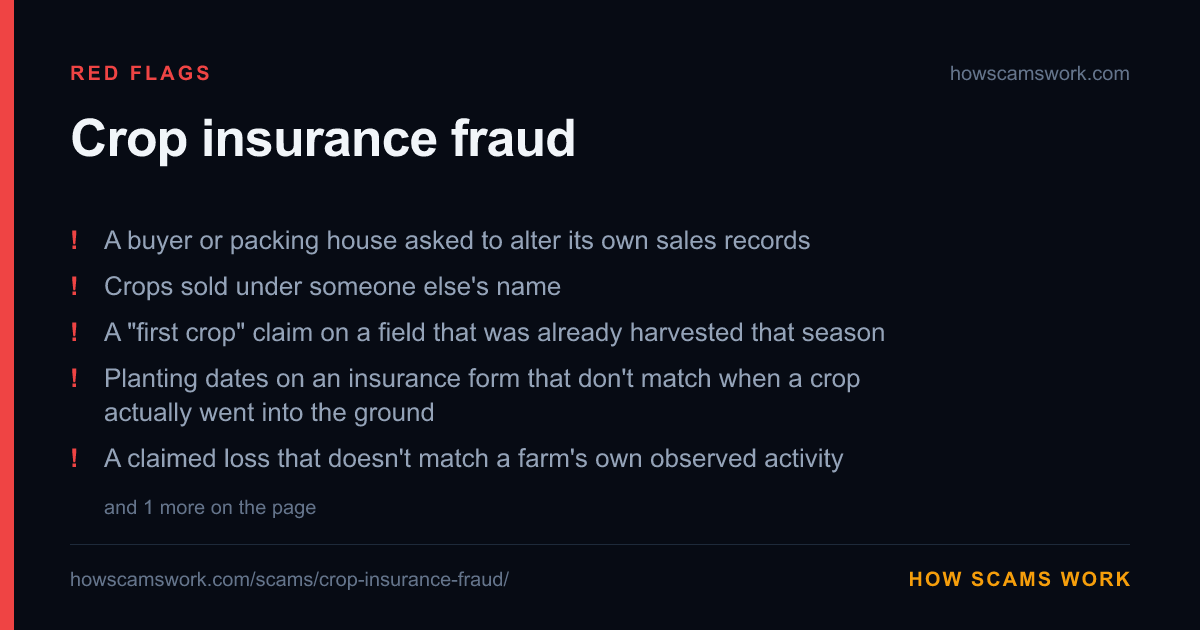
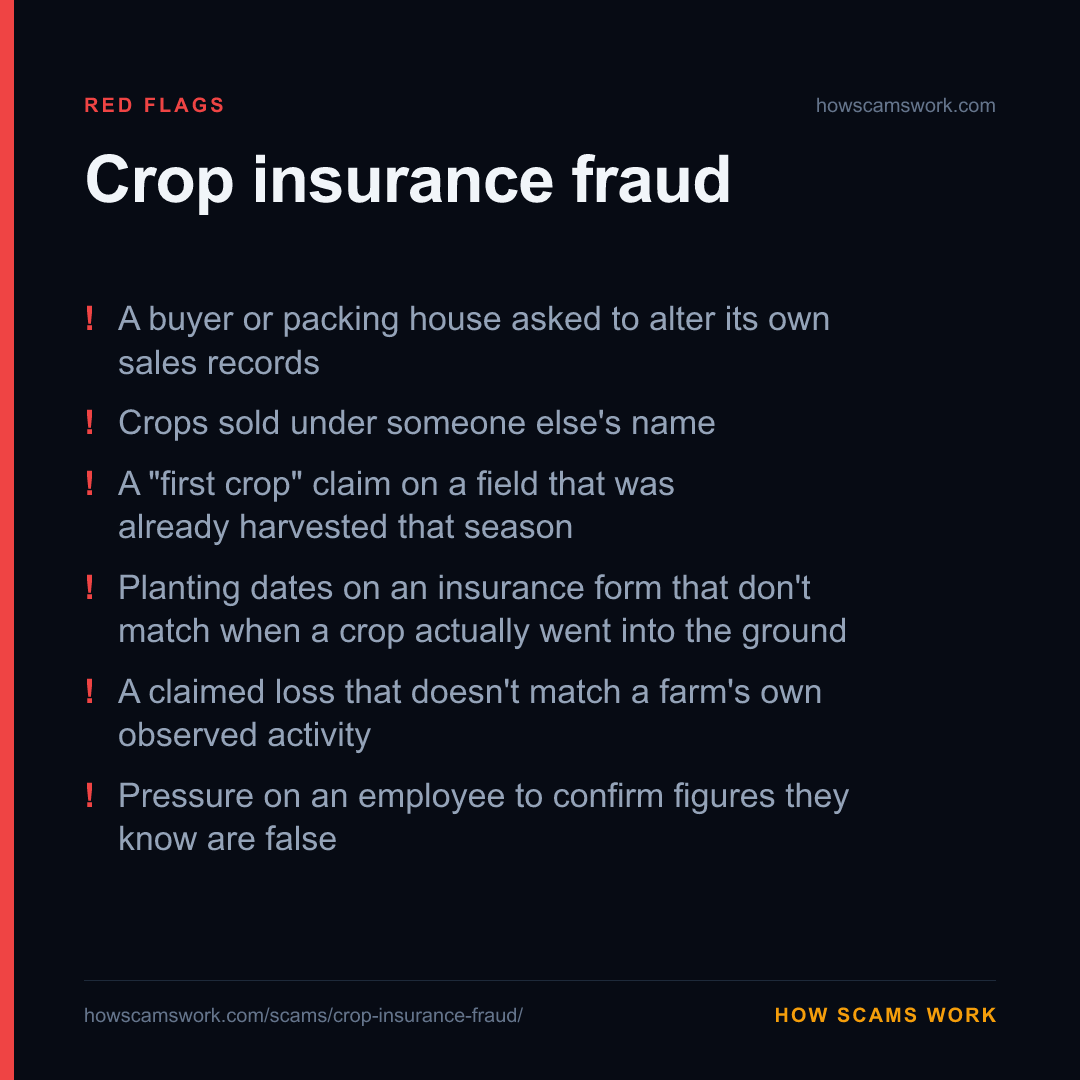
- A buyer or packing house asked to alter its own sales records, or to falsely confirm altered figures if the insurer calls to verify them.
- Crops sold under someone else’s name rather than the name of the operation that actually grew them.
- A “first crop” claim on a field that was already harvested that season, a specific, checkable double-cropping violation.
- Planting dates on an insurance form that don’t match when a crop actually went into the ground.
- A claimed loss that doesn’t match a farm’s own observed activity, equipment use, labor, trucking, that a neighbor, landlord or lender would reasonably expect to see.
- Pressure on an employee to confirm figures they know are false if a verification call comes in.
If it’s happening to you
This page describes fraud against a federal program, not a scam aimed at an individual consumer, so the
useful actions differ depending on who you are.
- If you are an employee asked to falsify or confirm records you know are false, you are being asked
to participate in a federal crime. Keep your own copies of what you are actually asked to do, and
understand that a prosecutor can and does charge the employee who confirms falsified figures, not just
the policyholder who benefits from them.
- If you are a landowner leasing ground to a farmer, a tenant’s crop insurance fraud is not
automatically your liability, but a written lease that specifies accurate, independently verifiable
production reporting protects you if the arrangement is ever examined.
- If you suspect a specific farm operation, buyer or insurance agent is misreporting figures, report
it to the USDA Office of Inspector General’s hotline, which investigates these cases jointly with the
Risk Management Agency’s Special Investigations Staff. See where to report for
the exact contact details and for agencies in other countries.
- If you are a policyholder with a past filing you are now worried about, talk to a lawyer before you
talk to an investigator. Every sentenced case on this page began with a guilty plea, which can affect
the eventual sentence; it does not happen automatically just because someone asks a question.
- If you are an insurance agent or claims adjuster seeing a pattern across multiple seasons, GAO’s
own finding was that detailed, specific red flags are what make a field inspection catch fraud instead
of missing it. A vague referral is far less useful than one that names exactly what doesn’t match.
Where the money goes
Directly into the policyholder’s own bank account, with no laundering chain to trace in any case
documented on this page.
A federal crop insurance claim is paid by check or electronic transfer straight from the private
Approved Insurance Provider to the farm operation that filed it. There is no shell company layer, no
overseas transfer, no cryptocurrency conversion in any of the cases here: the fraud is the claim itself,
not what happens to the money afterward. Reported uses of the proceeds range from ordinary farm operating
expenses and debt service to, in McBee’s case, a roughly $3.2 million personal gain the government sought
to claw back through forfeiture of specific assets, including three watches.
That directness is also why these are federal criminal prosecutions rather than, as with many of this
site’s schemes, a hunt for money moved through foreign accounts. The USDA’s Office of Inspector General
and the Risk Management Agency’s Special Investigations Staff can trace the money because it never left
the ordinary US banking and farm-finance system in the first place; the harder part, every case here
shows, is catching the false claim before the money is paid out, not tracing it afterward.
By the numbers
No published dataset breaks this scheme out as its own category yet, so there is no chart to show.
The data page explains which agency categories exist and why some schemes are
invisible in official statistics.
Every factual claim above traces to one of these. Statistics are reported losses; see
methodology for what that does and does not measure.