Also called: workers' compensation fraud · spinal surgery kickback scheme · Operation Spinal Cap · Operation Backlash · FECA kickback fraud · pay-for-referral workers' comp fraud
Workers' comp kickback fraud pays an injured worker's own doctor, chiropractor or medical director a fee for every patient referred to a specific hospital, surgical center, imaging lab or pharmacy, which then bills the workers' compensation insurer or federal benefit fund for the resulting treatment. California's Pacific Hospital of Long Beach billed $600 million this way before its owner's 63-month sentence; a Texas chiropractor who took the kickbacks instead was sentenced to 14 years.
What it is
A treating doctor, chiropractor or medical director gets paid, directly or through a disguised
consulting or marketing contract, for every injured worker they send to a specific hospital, surgical
center, imaging lab or pharmacy. That facility then bills a workers’ compensation insurer, a state fund,
a private carrier, or the US Department of Labor’s program for injured federal employees, for the
resulting treatment. The underlying workplace injury is usually real. What’s bought and sold is the
referral itself: which provider the patient ends up at, how much treatment they get, and sometimes
whether they need surgery at all, decisions a kickback is explicitly designed to distort.
How it actually works
The referral relationship
A treating physician, chiropractor or medical director becomes the funnel: whichever surgical center,
imaging lab or pharmacy they refer an injured worker to is the one that gets paid by the insurer, and in
these cases, the one paying them back for sending the patient.
The kickback
The facility pays the referring provider a flat fee or a share of future billings for every patient who
ends up there, sometimes disguised as a consulting or marketing contract rather than a straightforward
payment for referrals.
Where it could have stopped
Paying or accepting money for a patient referral is illegal under federal and state anti-kickback law on its own, before an insurer is ever billed a single dollar. In the documented cases on this page, prosecutors charged the kickback payments as separate counts from the billing fraud itself.
Inflating the price that funds the kickback
Some operators use a shell company they control to mark up the price of a surgical implant or device
before billing the insurer, with the markup itself generating the cash that pays the kickback, exploiting
billing rules, like California’s now-repealed spinal implant pass-through law, that let a provider pass
the full, unverified device cost on to the insurer.
Treatment driven by the kickback, not the injury
Spinal fusion surgery, MRIs, injections or pain medication get ordered based on what generates a referral
fee for the provider who sent the patient there, rather than solely on independent medical judgment about
what the injury requires.
Billed to the workers’ comp insurer or federal fund
The facility submits the claim to the state workers’ compensation system, a private carrier, or, for a
federal employee’s claim, the US Department of Labor’s Office of Workers’ Compensation Programs, which
pays largely on the provider’s own billing without independently verifying medical necessity before the
claim is paid.
The worker caught in the middle
The injured employee undergoes the real surgery or treatment, unaware the referral that sent them there
was paid for, with no practical way to know whether the volume or type of care they received was set by
their injury or by someone else’s cut.
Enforcement, built from billing data and bank records
State insurance fraud units, IRS Criminal Investigation, the FBI, the US Postal Service Office of
Inspector General, the Army Criminal Investigation Division and the Department of Labor’s own Inspector
General trace the kickback payments through bank records, consulting-contract paperwork and shell company
filings, a process that took years to reach a conviction and sentence in each case documented here.
Why it works
Insurers pay first and verify later, if at all. Like most large payers, a workers’ comp insurer or
federal benefit fund processes the overwhelming majority of claims on the treating provider’s own
paperwork. Independent, pre-payment review of whether a specific referral or procedure was medically
necessary is the exception, not the rule, which is the gap every case on this page exploited for years
before being caught.
A billing rule can turn a markup into a kickback fund. California’s now-repealed spinal implant
pass-through law let a hospital bill the insurer the device’s full, unverified cost. Pacific Hospital of
Long Beach used shell companies it controlled to inflate that cost, then used the markup to fund $40
million in kickbacks over 15 years, a mechanism that worked precisely because the insurer had no way to
see past the invoice to the real price.
The patient has no visibility into who is paying whom. An injured worker sees a referral from their
own doctor as medical advice, not as a business transaction. Nothing on the paperwork a patient receives
discloses whether the provider they were sent to pays the referring doctor a fee, which is what let
Garry Craighead build a referral network across six Texas cities, and Ronald Grusd’s clinics bill more
than $25 million, before either scheme was caught.
A single payer can be billed through dozens of entities at once. Operators in these cases didn’t rely
on one clinic; Craighead formed clinics under at least five different names across Texas, and Pacific
Hospital’s kickback network eventually implicated more than 20 separate doctors, chiropractors and
marketers, spreading the fraud across enough entities that no single relationship looked unusual on its
own.
Federal employee claims add a captive population. The Federal Employees’ Compensation Act gives
federal workers one government-run benefit program rather than a market of competing insurers, so
Craighead built relationships with union leaders inside agencies like the Bureau of Prisons and the US
Postal Service to steer a steady, renewable stream of injured-worker referrals toward clinics chosen for
the kickback they paid.
Where it comes from
Entirely domestic: this scheme exploits the billing structure of US workers’ compensation systems,
state-run funds, private carriers, and the federal government’s own Office of Workers’ Compensation
Programs, which does not exist in this form outside the United States.
California produced the two largest documented schemes here, both run through the state’s own
workers’ compensation system. Pacific Hospital of Long Beach’s owner, Michael Drobot, built a 15-year,
roughly $600 million kickback network paying doctors and chiropractors for spinal surgery referrals, while
Beverly Hills radiologist Ronald Grusd’s companies paid kickbacks to clinics across San Diego and Imperial
counties for referrals covering imaging, injections and pain medication, part of a wider “Operation
Backlash” investigation that has charged nearly 40 individuals and companies since 2015.
Texas produced the documented case against the federal program instead of a state one. Garry Wayne
Craighead’s Union Treatment Centers courted patients covered by the Federal Employees’ Compensation Act,
federal employees hurt on the job, and referred them to pharmacies, hospitals and surgical clinics chosen
for the kickback they paid him, billing the US Department of Labor’s Office of Workers’ Compensation
Programs more than $203 million from 2007 through 2014.
The schemes scale differently depending on who is doing the referring. Drobot and Grusd, as the
owners of the facilities being billed, paid kickbacks outward to the doctors and chiropractors sending
them patients. Craighead, as the referring provider himself, took kickbacks from the pharmacies and
clinics he sent federal employees to, the same underlying crime from the opposite side of the referral.
Real cases
2018 US Sentenced $600.0m
For at least 15 years, from 1997 to 2013, Michael Drobot used his ownership of Pacific Hospital of Long Beach, California, to run a kickback scheme built around the state's workers' compensation system. Drobot paid more than $40 million to dozens of doctors, chiropractors and other medical professionals who referred thousands of patients, some living hundreds of miles away, to his hospital for spinal surgeries. California law at the time let a hospital pass the full, unverified cost of an implanted spinal device on to the workers' comp insurer; Drobot used shell companies he controlled to inflate those device prices, and the markup helped fund the kickbacks. Over the scheme's final five years alone, the hospital submitted more than $500 million in fraudulent bills; the total across the full scheme is put at roughly $600 million. Drobot also admitted bribing then-state senator Ron Calderon, including paying Calderon's college-age son around $30,000 over three summers as a file clerk and providing plane trips and golf outings, to help keep the implant pass-through law on the books. Drobot pleaded guilty in 2014 to conspiracy and paying illegal kickbacks. US District Judge Josephine Staton sentenced him in January 2018 to 63 months in federal prison, a $500,000 fine, and $10 million in forfeiture, including real estate and three classic cars. More than 20 doctors, chiropractors and marketers have since been convicted in the broader scheme, and Calderon separately served a federal sentence for the bribery.
Read the case file ·
4 sources
2018 US Sentenced $25.0m
Ronald Grusd, a Beverly Hills radiologist, owned California Imaging Network Medical Group and Willows Consulting Company, which paid kickbacks to clinics across San Diego and Imperial counties in exchange for referring workers' compensation patients. The clinics then referred those patients for MRIs, ultrasounds, Shockwave treatments, toxicology testing and prescription pain medication, which Grusd's companies billed to insurers without disclosing the kickback arrangement, as required under California law. Trial evidence showed more than $100,000 in bribes paid out, calculated per patient or per body part, behind more than $25 million in fraudulent billings. Grusd and his companies were indicted in November 2015 as part of "Operation Backlash," a joint investigation by the US Attorney's Office, the San Diego District Attorney's Office, the FBI and the California Department of Insurance that has since charged nearly 40 individuals and companies. A federal jury convicted Grusd in December 2017 on 39 felony fraud counts after a trial. In June 2018, US District Judge Cynthia Bashant sentenced him to 10 years in federal custody and a $250,000 fine, and fined each of his two companies $500,000. At sentencing, Bashant said the kickback incentives made it "highly questionable if all services were necessary."
Read the case file ·
3 sources
2016 US Sentenced $98.0m
Garry Wayne Craighead, a Texas chiropractor, formed Union Treatment Centers (UTC) in 2007 and, from 2011 through 2014, opened clinics under various names across Dallas-Fort Worth, San Antonio, Austin, Corpus Christi, Killeen and Weslaco. Craighead courted claimants covered by the Federal Employees' Compensation Act (FECA), federal employees of agencies including the Bureau of Prisons, the Department of the Army, the Department of Veterans Affairs, the US Postal Service and Customs and Border Protection, building relationships with union leaders inside those agencies to steer a steady flow of injured federal workers to UTC. Craighead then referred those claimants to pharmacies, hospitals, surgical clinics and doctor specialists of his choosing in exchange for monthly kickbacks, processed through his own consulting company, CCM&D Consulting. From January 2007 through July 2014, UTC and its related entities billed the Department of Labor's Office of Workers' Compensation Programs (OWCP) more than $203 million, of which OWCP paid more than $98 million. Craighead pleaded guilty in December 2015 to soliciting and receiving illegal remunerations in federal health programs and to engaging in monetary transactions in property derived from unlawful activity. On June 10, 2016, he was sentenced to 168 months (14 years) in federal prison and ordered to pay approximately $18 million in restitution to the Department of Labor, and to forfeit land in Williamson County, Texas, and a Mooney M20J aircraft.
Read the case file ·
1 source
Red flags
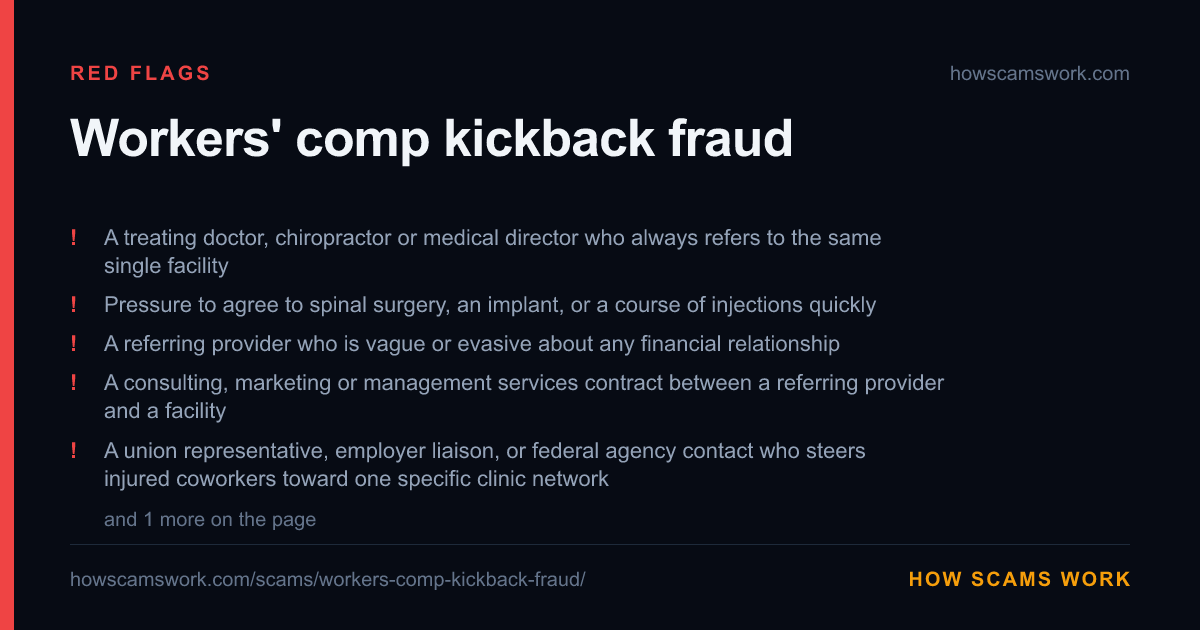
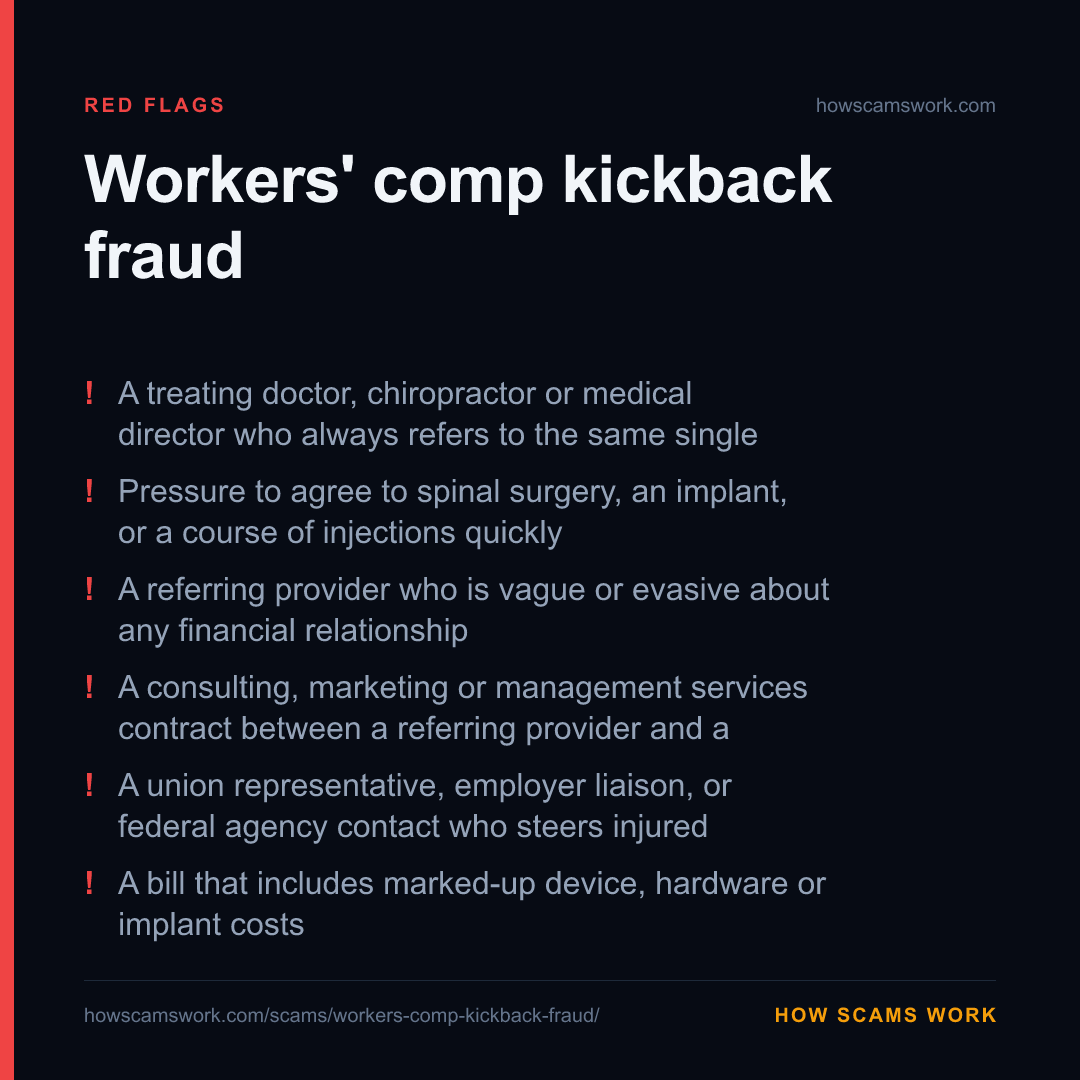
- A treating doctor, chiropractor or medical director who always refers to the same single facility, especially one far from where the patient lives or works.
- Pressure to agree to spinal surgery, an implant, or a course of injections quickly, without a clear, independent explanation of why less invasive treatment wasn’t tried first.
- A referring provider who is vague or evasive about any financial relationship with the facility, lab or pharmacy they’re sending you to.
- A consulting, marketing or management services contract between a referring provider and a facility that doesn’t describe any real work being performed.
- A union representative, employer liaison, or federal agency contact who steers injured coworkers toward one specific clinic network rather than letting the worker choose their own provider where the law allows it.
- A bill that includes marked-up device, hardware or implant costs you have no way to independently verify.
If it’s happening to you
If you think your own referral was driven by a kickback rather than your care:
- Ask who is paying your treating doctor, chiropractor or medical director, and whether they have any
financial relationship, consulting fee, or marketing arrangement with the facility, lab or pharmacy
they referred you to.
- Keep your own written record of what diagnosis and treatment you were told you needed, and when,
so you have something to compare against later if the recommendation changes.
- Ask your claims adjuster or your union representative, if you have one, whether the provider
network you were referred into has been the subject of any fraud investigation.
- Get a second opinion from a provider with no relationship to the one who referred you, especially
before agreeing to surgery.
- Report suspected workers’ compensation fraud to your state’s Department of Insurance fraud division.
For a federal employee’s Federal Employees’ Compensation Act claim specifically, report it to the US
Department of Labor Office of Inspector General hotline at 202-693-6999 or oig.dol.gov. See
where to report for agencies in other countries.
Where the money goes
Entirely domestic, moving from a workers’ compensation insurer or federal benefit fund into the billing
facility’s own accounts, then back out again as kickbacks to the people who sent the patients.
The insurer or fund pays the claim, the daily rate, the surgery bill, the implant cost, directly into the
billing facility’s bank account on the strength of the provider’s own paperwork, typically the most
traceable step in the chain since it comes from a regulated payer with its own records. From there, the
facility’s owner or controlling operator pays kickbacks to the referring doctors, chiropractors and
marketers who supplied the patients, in the documented cases here running from roughly $10,000 to $15,000
per spinal surgery referred, sometimes funded by first routing the money through a shell company used to
inflate a device’s invoiced price. What’s left moves into real estate, forfeited bank accounts, classic
cars, and, in Craighead’s case, an airplane, all eventually seized or ordered forfeited once the scheme
was prosecuted.
By the numbers
No published dataset breaks this scheme out as its own category yet, so there is no chart to show.
The data page explains which agency categories exist and why some schemes are
invisible in official statistics.
Every factual claim above traces to one of these. Statistics are reported losses; see
methodology for what that does and does not measure.