Also called: crash for cash · staged car accident scam · swoop and squat · jump-in fraud · staged collision ring
Staged accident insurance fraud deliberately engineers a car crash, often a "swoop and squat" or a collision with a commercial truck, then files inflated injury and repair claims against the other driver's insurer. Organized rings recruit paid "slammers," coordinate clinics and attorneys, and split the payout; one New Orleans network ran from 2011 to 2024 before 63 people were charged.
What it is
Someone deliberately causes a car crash, then treats the resulting injury and repair claims like a
genuine accident, filing them with an insurer for a payout the collision was engineered to produce. The
simplest version is solo: one driver staging a low-speed collision and inflating the resulting medical
bills. The largest version is an organised ring, recruiters, paid passengers, cooperating clinics and an
attorney, built specifically to manufacture lawsuits against commercial trucking companies, whose
insurance policies carry far higher limits than an ordinary driver’s.
This is not a new tactic. It has a name, “swoop and squat,” that entered national vocabulary in 1992
after a staged collision on a Los Angeles freeway went wrong and killed one of the people riding in the
car meant to collect the payout. More than three decades later, a federal investigation in New Orleans,
Operation Sideswipe, charged 63 people over a scheme that staged collisions with 18-wheelers from
2011 to 2024, convicting two of the city’s own personal injury attorneys at trial in March 2026.
How it actually works
Recruiting the passengers
A “capper” or recruiter finds people willing to ride in a car that is about to be deliberately crashed,
usually for a flat fee per passenger per crash, often a few hundred dollars for a seat in a vehicle
headed for a collision with an 18-wheeler.
Picking the target
The ring looks for a vehicle with a profile worth suing: a commercial truck or delivery van with deep
liability insurance limits, or, in the simpler solo version, any ordinary driver in traffic.
The staged collision
A “squat” car pulls in front of the target and brakes; a “swoop” car cuts into the gap between them
first, so the target has no time to react and the squat car, full of passengers, takes the hit. Operators
favour quiet roads, early hours, or highway traffic where a sudden stop looks ordinary.
Where it could have stopped
A dashcam, an immediate call to police, and photographs of every occupant and every vehicle before anyone leaves the scene defeat this tactic directly: it depends on there being no independent record of who was actually in the car and how the “accident” actually happened.
Building the paper trail
Occupants report injuries at the scene and are steered to a clinic the ring already works with, where
soft-tissue injuries like whiplash, genuinely hard for anyone to disprove, are diagnosed and documented
on a schedule built for a lawsuit, not for recovery.
Inflating the claim
Treatment escalates: repeat visits, imaging, sometimes surgery that is medically unnecessary, each one
adding to the “specials,” the documented medical cost a settlement or jury award is calculated from.
Filing and settling
A personal injury attorney, in the organised version often in on the scheme from the start, files the
claim or lawsuit against the target’s insurer. Commercial auto insurers frequently settle rather than
litigate every soft-tissue claim, especially against a sympathetic-looking set of injured passengers.
Splitting the payout
The settlement is divided: a cut to the recruiter, a cut to the clinic, a flat fee to each “slammer,” and
the largest share to the attorney, whose normal contingency fee now sits on top of a claim that was
fraudulent from the moment of impact.
Why it works
Soft-tissue injuries are real, common, and medically hard to disprove. Whiplash does not show up on
an X-ray. An insurer weighing the cost of a drawn-out dispute against a comparatively modest settlement
often pays rather than litigates, which is exactly the gap a staged claim is built to sit inside.
Commercial insurance policies carry far more money to aim at. A trucking company’s liability coverage
can run into seven figures, against a few hundred thousand for an ordinary driver, and a jury primed to
see a large company as a deep-pocketed defendant is a courtroom asset a ring can plan around from the
start, which is exactly why Operation Sideswipe staged its collisions against 18-wheelers specifically.
Most US states presume the rear driver at fault in a rear-end collision. Both the “swoop and squat”
and simple sudden-braking tactics exploit this directly: the staged crash is engineered to look, on paper,
exactly like the ordinary accident the law already has a default answer for.
An attorney working on contingency has little to lose by taking the case. The fee comes out of the
settlement, not up front, so a corrupt attorney’s financial risk in joining a scheme is close to zero
until investigators start asking why one practice’s injury caseload keeps intersecting with the same small
group of “accident victims.”
And recruiting spreads the risk, and the culpability, across dozens of people. A single operator can
only stage so many crashes themselves. A network of recruiters, drivers and passengers, each paid a flat
fee and often unaware of the scheme’s full size, is how a investigation like Operation Sideswipe grows to
63 charged defendants over more than a decade.
Where it comes from
Domestic, decades old, and concentrated in a handful of states with heavy traffic and plaintiff-friendly
injury litigation.
The tactic has a documented history going back to at least 1992. A staged collision on Los Angeles’s
Golden State Freeway that June killed one of the passengers riding in the car meant to collect the
payout, bringing the “swoop and squat” tactic, and California’s then-estimated $1.5 to $2 billion a year
in staged-accident payouts, to national attention for the first time.
It runs in three tiers. Professionals, attorneys and clinic operators, sit at the top and take the
largest cut; recruiters and “cappers” sit in the middle, finding vehicles and participants; and the
passengers who take the actual physical risk of a real collision sit at the bottom, for the smallest and
most immediate payday.
Hotspots track dense traffic and large commercial-insurance pools. California, Louisiana, New York,
New Jersey and Florida consistently report the most staged and suspected-staged auto claims; New York and
New Jersey both saw double-digit percentage increases in staged-accident claims between 2022 and 2023.
The money never leaves the US financial system. A settlement check moves from a trucking company’s
insurer to an attorney’s trust account to the ring’s participants, cash in hand for the “slammers,” checks
or bank transfers for everyone above them. There is no offshore leg to trace; the fraud is entirely in how
the claim was generated, not in how the money later moves.
Real cases
2026 US Convicted $10.0m
A federal jury in New Orleans convicted personal injury attorneys Vanessa Motta and Jason F. Giles on March 20, 2026, finding both guilty on every count tied to a staged-collision ring, "Operation Sideswipe," that prosecutors say paid "slammers" to crash cars into 18-wheelers from December 2011 to December 2024. The wider investigation charged 63 people; a cooperating witness was murdered in 2020 after agreeing to testify.
Read the case file ·
7 sources
2025 US Sentenced $107,951
Adrian Peebles, 32, of St. Louis, Missouri, was sentenced on April 15, 2025 to 18 months in federal prison for staging vehicle accidents alone, at night and in remote areas, between September 2021 and January 2023, then redirecting $107,951 in resulting payments from two insurance companies to himself rather than to the hospitals that treated him.
Read the case file ·
3 sources
2019 US Sentenced $5.7m
Sandra Victoria Talento, 58, of Spokane, Washington and Henderson, Nevada, was sentenced to 70 months in federal prison on November 7, 2019, for her role staging more than 30 automobile accidents across Washington, Idaho, California and Nevada that defrauded 19 insurance companies out of $5,659,026 in fraudulent bodily injury claims.
Read the case file ·
2 sources
Red flags
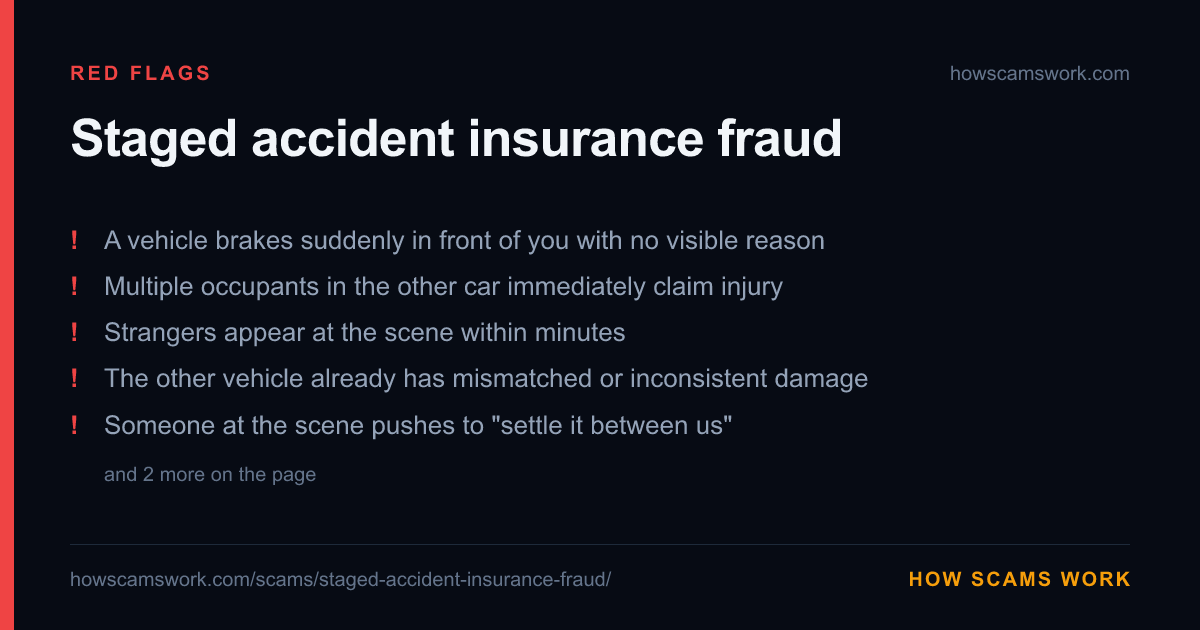
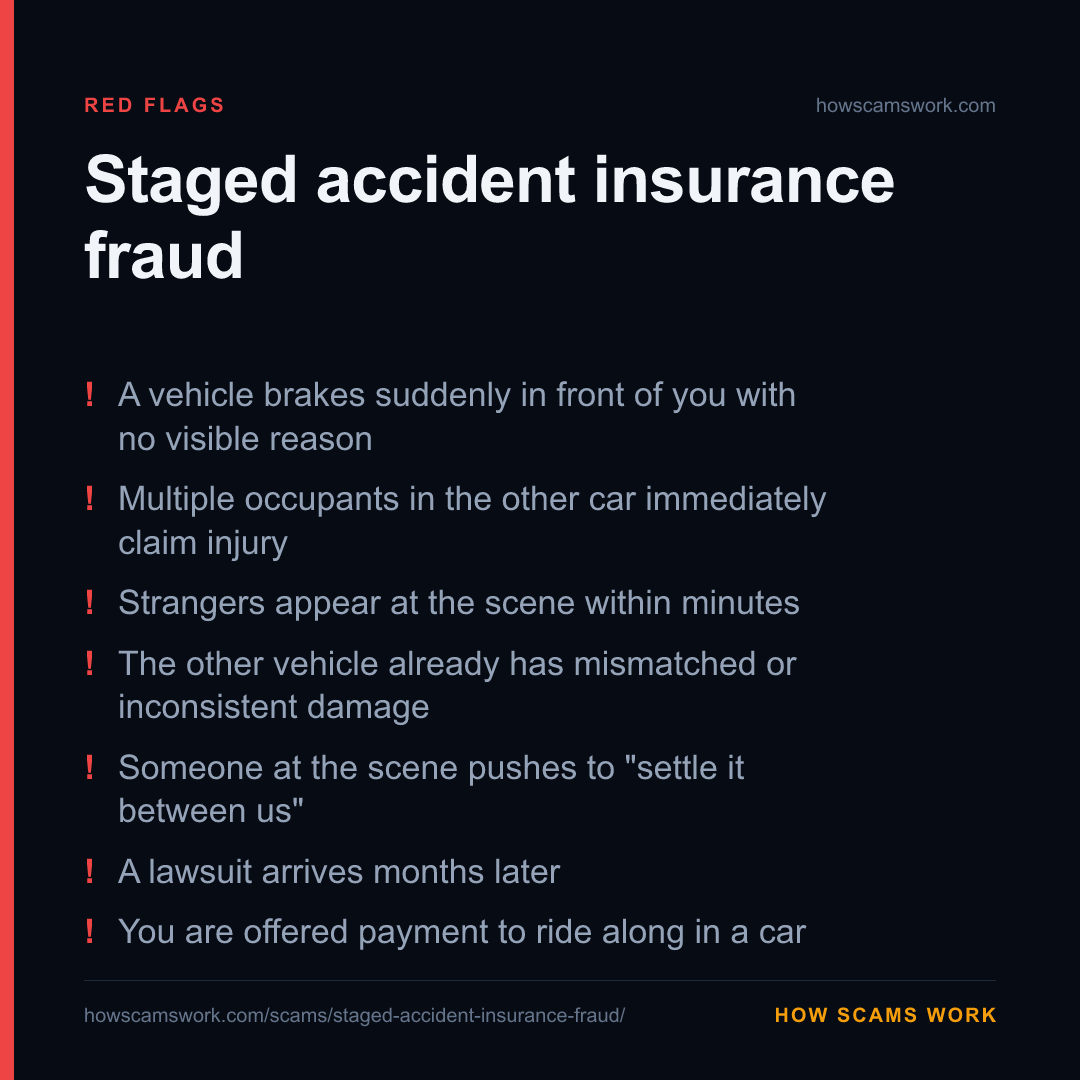
- A vehicle brakes suddenly in front of you with no visible reason, especially right after another car has just cut into the gap ahead of it.
- Multiple occupants in the other car immediately claim injury, even in a low-speed collision with minor visible damage.
- Strangers appear at the scene within minutes recommending a specific doctor, clinic or attorney before you have even called police.
- The other vehicle already has mismatched or inconsistent damage that does not quite match how this collision is described.
- Someone at the scene pushes to “settle it between us” and avoid calling the police at all.
- A lawsuit arrives months later claiming medical costs far beyond what the visible damage at the scene would suggest.
- You are offered payment to ride along in a car “in case there’s an accident,” a direct recruitment pitch, not a job.
If it’s happening to you
Call the police to the scene every time, no matter how minor the collision looks. A staged accident
depends on there being no independent, contemporaneous record of what actually happened.
- Photograph everything before anyone leaves: every vehicle from multiple angles, all visible damage,
every license plate, and how many people got out of each car.
- Do not admit fault, apologise, or agree to “settle it between us” at the scene. Exchange insurance
information and let the claims process, not a roadside conversation, sort out liability.
- Decline any referral offered at the scene to a specific doctor, clinic or attorney. A legitimate
need for medical care does not come with a stranger’s business card already in hand.
- Report it to your own insurer’s special investigations unit and to the National Insurance Crime
Bureau at nicb.org, which exists specifically to flag patterns across claims that one insurer alone
would not see.
- If you are approached to be paid for riding in a car “in case there’s an accident,” that is a
recruitment pitch into federal mail and wire fraud, not a payday. Walk away, and consider reporting it.
- Report it to the FTC at ReportFraud.ftc.gov. See where to report for
other countries.
Where the money goes
Straight through the US insurance and legal system, no offshore leg required, which is also why the
money trail is usually easier to prove than the staging itself.
An insurer’s settlement check is paid to the claimant’s attorney, who deposits it into a client trust
account before disbursing it: a cut to the clinic that documented the injuries, a flat cash fee to each
recruited “slammer,” a share to whoever recruited them, and the largest remaining piece, the attorney’s
own contingency fee, now charged on top of a claim engineered from the start. Clinics that bill real
insurers for treatment scripted to a lawsuit’s needs, rather than a patient’s, sit in the same cash-heavy,
hard-to-audit space as the small businesses money launderers favour for an entirely different reason.
By the numbers
No published dataset breaks this scheme out as its own category yet, so there is no chart to show.
The data page explains which agency categories exist and why some schemes are
invisible in official statistics.
Every factual claim above traces to one of these. Statistics are reported losses; see
methodology for what that does and does not measure.