Also called: Obama phone scam · Lifeline fraud · free government phone scam · USF fraud · Universal Service Fund fraud
Lifeline phone subsidy fraud bills the FCC's low-income phone program for subscribers who were never really using the service, or who never agreed to be enrolled at all. A carrier can fabricate usage records; a recruiter can enroll real people with stolen identities. Q Link Wireless's founder was sentenced to 5 years in July 2025 after stealing over $100 million; a Michigan Lifeline agent used 7,000 stolen identities to collect free phones he resold.
What it is
Lifeline is a real federal program, not a pretext. Since 1985 it has used the Universal Service Fund,
money collected through a surcharge on phone bills, to discount a qualifying low-income household’s
phone or internet service by up to $9.25 a month, or $34.25 on Tribal lands. A household qualifies
by income or by already being enrolled in SNAP, Medicaid, SSI or a few other federal benefit programs. The
Universal Service Administrative Company (USAC) administers it and reimburses the participating carrier,
not the customer, for every subscriber it reports as enrolled.
That last detail is the opening. Because the payment flows to whichever carrier reports a subscriber as
active, a carrier that reports more active subscribers than it actually has gets paid for customers who
do not exist, who never asked to be enrolled, or who stopped using the service long ago. The documented
cases on this page show that happening two different ways: a company fabricating its own subscriber and
usage records, and an individual enrolling real people using someone else’s stolen identity.
How it actually works
A real subsidy, paid to the carrier, not the customer
Lifeline pays the carrier a fixed monthly amount for every subscriber it reports as enrolled and eligible,
funded through the Universal Service Fund and administered by USAC. The customer never sees or controls
that payment.
Subscriber count becomes a revenue line
Because reimbursement tracks reported subscribers rather than verified usage, a carrier’s unverified count
of active, eligible customers is worth real money, creating a direct incentive to inflate it.
The count gets inflated two different ways
A carrier can fabricate its own records: Q Link Wireless manufactured cellphone activity logs for
customers who were not using their phones. Or an outside recruiter can enroll real people without their
knowledge: Dewan Williams bought Social Security numbers stolen from identity theft victims on the dark
web and used them to file nearly 3,000 fraudulent Medicaid applications, which made those stolen
identities look eligible for a free Lifeline phone.
The program’s own anti-fraud rules get turned into cover
Lifeline requires annual recertification and, for subscribers who do not pay anything out of pocket, use
of the service at least once every 30 days or risk losing it. Icon Telecom’s owner Wes Yui Chew responded
to a USAC audit request by fabricating recertification forms with fictitious signatures rather than admit
the company had thousands fewer real customers than it had reported. Q Link ran coercive robocalls telling
customers to “make sure you continue to use the device at least once every 30 days,” not to help them keep
a benefit, but so the company could keep billing for the account.
Where it could have stopped
A USAC audit asking a carrier to produce its actual recertification records is exactly the moment built to catch an inflated subscriber count. It only worked when a carrier was willing to fabricate the paperwork rather than hand over the real numbers; verifying a sample of recertifications directly against the subscriber, rather than trusting the carrier’s own forms, is the gap every documented case here exploited.
The claim is paid on the strength of the carrier’s own reporting
USAC disburses Lifeline support based on the subscriber data a carrier submits, reconciled against
databases like the National Lifeline Accountability Database rather than verified against each individual
subscriber’s actual phone use.
The free device becomes a second asset to exploit
In identity-theft-based schemes, the physical phone itself has resale value on top of the monthly
subsidy. Investigators recovered about 150 new and pre-packaged Safelink Wireless phones from Williams’s
home; he activated and resold them for profit after enrolling stolen identities to receive them.
Oversight catches it years after the money is gone
Icon Telecom’s fraud ran from July 2011 to September 2013 and was not charged until April 2014. Q Link’s
ran from as early as 2012 through at least 2021 and was not charged until October 2024. By the time an FCC,
IRS-CI or state investigation reaches a sentencing, the underlying subsidy payments are long spent.
Why it works
The subsidy is paid per subscriber claimed, not per service verified. A carrier’s own reported count
is the input the whole payment runs on, which makes inflating that count, rather than tricking an
individual victim, the entire scheme.
The program’s legitimate anti-waste rules assume a carrier reporting in good faith. The 30-day use
requirement and annual recertification exist to catch subscribers who no longer need the benefit. Two
different schemes on this page turned those same rules into tools: one to justify continued billing with a
coercive phone call, the other to fabricate paperwork when an audit finally asked for proof.
A fixed per-subscriber reimbursement scales with however many names a carrier can put on its rolls.
There is no cap tied to how many actual phones are in actual hands, only to how many subscribers the
carrier reports and USAC does not catch.
Identity theft turns a population already receiving means-tested aid into cover. Someone enrolled in
Medicaid or SNAP is, by definition, already eligible for Lifeline, which is exactly why Williams’s fraud
targeted stolen identities rather than inventing fictitious people: a real, already-eligible identity
survives a basic eligibility check that a fabricated one would not.
And enforcement runs years behind the fraud. The underlying conduct in every documented case here
predates the charges by one to twelve years; by the time a prosecution lands, the annual subsidy budget
that was depleted is long since spent and reallocated.
Where it comes from
Entirely domestic, built on top of a real federal program rather than a fabricated one.
Scale runs from an individual agent to a nationwide carrier. Dewan Williams worked alone out of
Detroit, using stolen identities to enroll in a program that then issued him physical phones to resell.
Wes Yui Chew’s Icon Telecom was a single regional reseller inflating its own numbers. Issa Asad’s Q Link
Wireless, by contrast, was a nationwide carrier that the Justice Department called the largest criminal
fraud in FCC history, run for nearly a decade before charges were filed in 2024.
The mechanism splits into two distinct patterns. A carrier can fabricate its own subscriber and usage
data, which is what both Q Link and Icon Telecom did. Or an outside actor can enroll real, unsuspecting
people using stolen identities, which is what Williams did, and which depends on identity theft rather
than paperwork fabrication.
Enforcement is a mix of federal and state authority. The FCC’s Office of Inspector General, the FBI and
IRS Criminal Investigation handled the Q Link and Icon Telecom prosecutions; Williams was prosecuted by the
Michigan Attorney General’s office after a joint investigation with the Michigan Department of Health and
Human Services’ Office of Inspector General and Michigan State Police, with the FCC OIG’s own case index
crediting it as a related Lifeline enforcement action.
Money moves through ordinary accounts, sometimes overseas. Icon Telecom’s and Williams’s proceeds
stayed inside the US financial system and in resold physical devices. Q Link’s did not: prosecutors say
Asad funneled more than $50 million in fraudulently obtained Lifeline funds to bank accounts in Jordan
controlled by himself and a family member.
Real cases
2025 US Sentenced $109.6m
Issa Asad, 51, founder and CEO of Florida-based Q Link Wireless, pleaded guilty to conspiring to defraud the United States and to money laundering after federal prosecutors said that from as early as 2012 through at least 2021 he directed Q Link to submit fraudulent reimbursement claims to the FCC's Lifeline program, often for customers who were not using their service or had never requested it. Q Link ran coercive robocalls falsely implying customers' Medicaid and food assistance benefits were at risk if they left the carrier, manufactured fictitious cellphone activity logs, and, after learning of an FCC investigation, fabricated call records and false documents to conceal the fraud rather than return the money. Over $50 million in fraudulently obtained Lifeline funds moved to bank accounts in Jordan controlled by Asad and a family member. Asad separately pleaded guilty to laundering Paycheck Protection Program funds he obtained by falsely claiming the pandemic had hurt Q Link's business, spending the proceeds on a Land Rover, jewelry, personal credit card bills and property taxes. He was sentenced in July 2025 to 60 months in prison, and he and Q Link agreed to pay over $109.6 million in restitution to the FCC, with combined financial penalties across both cases topping $128 million, including a $17.5 million personal forfeiture from Asad.
Read the case file ·
2 sources
2023 US Sentenced $11.0m
Dewan Anton Williams, 47, of Detroit, bought Social Security numbers stolen from identity theft victims on the dark web and used them to submit nearly 3,000 fraudulent Medicaid applications to the State of Michigan, making those stolen identities appear eligible for free government cell phones under the Lifeline program's Safelink Wireless brand. After the phones arrived, Williams activated and resold them for personal profit. Investigators recovered about 150 new and pre-packaged Safelink Wireless phones from his home, along with personal information stolen from roughly 7,000 identity theft victims. The fraudulent applications cost the State of Michigan $11 million in unnecessary payments before the accounts were identified as fraudulent and shut down, allowing the state to recoup the money. Michigan Attorney General Dana Nessel charged Williams in October 2022 with Conducting a Criminal Enterprise, Identity Theft, Use of a Computer to Commit a Crime, and Welfare Fraud. He pleaded guilty to Conducting a Criminal Enterprise and Identity Theft, and on February 17, 2023 a Wayne County circuit judge sentenced him to 2 to 20 years in the Michigan Department of Corrections plus restitution.
Read the case file ·
2 sources
2015 US Sentenced $20.5m
Wes Yui Chew was the sole owner and president of Icon Telecom, Inc., an Oklahoma City wireless reseller that participated in the FCC's Lifeline program from July 2011 to September 2013. When the Universal Service Administrative Company audited Icon's subscriber records, Chew and the company fabricated customer recertification forms, including fictitious signatures, to falsely show thousands more active, eligible customers than Icon actually had. Chew pleaded guilty in June 2014 to one count of money laundering for transferring $20,455,829.10 from Icon's bank account to his own personal account despite knowing the company had far fewer real customers than it had reported to the FCC, and pleaded guilty on Icon's behalf to making a false statement to the agency. In April 2015 a federal judge sentenced Chew to 48 months in prison and a fine matching the cost of his imprisonment, and sentenced Icon itself to three years of probation; both agreed not to contest the forfeiture of more than $27 million seized during the investigation. A former associate, Oscar Enrique Perez-Zumaeta, was separately convicted of money laundering in connection with the same fraudulent Lifeline claims after pleading guilty in November 2014. The FCC later debarred Chew from the Lifeline program for three years.
Read the case file ·
3 sources
Red flags
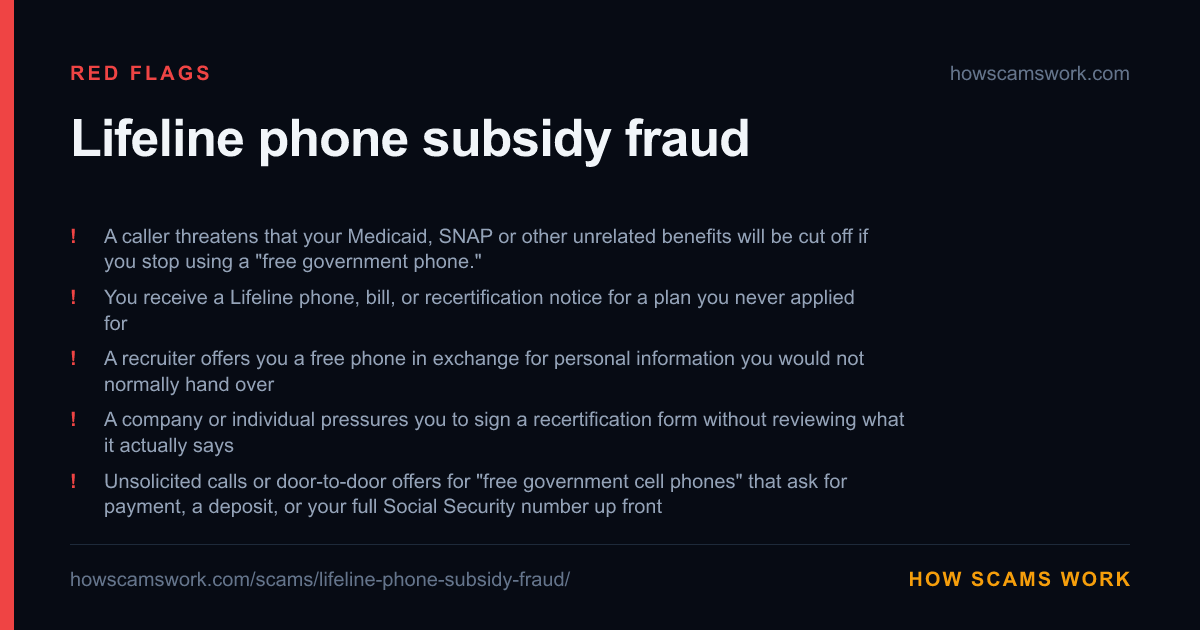
- A caller threatens that your Medicaid, SNAP or other unrelated benefits will be cut off if you stop using a “free government phone.” No agency links those programs that way; this is a tactic used to keep billing a subsidy, not a real rule.
- You receive a Lifeline phone, bill, or recertification notice for a plan you never applied for. Treat it as a sign your identity or Social Security number may have been used without your knowledge.
- A recruiter offers you a free phone in exchange for personal information you would not normally hand over, including your Social Security number, outside of an official application through a known carrier or the National Verifier.
- A company or individual pressures you to sign a recertification form without reviewing what it actually says, or asks you to sign on someone else’s behalf.
- Unsolicited calls or door-to-door offers for “free government cell phones” that ask for payment, a deposit, or your full Social Security number up front.
If it’s happening to you
- If you suspect your identity was used to enroll in Lifeline without your knowledge, request your
records through USAC’s National Lifeline Accountability Database and file a report at
IdentityTheft.gov.
- Report suspected Lifeline fraud to the FCC’s Lifeline Fraud Tip Line at 1-855-4LL-TIPS
(1-855-455-8477) or [email protected], and to the FCC Office of Inspector General. See
where to report for other countries.
- If you received a robocall threatening your Medicaid, SNAP or SSI benefits over phone usage, do not
act on it. Hang up and verify your actual benefit status directly with the agency that administers it,
never through a number the caller gave you.
- Do not sign a recertification form you have not read, or sign on behalf of someone else, even if
asked by a representative who claims to be helping you keep your service.
- If you work for a carrier or an agency administering Lifeline and are asked to falsify a subscriber
count, usage record or recertification form, document the request and report it; every documented
case on this page shows that instruction coming from someone who was later criminally charged.
- Keep any paperwork, text messages or call logs connected to a Lifeline enrollment you did not
initiate, since that record is what an identity theft or fraud investigation will need.
Where the money goes
The Universal Service Fund, built from a surcharge on phone bills nationally, pays USAC, which pays the
carrier reporting the subscriber as active and eligible. Because the payment goes to the carrier rather
than the customer, the fraud only has to control what the carrier reports, not convince any individual
victim of anything.
What happens next depends on who is running the scheme. A corporate carrier can keep the money inside the
company and divert it through ordinary business accounts, as Icon Telecom did before its owner personally
transferred over $20 million out, or move it overseas, as Q Link’s founder did in funneling more than $50
million to accounts in Jordan controlled by himself and a family member. An individual recruiter working
through identity theft, like Williams, instead collects physical devices issued under the stolen
identities and converts them directly into cash by activating and reselling them. Recovery, where it
happens, comes through restitution orders and criminal forfeiture imposed years after the underlying
subsidy payments were already spent.
By the numbers
No published dataset breaks this scheme out as its own category yet, so there is no chart to show.
The data page explains which agency categories exist and why some schemes are
invisible in official statistics.
Every factual claim above traces to one of these. Statistics are reported losses; see
methodology for what that does and does not measure.