Also called: preneed funeral scam · prepaid funeral fraud · funeral home scam · burial insurance scam · preneed funeral trust fraud
A prepaid funeral scam collects money, often thousands of dollars, for a casket, cremation or burial years before it is needed, then diverts it instead of placing it in the trust account or life insurance policy state law requires. A Colorado funeral home collected over $130,000 while leaving at least 190 bodies uncremated; Missouri's National Prearranged Services took more than $450 million from over 97,000 families before collapsing in 2008.
What it is
Someone pays a funeral home, or an agent selling on its behalf, for a specific casket, cremation or
burial, often years or decades before it will actually be needed. The pitch is framed as a kindness:
lock in today’s price, decide everything in advance, spare the family a decision and a bill during
grief. It is a real, legal product, bought by millions of Americans.
The scam is what is supposed to happen to that money next. Nearly every US state requires it to be kept
untouched, either in a trust account or inside a life insurance policy issued in the customer’s own
name, specifically so it still exists decades later when the death finally occurs. In every documented
case on this page, that step was skipped. The money was spent instead, on the operator’s own expenses,
on unrelated customers’ funerals, or both, years or decades before anyone noticed.
The scale runs from a single funeral home to an organised, multi-state operation. National
Prearranged Services took more than $450 million from over 97,000 families across 16 states
before collapsing in 2008. A Colorado Springs funeral home collected over $130,000 from grieving
families while leaving at least 190 bodies uncremated, some families handed concrete mix in an urn
instead of ashes.
How it actually works
The pitch
Sold as a kindness: lock in today’s price, decide every detail in advance, and spare the family a
decision and a bill during grief. Often pitched in person by a funeral director or an independent
“prearrangement” agent, sometimes at a seminar aimed at retirement communities and churches.
The payment
The family pays a lump sum or an instalment plan, commonly thousands of dollars, for a specific casket,
cremation or burial that may not actually be needed for years or decades.
The money’s one legal destination
State law, not the federal Funeral Rule, is supposed to keep this money safe. Missouri, before reform,
required at least 80 percent of every prepaid payment into a trust account; most other states instead
require it fund a life insurance policy issued in the customer’s own name.
Where it could have stopped
If the money had actually gone into the required trust account or insurance policy, untouched, it would still exist when the death occurred, decades later if needed, regardless of what happened to the business in between. Every documented case on this page shows that step being skipped.
The diversion
Instead, the money pays current operating costs, the operator’s own personal expenses, or, in the
largest documented case, the funerals of customers who had paid years earlier, a Ponzi dynamic in which
new contracts quietly fund old promises.
Years of looking normal
The business keeps selling new prepaid contracts and looks solvent for years, sometimes well over a
decade, while the trust or policy behind each existing contract is hollowed out, or was never created at
all.
The worst possible moment to find out
The death finally happens, and there is no trust, no policy, or, in the most extreme documented case,
the body itself was never cremated or buried: concrete mix sits in the urn, or remains are found in
storage months or years later.
A funeral paid for twice
Families are told to pay the real cost of the funeral over again. A state insurance guaranty fund, where
one exists and applies, may cover an insurer’s obligations up to a statutory limit, but families and the
funeral homes actually left to perform the service often absorb the rest.
Enforcement, long after the fact
Regulators and prosecutors typically act only once the business has already collapsed or remains have
been discovered, years or decades after the diversion began. Restitution is ordered far more often than
it is ever actually collected.
Why it works
The product answers a real fear at the right moment. Planning your own funeral, or a parent’s, in
advance is a genuinely sensible thing to do, which is exactly why a dishonest seller does not have to
invent demand, only intercept it.
The protection is a state law almost nobody reads. Which state requires a trust versus an insurance
policy, what percentage must be deposited, and how quickly, varies state by state and is not the kind of
detail a grieving or elderly customer is positioned to verify at the point of sale.
Discovery is delayed by design, not deception. A prepaid contract can sit untouched, or quietly
diverted, for ten, twenty, even thirty years. Nobody checks whether the money is really there until the
one moment it is needed, at which point the person who signed the original contract may no longer be
able to ask questions.
New customers can fund the cover-up. Where the diversion becomes a genuine Ponzi dynamic, as
National Prearranged Services’ collapse showed, new prepaid contracts keep the business looking solvent
and keep paying for current funerals, right up until new sales can no longer outrun the shortfall.
The seller is a licensed, trusted local institution. A funeral director is one of the few
professionals a family deals with only at the worst moments of their lives, which makes the relationship
one of unusual trust, and unusually poor conditions for a customer to ask hard financial questions.
Where it comes from
Entirely domestic in every documented case on this page, and run by state-licensed businesses, not
anonymous operators.
Scale runs from one local funeral home to a 16-state network. Stephen Kezmarsky’s Uniontown,
Pennsylvania business took from 80 named clients over 12 years; National Prearranged Services, based in
Clayton, Missouri, took from over 97,000 families across 16 states over more than 15 years before its
2008 collapse.
Enforcement is criminal, not civil, in every documented case here, a contrast with purely financial
schemes elsewhere on this site. Charges include wire fraud, mail fraud, bank fraud, money laundering and
insurance fraud, and, where remains were also mishandled, state charges of abuse of a corpse, reflecting
that the harm here is not only financial.
The money sits inside the ordinary financial and insurance system, not offshore. National
Prearranged Services’ contracts ran through an affiliated life insurer, Lincoln Memorial Life Insurance,
structured, unlike most states’ insurance-funded arrangements, as a trust instead; the Hallfords spent
diverted funds and a separate $882,300 in fraudulently obtained COVID-19 small-business relief on
cryptocurrency, vehicle leases and luxury goods.
Recovery is poor across every documented case. National Prearranged Services’ victims were called
unlikely to see “significant repayments” despite a $435 million restitution order; a civil suit over the
remaining losses was still pending years after the criminal sentences.
Real cases
2025 US Sentenced $1.1m
Jon and Carie Hallford operated Return to Nature Funeral Home in Colorado Springs and Penrose, Colorado. From September 2019 through October 2023, they collected more than $130,000 from grieving families for cremation and burial services they never performed, while also fraudulently obtaining $882,300 in COVID-19 small-business relief loans. A 2023 search of their Penrose building found at least 190 decomposing bodies. Both pleaded guilty to conspiracy to commit wire fraud; Jon Hallford was sentenced in June 2025 to 240 months (20 years) in federal prison, and Carie Hallford was sentenced in March 2026 to 216 months (18 years), with both ordered to pay $1,070,413.74 in restitution. Separate state charges of nearly 200 counts of abuse of a corpse were still pending against both at the time this page was last reviewed.
Read the case file ·
4 sources
2020 US Sentenced $500,000
Stephen Kezmarsky, former owner of a funeral home in Uniontown, Pennsylvania, accepted pre-need funeral policy payments from elderly clients between 2005 and 2017, but never submitted their completed policies to the insurer, Homesteaders Life, pocketing roughly $500,000 from 80 victims instead. He pleaded guilty to 172 counts including theft by deception, theft by failure to make required disposition of funds, forgery and insurance fraud, and was sentenced in February 2020 to four to eight years in prison, 20 years of probation, and $555,000 in restitution. Investigators separately found cremated remains improperly stored, some unlabeled, in a storage unit.
Read the case file ·
1 source
2013 US Sentenced $450.0m
National Prearranged Services Inc., based in Clayton, Missouri, sold prepaid funeral contracts in several states, telling customers their money would be held safely in trust. Instead, over more than 15 years, company officers used the money for personal enrichment and to cover the funerals of customers who had paid years earlier, a federal judge called it "an enormous Ponzi scheme." NPS collapsed in 2008, having taken more than $450 million from over 97,000 customers across 16 states. Six people, including the company's owner, his son, and its former chief financial officer, were sentenced in November 2013 to prison terms of 18 months to 10 years, and ordered to pay a combined $445.5 million in restitution.
Read the case file ·
3 sources
Red flags
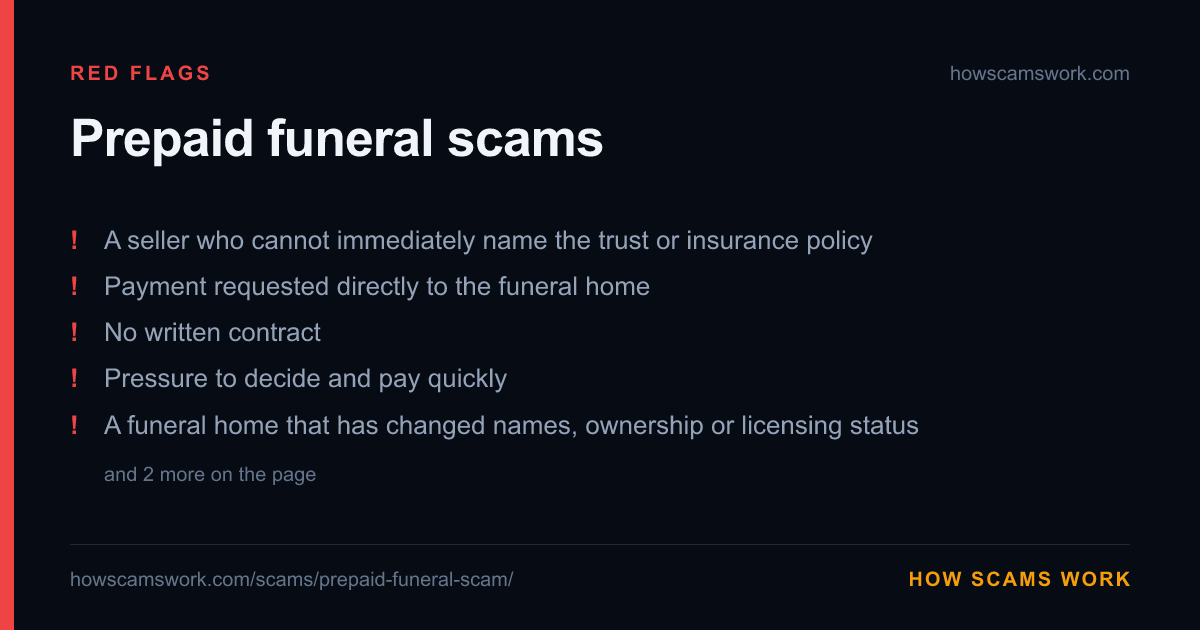
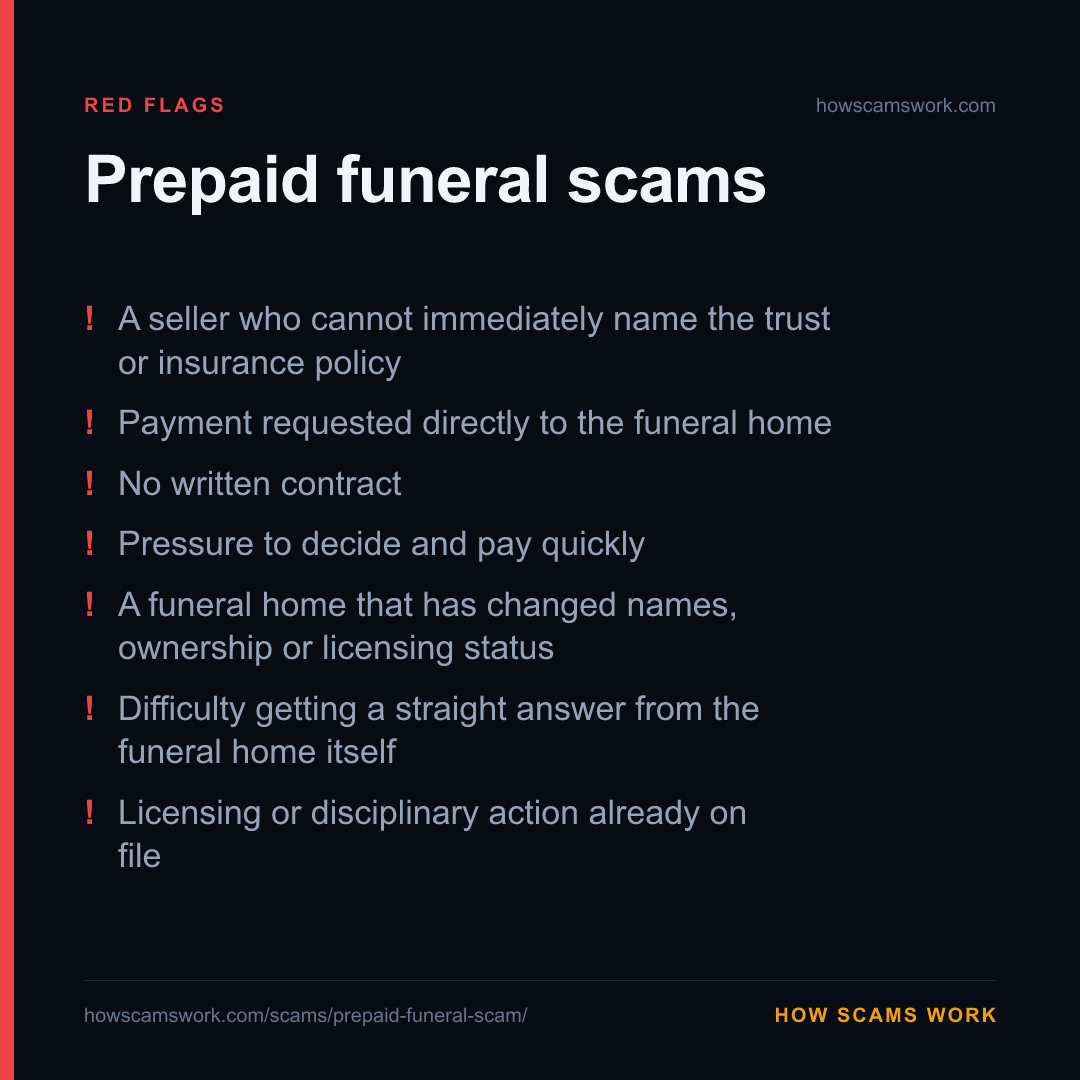
- A seller who cannot immediately name the trust or insurance policy your money is supposed to go into, with an account or policy number you can verify independently.
- Payment requested directly to the funeral home rather than to a named trustee or insurer, or a long delay before the money is reportedly deposited.
- No written contract specifying exactly what is being purchased, the total cost, and where the money is held.
- Pressure to decide and pay quickly, especially when someone is already in hospice or has just died.
- A funeral home that has changed names, ownership or licensing status since an older contract was signed.
- Difficulty getting a straight answer from the funeral home itself about the current balance or status of an existing prepaid contract.
- Licensing or disciplinary action already on file with your state’s funeral or cemetery board, searchable before you ever sign anything.
If it’s happening to you
- Get the trust or policy details in writing: the trustee or insurer’s name, the account or policy
number, and the current balance or death benefit, then verify it directly with that trustee or
insurer, not only with the funeral home.
- Check your state’s funeral or cemetery licensing board for the provider’s current license status
and any existing complaints or disciplinary actions.
- Contact your state insurance department if the plan was meant to be insurance-funded, to confirm
a policy actually exists in your name.
- Report it to your state Attorney General’s consumer protection division and to the FTC at
ReportFraud.ftc.gov. See where to report for other countries.
- If remains or a completed service are involved, contact local law enforcement directly; this is
not only a financial matter.
- Keep every document: the original contract, payment receipts, and any correspondence. Restitution
and guaranty-fund claims in cases like these are often paid out, if at all, only years later.
Where the money goes
Straight into the US financial and insurance system the prepaid-funeral industry already uses, not an
offshore network.
A trust account or an affiliated life insurer is where the money is legally supposed to sit, untouched,
for however many years pass before it is needed. In every documented case here, it instead moved into
the operator’s own spending, or into paying for unrelated customers’ current funerals, a dynamic that
keeps the business looking solvent for years past the point the underlying money is actually gone.
By the numbers
The $4,600 to $6,250 range below is derived directly from the two multi-victim cases on this page:
National Prearranged Services’ $450 million-plus loss divided across its more than 97,000 customers, and
Stephen Kezmarsky’s roughly $500,000 divided across his 80 named victims. It is a small sample, and
individual prepaid funeral contracts commonly run higher or lower depending on the services purchased.
No published dataset breaks this scheme out as its own category yet, so there is no chart to show.
The data page explains which agency categories exist and why some schemes are
invisible in official statistics.
Every factual claim above traces to one of these. Statistics are reported losses; see
methodology for what that does and does not measure.