Also called: rent-a-tribe scam · tribal payday loan scam · sovereign lending scam · fake tribal lender
A tribal lending scam sells a payday or installment loan at 400% to over 900% APR by claiming it was issued by a Native American tribe's own sovereign business, immune from state interest-rate caps. Courts have repeatedly found the tribe received only a token cut, as little as 1% of revenue in one case, while a non-Native operator ran the business from off-reservation and kept the rest.
What it is
An online lender offers a payday or instalment loan at an interest rate no state-licensed lender could
legally charge, sometimes above 700% APR, and defends the rate by claiming the loan was issued by
a Native American tribe’s own sovereign business, immune from state interest-rate caps and licensing
law.
In every documented case on this page, that claim did not hold up. Courts and regulators found the tribe
was paid a small fee for the use of its name, Colorado’s investigation into Scott Tucker’s operation
found the tribes kept roughly 1% of revenue while Tucker kept the rest, while a non-Native operator
designed the loan product, ran the marketing, collected the payments, and controlled the money the whole
time.
The arrangement has a name among the lawyers and judges who have spent nearly two decades litigating it:
“rent-a-tribe.” A federal appeals court used that exact term in 2025, describing a scheme “in which a
payday lender partners with a Native American tribe to cloak the lender in the sovereign immunity of the
tribe, thereby precluding enforcement of otherwise applicable usury laws.”
How it actually works
The pitch
An ad or search result for a “tribal loan,” a “sovereign lending” product, or simply a loan with “no
credit check”, aimed at people who cannot get approved by a bank or a state-licensed lender, often
because their state caps interest rates low enough to make ordinary payday lending unprofitable there.
Borrowing a tribe’s sovereign immunity
The lender is structured so a federally recognised tribe’s business entity appears to issue the loan.
Federally recognised tribes are genuinely immune from many state lawsuits, a real protection the
arrangement is built to exploit rather than to honour.
Where it could have stopped
A tribe’s sovereign immunity protects a business the tribe actually owns, controls and profits from. In Scott Tucker’s arrangement, the tribes involved received about 1% of revenue while Tucker kept the rest and ran the business himself, a fact investigators had to dig out of bank records and contracts years after the loans were made, because the loan paperwork itself said otherwise.
A loan priced far above any state’s cap
The interest rate is disclosed as a “finance fee,” not the annualised cost, as high as 448% APR in
the Think Finance-linked cases, and more than 700% APR in Matt Martorello’s, against a 12% legal limit
in Virginia.
Withdrawals that never end
Rather than a single repayment, the lender debits the borrower’s bank account repeatedly, assessing a
new finance fee with each withdrawal, so the balance the borrower owes does not fall even as money
keeps leaving their account, a practice the FTC documented in Tucker’s case.
Collecting on a debt courts say doesn’t exist
When a state’s usury law voids a loan outright for exceeding the legal rate, the lender’s obligation is
to stop collecting. The CFPB’s case against Think Finance’s tribal-lending entities alleged they kept
collecting anyway, in 17 states where the underlying debt was not legally owed at all.
Years of fighting over who can even be sued
A tribal-immunity defence lets the lender argue, before any court considers the interest rate at all,
that it cannot be sued in that court in the first place. The Martorello litigation went through three
separate Fourth Circuit appeals over six years on exactly this question.
A judgment against the person, not the tribe
Once a court finds the tribe’s role was nominal, liability lands on the human operator personally.
Martorello, not any tribe, was the one ordered to pay when the Fourth Circuit affirmed a
$43,401,817.47 judgment in July 2025.
Collection, and refunds, years later
Refunds in the Tucker case reached consumers only after his criminal conviction and a multi-year asset
recovery process: 1,179,803 checks totalling over $505 million, mailed in September 2018, five years
after the underlying case was first filed.
Why it works
A real legal doctrine provides real cover. Tribal sovereign immunity is genuine law, not a
fabrication, which is exactly why wrapping a lending business in a tribe’s name is so effective at
delaying enforcement, even when the arrangement itself turns out to be a sham.
The rate is disclosed, just not in a way that reads as an interest rate. A “finance fee” per $100
borrowed sounds like a flat cost. Multiplied out over a year, it is a rate no state-licensed lender
could legally offer, but the loan document never states it that way.
The borrower has already been turned down elsewhere. Someone applying for a tribal or “no credit
check” loan online is, in nearly every case, someone a bank or a licensed lender has already declined,
which is precisely the population with the least leverage to walk away from a bad rate.
Litigating the immunity question takes years, by design. Because the sovereign-immunity defence is
decided before the interest-rate question is even reached, an operator can keep collecting payments for
the entire span of an appeal, sometimes the better part of a decade, as in the Martorello case.
The tribe’s name is the whole product. Once regulators strip away marketing and litigation, what is
being sold is not a loan a tribe designed; it is legal cover an operator purchased for a small
percentage of revenue.
Where it comes from
Entirely domestic in every documented case here, a US legal structure exploited by US operators, not an
imported fraud.
The structure requires a real, federally recognised tribe willing to license its name. Tucker’s
arrangement involved the Miami and Modoc tribes of Oklahoma and the Santee Sioux tribe of Nebraska;
Think Finance partnered with tribal entities to run Plain Green Loans and related brands; Martorello’s
Big Picture Loans and Red Rock Tribal Lending operated through the Lac Vieux Desert Band of Lake Superior
Chippewa Indians, a relationship an attorney helped establish in 2011.
The lawyers who structure these deals are a documented, recurring feature. Timothy Muir, the
attorney who helped run Tucker’s tribal arrangement, was sentenced alongside him. A tribal-lending
attorney is named in the Martorello litigation as the person who helped establish that relationship in
2011.
Enforcement has run through every available tool, a criminal RICO prosecution and 16-plus-year
sentence for Tucker, civil FTC and CFPB actions against Think Finance’s entities, a state attorney
general’s suit in Pennsylvania, and a private class-action civil RICO judgment against Martorello
personally. No single agency or type of case has been sufficient on its own; each documented takedown on
this page used a different legal tool.
The fight over jurisdiction routinely outlasts the underlying loans by years. Martorello’s case
alone spanned three separate rounds at the Fourth Circuit over six years, all before the interest-rate
question was finally settled in 2025, for loans made over a decade earlier.
Real cases
2025 US Sanctioned $43.4m
Matt Martorello, through his company and lending brands Big Picture Loans and Red Rock Tribal Lending, partnered with the Lac Vieux Desert Band of Lake Superior Chippewa Indians to issue loans at over 700% APR to Virginia borrowers, nearly 60 times the state's 12% usury cap. After three separate rounds at the Fourth Circuit Court of Appeals over six years, the court affirmed a $43,401,817.47 civil RICO judgment against Martorello personally in July 2025, rejecting his sovereign-immunity, choice-of-law and mistake-of-law defences.
Read the case file ·
3 sources
2019 US Settled $133.0m
Think Finance operated online lending brands including Plain Green Loans through partnerships with tribal entities, charging interest rates as high as 448% while shielding the arrangement behind claims of tribal and bank-partner immunity from state law. Pennsylvania's Attorney General sued, and in July 2019 announced a settlement cancelling all remaining balances on roughly $133 million in loans made to about 80,000 Pennsylvania borrowers. The CFPB separately settled its own 2017 suit against related tribal-lending entities in 2020, requiring more than $39 million set aside for consumer redress.
Read the case file ·
2 sources
2018 US Sentenced $1.3bn
Scott Tucker ran AMG Services and related companies as an online payday lending business charging up to 700% interest, while claiming the businesses were owned by Native American tribes and therefore immune from state usury laws. In October 2016 a federal court imposed a $1.3 billion judgment against him, the largest the FTC had ever obtained in a litigated case, and in January 2018, after a criminal conviction on 14 counts, he was sentenced to more than 16 years in prison. The FTC and DOJ mailed 1,179,803 refund checks totalling over $505 million to affected consumers in September 2018.
Read the case file ·
4 sources
Red flags
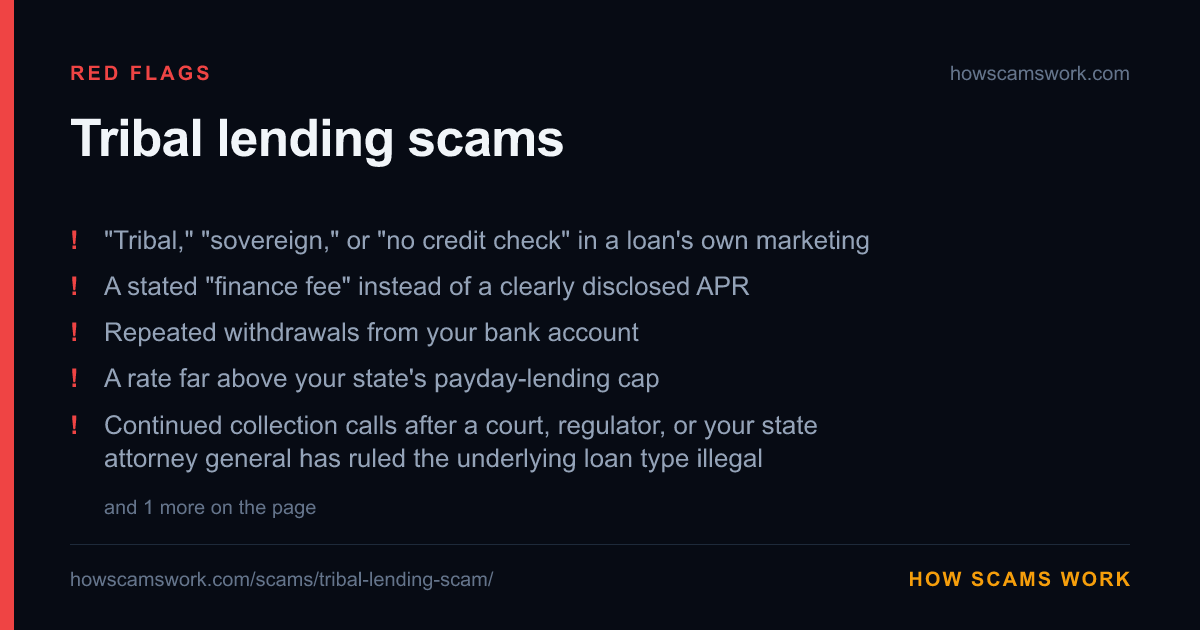
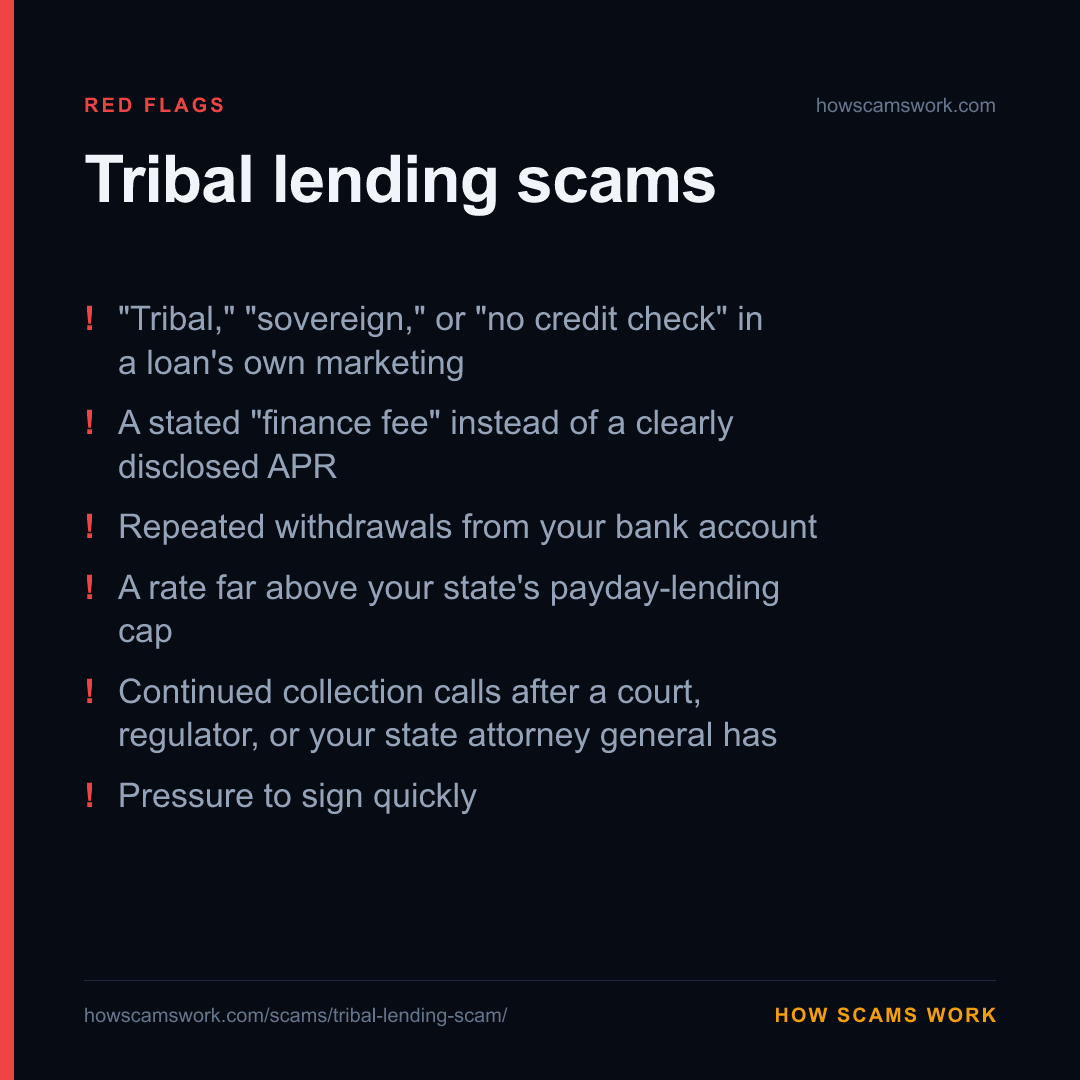
- “Tribal,” “sovereign,” or “no credit check” in a loan’s own marketing, a genuine lender does not need to say this to make a sale.
- A stated “finance fee” instead of a clearly disclosed APR. Federal law requires the annualised rate to be disclosed; do the math yourself if it is buried in fee language.
- Repeated withdrawals from your bank account where the balance you owe does not visibly go down despite ongoing payments.
- A rate far above your state’s payday-lending cap, or a loan offered at all in a state that bans payday lending outright.
- Continued collection calls after a court, regulator, or your state attorney general has ruled the underlying loan type illegal.
- Pressure to sign quickly, with the tribal or sovereign-immunity language presented as the reason state consumer-protection rules do not apply to you.
If it’s happening to you
- Check your state’s usury and payday-lending law. Many states cap payday loan rates far below what
these operators charge, or ban the product outright, the loan may be void regardless of any tribal
claim.
- Stop authorising further withdrawals if you can, and contact your bank about revoking a standing
ACH authorisation on a loan you believe is illegal.
- Do not assume a “tribal” label ends the conversation. Courts have repeatedly ruled that a state’s
consumer-protection law applies to lending aimed at that state’s residents, regardless of what a loan
contract says about tribal law.
- Report it to your state attorney general, the CFPB at consumerfinance.gov/complaint, and the
FTC at ReportFraud.ftc.gov. See where to report for other countries.
- Keep every document: the loan agreement, your payment and withdrawal history, and any collection
communications. Refunds in concluded cases on this page took years to reach consumers, and required
detailed records to distribute.
- Watch for a class action or regulatory redress notice tied to the specific lender’s name, several
of the cases on this page resulted in consumer refund or debt-cancellation programmes announced long
after the loans were made.
Where the money goes
Kept almost entirely in the United States, split between the operator and a small, contractual cut to
the tribe whose name licenses the arrangement.
The borrower’s payment goes to the lending company, which is run and controlled by the operator, not the
tribe. A documented, fixed percentage, as low as roughly 1% of revenue in Scott Tucker’s arrangement,
passes to the tribal entity as the fee for the use of its sovereign status. The bulk of the money stays
with the operator, funding, in Tucker’s case, a professional auto-racing team, an $8 million vacation
home, and other personal spending the FTC’s case against him documented.
When enforcement succeeds, money moves back the other way, but slowly: refunds in the Tucker case took
over five years from the original 2012 complaint to reach consumers, and the 2025 judgment against
Martorello is a legal finding of liability, not money already collected, a distinction that matters,
because a defendant found liable does not always have, or willingly hand over, the funds a court has
ordered.
By the numbers
No published dataset breaks this scheme out as its own category yet, so there is no chart to show.
The data page explains which agency categories exist and why some schemes are
invisible in official statistics.
Every factual claim above traces to one of these. Statistics are reported losses; see
methodology for what that does and does not measure.