Medical alert device scams

Also called: free medical alert robocall scam · medical alarm robocall scam · senior medical alert scam · medical alert telemarketing fraud

A medical alert device scam uses robocalls, often with spoofed caller ID, to tell seniors a friend or relative already bought them a "free" medical alert system, falsely claims health-group endorsements, then charges a monthly monitoring fee immediately rather than after activation as promised. The FTC's largest judgment against one operator, Lifewatch Inc., totaled $25.3 million; a related telemarketer was separately ordered to pay nearly $23 million.

Key facts

Category
Purchase & marketplace
First documented
2012
Typical loss
$159–$299 USD, per victim
Main channels
robocalls, spoofed caller ID, telemarketing, pre-recorded messages
Who is targeted
Seniors who live alone and have limited or fixed incomes, named specifically in the FTC's 2014 case against the robocall operation's telemarketer; Anyone on the National Do Not Call Registry, which the operations are alleged to have ignored outright; People told, falsely, that a specific friend or family member already paid for their device, a claim the telemarketers refused to back up with any name; Consumers across the United States and Canada, per the FTC and Florida Attorney General's 2015 complaint against Lifewatch
Documented origins
United States
Main targets
United States, Canada
Case files
3 documented cases
Last reviewed
2026-11-17
Anatomy of a medical alert device scamAnatomy of a medical alert device scam. A robocall that claims someone already paid, and a company that keeps going after its telemarketer is banned. 1. The robocall: A pre-recorded message reaches a phone, often one already on the National Do Not Call Registry, using caller ID spoofed to look like a different number. 2. "Someone already paid for this": The recording claims a friend or relative already bought a 'free' medical alert system. One script impersonated 'John from the shipping department of Emergency Medical Alert.' No telemarketer would actually name who paid. 3. The live operator's pitch: A live telemarketer insists the system, said to be worth over $400, is genuinely free and falsely claims endorsement by groups like the American Heart Association. 4. Charged immediately, device maybe never: The fee was promised only after activation. One complaint alleges consumers were charged immediately regardless; another alleges some $159 to $299 devices were never delivered at all. 5. The monitoring trap: A monthly fee of $29.95 to $39.95 continues until the consumer disputes it or manages to cancel, which one case alleges was made deliberately difficult. 6. When one telemarketer is banned, another appears: Worldwide Info Services was banned from robocalling in 2014. The FTC later alleged that Lifewatch, the company whose product it sold, simply hired new telemarketers and kept the same campaign running. 7. The regulator, years later: The FTC and Florida's Attorney General sued Lifewatch in 2015, settled in 2019 for a $25.3 million judgment, and didn't finish mailing consumer refunds until December 2021. The diagram marks stage 6 as the point where the scheme can still be stopped: A ban on one telemarketing firm does not bind the company that hired it. Investigators had to trace the script and the money back from a banned telemarketer to the medical alert seller itself, and that second lawsuit produced the largest judgment of either case.Anatomy of a medical alert device scamA robocall that claims someone already paid, and a company that keeps going after its telemarketer is banned.1The robocallA pre-recorded messagereaches a phone, often onealready on the National DoNot Call Registry, usingcaller ID spoofed to looklike a different number.Seconds2"Someone already paidfor this"The recording claims afriend or relative alreadybought a 'free' medicalalert system. One scriptimpersonated 'John from theshipping department ofEmergency Medical Alert.'No telemarketer wouldactually name who paid.The same call3The live operator'spitchA live telemarketer insiststhe system, said to beworth over $400, isgenuinely free and falselyclaims endorsement bygroups like the AmericanHeart Association.Minutes4Charged immediately,device maybe neverThe fee was promised onlyafter activation. Onecomplaint alleges consumerswere charged immediatelyregardless; another allegessome $159 to $299 deviceswere never delivered atall.Same day5The monitoring trapA monthly fee of $29.95 to$39.95 continues until theconsumer disputes it ormanages to cancel, whichone case alleges was madedeliberately difficult.Months to years6When one telemarketeris banned, anotherappearsWorldwide Info Services wasbanned from robocalling in2014. The FTC later allegedthat Lifewatch, the companywhose product it sold,simply hired newtelemarketers and kept thesame campaign running.Ongoing7The regulator, yearslaterThe FTC and Florida'sAttorney General suedLifewatch in 2015, settledin 2019 for a $25.3 millionjudgment, and didn't finishmailing consumer refundsuntil December 2021.YearsWhere it can still be stopped: stage 6A ban on one telemarketing firm does not bind the company that hired it. Investigators had to trace the script and the money back from a banned telemarketer tothe medical alert seller itself, and that second lawsuit produced the largest judgment of either case.Stages drawn from the FTC and Florida Attorney General's 2014 settlement with Worldwide Info Services, their 2015 to 2019 case against Lifewatch Inc., and New Jersey's 2018 settlement with Life Aid Connect, Safety Alert USA and Mobile Alert. Allegations in these civil settlements were not admitted by the defendants. Sources accessed 2026-11-17.howscamswork.com
The stages of the scheme, in order, with the point where it can still be stopped.

What it is

A medical alert device scam uses a pre-recorded robocall, often to a phone number on the National Do Not Call Registry, to tell an older consumer that a medical alert system, a wearable or base-station device that calls for help at the press of a button, has already been bought for them by a friend or family member, “at no cost whatsoever.” A live operator then signs the consumer up, insists the device is free and endorsed by major health organizations, and charges a recurring monthly monitoring fee immediately rather than after the device arrives and is activated, as promised on the call.

Three federal and state cases since 2014 describe the same pattern run by different companies, one of which simply kept going after the first was shut down. The FTC and Florida’s Attorney General banned telemarketer Worldwide Info Services from robocalling in 2014 and secured a nearly $23 million judgment. Months later, their investigation found that the company that had hired Worldwide, Lifewatch Inc., had “continued its telemarketing campaign using a variety of other telemarketers” after Worldwide was shut down. Lifewatch itself was not permanently banned from telemarketing and ordered to pay a $25.3 million judgment until 2019, four years after being sued.

How it actually works

  1. The robocall

    A pre-recorded message reaches a phone, frequently one already listed on the National Do Not Call Registry, using caller ID spoofed to look like a different, unrelated number.

  2. “Someone already paid for this”

    The recording claims a friend, relative or acquaintance already bought the consumer a medical alert system and it can be received “at no cost whatsoever.” One script used by Worldwide Info Services impersonated “John from the shipping department of Emergency Medical Alert.” No telemarketer in any case on this page would actually name who supposedly paid.

  3. The live operator’s pitch

    A consumer who presses a key to ask questions reaches a live telemarketer who insists the system, described as worth over $400, is genuinely free, and falsely claims it is recommended by groups such as the American Heart Association, the American Diabetes Association or the National Institute on Aging.

  4. Charged immediately, device maybe never

    The telemarketer promises the $29.95 to $39.95 monthly monitoring fee will only be charged once the device arrives and is activated. The FTC’s 2014 complaint alleges consumers were instead charged immediately regardless of activation, and New Jersey’s 2018 case alleges some devices, priced $159 to $299 when sold outright, were never delivered at all.

  5. The monitoring trap

    The monthly fee continues until the consumer notices it, disputes it with their bank, or successfully cancels, which the New Jersey case alleges the companies made deliberately difficult.

  6. When one telemarketer is banned, another appears

    Worldwide Info Services was permanently banned from robocalling and medical alert sales in November 2014. The FTC and Florida’s Attorney General later alleged that Lifewatch, the company whose product Worldwide had been selling, simply hired new telemarketers and kept the same campaign running.

    Where it could have stopped

    A ban on one telemarketing firm does not bind the company that hired it. Investigators had to trace the money and the script back from a banned telemarketer to the medical alert seller itself, and that second lawsuit, not the first, is what eventually produced the largest judgment in either case.

  7. The regulator, years later

    The FTC and Florida’s Attorney General sued Lifewatch in July 2015, amended the complaint in 2016, and reached a stipulated order in 2019 permanently banning the Lifewatch defendants from telemarketing and imposing a $25.3 million judgment. The FTC did not finish mailing refund checks to consumers until December 2021, six years after the suit was filed.

Why it works

A false claim that someone already paid removes the one hesitation a cold sales call usually meets. Consumers who would hang up on an unsolicited sales pitch are more likely to stay on the line to find out who supposedly bought them a gift, which is exactly the opening the script is built to create.

A fabricated health-group endorsement borrows trust the caller never earned. Invoking the American Heart Association or the National Institute on Aging by name gives an unsolicited call a credibility it has no legal basis to claim.

Immediate billing defeats the “free, until activated” promise before a consumer can check it. By the time a consumer realizes the monitoring fee was charged the same day, not after installation as promised, the transaction has already gone through.

Being on the Do Not Call Registry is a right to sue, not a technical block. The registry does not stop a call from being placed, especially with spoofed caller ID; it only makes the call illegal after the fact, and enforcement can take years to catch up.

And a settlement against one company’s telemarketer doesn’t stop the company. Worldwide Info Services’ 2014 ban ended one telemarketing operation. It took a second, multi-year lawsuit against Lifewatch itself, the company whose product was being sold, to reach the business actually behind the campaign.

Where it comes from

Entirely domestic telemarketing operations, run as ordinary registered companies rather than hidden operations, selling into the US and Canada.

Every documented case on this page is a US-based telemarketing or device-sales operation. Worldwide Info Services and Lifewatch operated out of Florida and New York; the New Jersey case involved Monmouth County residents selling directly into their home state. None of the conduct described involves an overseas call center or a cryptocurrency payment.

Enforcement runs through the FTC’s Telemarketing Sales Rule and state consumer-fraud and do-not-call laws, as a civil matter, not a criminal one. None of the operators named on this page faced a criminal charge in any source reviewed for this page; all three cases ended in civil settlements or consent judgments.

A corporate hierarchy can absorb a single sanction without stopping the underlying business. Worldwide Info Services’ telemarketing ban addressed one firm. Lifewatch, the company that had hired Worldwide and kept selling the same product through replacement telemarketers, was not itself banned until a separate case concluded four years later, the exact pattern this site’s sibling site on money laundering tracks under a different name: a sanction on one corporate link doesn’t reach the rest of the chain.

Real cases

Lifewatch's billion robocalls end in a $25.3 million judgment, and refunds six years later

2019 US · CA Settled $25.3m

The FTC and Florida's Attorney General sued New York-based Lifewatch Inc. (also doing business as Lifewatch USA and Medical Alarm Systems) and its Vice-President Evan Sirlin in July 2015, alleging the company had bombarded primarily elderly consumers across the US and Canada with at least a billion unsolicited robocalls since 2012 pitching supposedly "free" medical alert systems, including by continuing the same campaign through new telemarketers after its original telemarketer, Worldwide Info Services, was banned in 2014. A stipulated order reached in 2019 permanently banned the Lifewatch defendants from telemarketing and imposed a $25.3 million judgment; the same order addressed a second set of defendants, Safe Home Security Inc., MedGuard Alert Inc. and David Roman. The FTC did not finish mailing refunds to defrauded consumers until December 2021.

Read the case file · 3 sources

Three New Jersey companies dissolved over emergency alert telemarketing to seniors

2018 US Settled

New Jersey's Division of Consumer Affairs announced a $295,545 Final Consent Judgment in April 2018 against Monmouth County residents Ezra Rishty and Larry J. Ansell and their three companies, Life Aid Connect, Inc., Safety Alert USA Limited Liability Company (also doing business as Med Aid Alert), and Mobile Alert, Inc., resolving a 2016 civil complaint that accused them of selling emergency response systems to senior citizens through aggressive and deceptive telemarketing. The systems, priced $159 to $299 plus $34.95 to $39.95 in monthly monitoring fees, sometimes were never delivered, often did not work properly, or could not even be activated where the consumer lived. All three companies were permanently barred from selling such systems in New Jersey and ordered dissolved.

Read the case file · 1 source

A nearly $23 million judgment against the telemarketer behind 'free' medical alert robocalls

2014 US Settled $23.0m

In November 2014 the FTC and Florida's Attorney General settled charges against an Orlando-based robocall operation, Worldwide Info Services, Inc. (also doing business as The Credit Voice), and eight related companies and four individual principals, permanently banning them from robocalling and from ever selling or marketing medical alert products again. The settlement order imposed a judgment of $22,989,609, the total amount consumers paid for monthly monitoring on medical alert systems the robocalls had falsely claimed were already paid for by a friend or relative.

Read the case file · 1 source

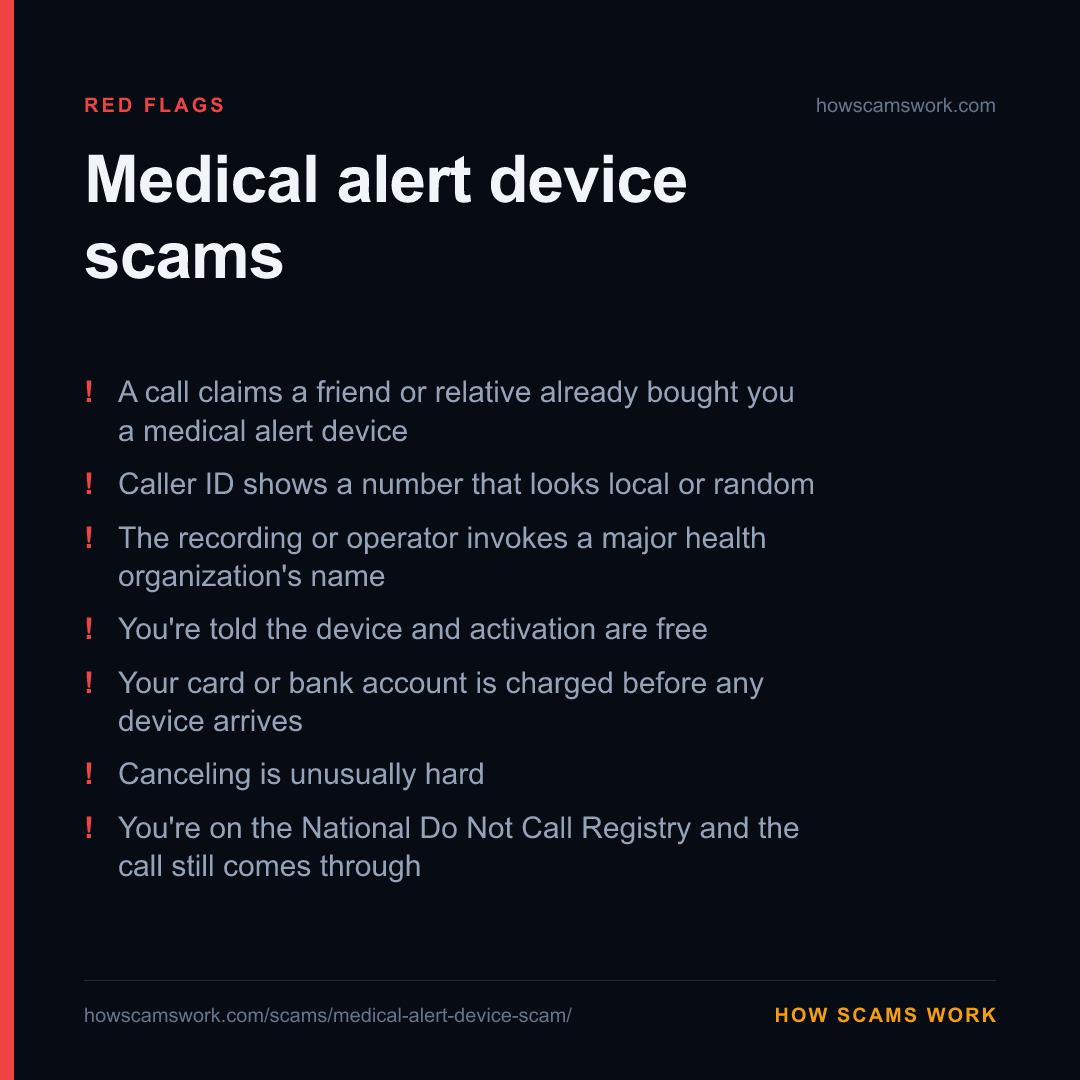
Red flags

  • A call claims a friend or relative already bought you a medical alert device, but the caller won’t or can’t say who.
  • Caller ID shows a number that looks local or random and doesn’t match any company name you recognize; it may be spoofed.
  • The recording or operator invokes a major health organization’s name, such as a national heart, diabetes or aging association, as an endorser.
  • You’re told the device and activation are free, with no mention of a monthly fee until after you’ve agreed to receive it.
  • Your card or bank account is charged before any device arrives, despite being told the fee starts only after installation.
  • Canceling is unusually hard, with long hold times, transfers, or a refusal to confirm cancellation in writing.
  • You’re on the National Do Not Call Registry and the call still comes through, which does not make the call legitimate, only illegal.

If it’s happening to you

  1. Hang up. Don’t press any number on the call, including the one offered to “speak to a representative” or to be removed from the list; pressing a key can simply confirm the number is active.
  2. Don’t give payment or bank information to an unsolicited caller, regardless of what the device is claimed to be worth.
  3. If you’ve already been charged, dispute it with your card issuer or bank and ask them to block future charges from the merchant.
  4. Check whether a company you’re dealing with has already been sued or sanctioned. A new or unfamiliar company name doesn’t mean it’s unconnected to a previously banned operation.
  5. Report it to the FTC at ReportFraud.ftc.gov, to your state attorney general, and register any affected numbers at donotcall.gov. See where to report for other countries.
  6. If you do want a medical alert device, buy one directly from a company you chose, not one that called you first.

Where the money goes

Straight into the calling operation’s own revenue through recurring card and bank charges, with no laundering chain to trace, until a court-ordered asset freeze catches up with what’s left.

The money moves from the consumer’s card or bank account directly into the telemarketing and device-sales operation. New Jersey’s 2018 case documents devices priced $159 to $299, on top of monthly monitoring fees of $34.95 to $39.95, figures that form the basis of this page’s typical-loss estimate, drawn from a small sample of the dollar figures these cases actually document rather than a larger survey; a consumer who doesn’t notice or successfully cancel the monthly charge for several months accumulates losses well beyond the device price alone.

When regulators do catch up, the recovered total is often far smaller than the judgment. The FTC’s $22,989,609 judgment against Worldwide Info Services’ principals was suspended once they surrendered roughly $79,000 in cash and assets, including a BMW, a 1984 sailboat, a Mercedes and a Lincoln Navigator; one defendant, Joseph Settecase, was hit with a separate, non-suspended $39,300 judgment specifically for selling a Ferrari in violation of the court’s asset freeze and moving part of the proceeds to another defendant.

Refunds, when they arrive, are a small fraction of what was taken, and come years later. The FTC’s December 2021 refund to consumers defrauded by Lifewatch totaled $1,808,260, paid out as 71,899 checks of $25.15 each, six years after the company was first sued and nine years after the robocalls the complaint describes are alleged to have begun.

The other half of this story

Our sibling site Clean on Paper explains why a banned telemarketer’s campaign can just continue under a different company, the same structural gap that let Lifewatch keep selling through new telemarketers after Worldwide Info Services was banned.

By the numbers

No published dataset breaks this scheme out as its own category yet, so there is no chart to show. The data page explains which agency categories exist and why some schemes are invisible in official statistics.

Sources

Every factual claim above traces to one of these. Statistics are reported losses; see methodology for what that does and does not measure.
  1. Settlement with the FTC and Florida Attorney General Stops Operations that Used Robocalls to Fraudulently Pitch Medical Alert Devices to Seniors. US Federal Trade Commission. Accessed 2026-11-17. Supports: The November 13, 2014 settlement, the $22,989,609 judgment, the defendant list (Worldwide Info Services Inc. dba The Credit Voice and related entities, and principals Michael Hilgar, Gary Martin, Joseph Settecase and Yuluisa Nieves), the $39,300 additional judgment against Settecase for selling a Ferrari in violation of the asset freeze, the false American Heart Association, American Diabetes Association and National Institute on Aging endorsement claims, the $34.95 monthly fee, the Jessica Rich and Pam Bondi quotes, and the assets surrendered including a BMW, a sailboat, a Mercedes and a Lincoln Navigator.
  2. FTC, Florida Attorney General Sue to Stop Deceptive Robocalls from Operation That Pitched Seniors "Free" Medical Alert Systems. US Federal Trade Commission. Accessed 2026-11-17. Supports: The July 6, 2015 joint complaint against Lifewatch, the allegation that Lifewatch's telemarketer Worldwide Info Services was banned in 2014 and that Lifewatch continued the same campaign through other telemarketers, the monthly fees ranging from $29.95 to $39.95, the claim that calls since 2012 bombarded primarily elderly consumers across the US and Canada, the spoofed caller ID and National Do Not Call Registry violations, the 'John from the shipping department of Emergency Medical Alert' pre-recorded message, and the Jessica Rich and Pam Bondi quotes.
  3. Lifewatch Inc. (FTC Matter/File Number 142 3123, Civil Action 1:15-cv-05781). US Federal Trade Commission, Legal Library. Accessed 2026-11-17. Supports: The case being announced in June 2019 as part of a crackdown on robocall operations responsible for more than one billion calls, the two sets of defendants (Lifewatch, Inc., Evan Sirlin and Mitchel May; and the Roman defendants, Safe Home Security Inc., MedGuard Alert Inc. and David Roman), the permanent telemarketing ban, the $25.3 million financial judgment against Lifewatch and Sirlin, and the case timeline of the July 2015 complaint, the July 2016 amended complaint, and the June 2019 stipulated order.
  4. FTC Issues Refunds Totaling More Than $1.8 Million to Consumers Defrauded by Lifewatch, Inc.'s Deceptive Medical Alert Telemarketing Scheme. US Federal Trade Commission. Accessed 2026-11-17. Supports: The December 1, 2021 refund announcement, the 71,899 checks worth $25.15 each totaling $1,808,260, the description of consumers tricked into paying for supposedly free in-home medical alert devices, the claimed American Heart Association endorsement, the difficulty consumers had canceling without a penalty, and the note that the US Supreme Court's 2021 ruling limited the FTC's ability to seek monetary relief in future cases.
  5. NJ Division of Consumer Affairs Settles Lawsuit by Permanently Shutting Down Three Monmouth County Companies that Targeted Seniors in Aggressive and Deceptive Telemarketing of Emergency Response Systems. New Jersey Office of the Attorney General. Accessed 2026-11-17. Supports: The April 25, 2018 Final Consent Judgment, the $295,545 settlement ($206,000 in civil penalties, $8,669 in consumer restitution, $57,980 in attorney's fees and $22,783 in investigative costs), the defendants Ezra Rishty, Larry J. Ansell, and their companies Life Aid Connect Inc., Safety Alert USA LLC (dba Med Aid Alert) and Mobile Alert Inc., the 2016 civil complaint filed in Monmouth County Superior Court, the $159 to $299 device price range, the $34.95 to $39.95 monthly monitoring fee range, the permanent dissolution and sales ban, and the Gurbir Grewal quote.

Common questions

Did someone really already buy me a medical alert device?

No. In every case on this page, the claim that a friend or family member already purchased the device was itself the deception used to lower a senior's guard. The FTC's complaints describe telemarketers who, when pressed, would not say who supposedly paid, and pre-recorded messages invented a sender, such as one that claimed to be 'John from the shipping department of Emergency Medical Alert.'

I'm on the National Do Not Call Registry. Why do these calls still get through?

Being on the registry makes the calls illegal, it doesn't stop them from happening. The FTC and Florida's Attorney General alleged these operations called numbers on the registry anyway and used spoofed caller ID so the calls looked like they came from somewhere else. Enforcement catches up with an operator eventually, but years can pass first.

Are Life Alert and these scam operations the same company?

No. The operations documented on this page, Worldwide Info Services, Lifewatch, and the New Jersey companies Life Aid Connect, Safety Alert USA and Mobile Alert, are separate businesses from any single well-known brand. Several used names chosen to sound like a generic 'emergency medical alert' service rather than naming a specific company on the call itself, which is part of what made the false free-device claim easier to sell.

A company already settled with regulators years ago. Why do I still see similar calls?

Because a settlement binds the company that was sued, not the industry. The FTC's 2015 complaint against Lifewatch alleges that after its telemarketer Worldwide Info Services was banned in 2014, Lifewatch simply continued the same campaign through other telemarketers. A new company making the same pitch is not bound by someone else's settlement.

Where the monthly fee actually goesWhere the monthly fee actually goes. Straight into the telemarketing operation, until a court-ordered asset freeze catches up with what's left. Where the monthly fee actually goesStraight into the telemarketing operation, until a court-ordered asset freeze catches up with what's left.A senior who wascalled firstA card or bank accountcharged immediately,often for a devicepriced $159 to $299plus a $29.95 to$39.95 monthly feeThe telemarketing firmmaking the callsMonitoring revenueflows up to thecompany whose medicalalert product isactually being soldThe company whoseproduct is soldWhen one telemarketeris banned, the selleris alleged to havesimply hired a new oneand kept the samescript runningA new telemarketer,hired after the lastone was bannedYears later, asettlement fundsrefund checks, $25.15each in one case, asmall fraction of whatwas originally chargedA regulator's refund,years laterReversibilityA recall is realistically possible only at the first hop, and only in the first hours. After the money is converted it becomes an investigation, not a refund.Why a banned telemarketer's campaign can just continue under a different company: Clean on Paper, our sibling sitehttps://cleanonpaper.com/techniques/shell-companies/Amounts from the FTC and Florida Attorney General's settlements with Worldwide Info Services (2014) and Lifewatch Inc. (2019, refunds 2021), and New Jersey's 2018 settlement with Life Aid Connect, Safety Alert USA and Mobile Alert, accessed 2026-11-17. A settlement total is not the same as the amount any one consumer actually recovers.howscamswork.com
Where the money goes after it leaves, and where it becomes hard to recover.

Report it

Reporting is what produces the enforcement data on this page. Find the right agency and phone number for your country on the report page. If money moved in the last few hours, call your bank first.