Public adjuster claim theft

Also called: public adjuster fraud · claims adjuster embezzlement · insurance settlement theft · hurricane claim adjuster scam · adjuster pockets settlement

Public adjuster claim theft is when a person hired, for a percentage, to negotiate a storm-damage insurance claim collects the insurer's payment and keeps it, sometimes by forging the policyholder's signature. In a Georgia church case, an insurer sent an adjuster more than $6 million and he was sentenced to 19 years.

Key facts

Category
Purchase & marketplace
First documented
2015
Typical loss
$45k–$4000k USD, per victim
Main channels
solicitation of homeowners after a storm, a construction company's representative recommending an adjuster (Georgia), a contract paying the adjuster a percentage of the settlement, settlement checks sent to or deposited into the adjuster's business account, forged endorsements on settlement checks, a license issued to a spouse or a colleague used in place of the adjuster's own
Who is targeted
Homeowners with hurricane damage who hire an adjuster to negotiate their claim for a share of the settlement; Churches and other organizations, as in the Georgia case, where the claim ran to millions of dollars; Clients whose settlement money was used to pay other clients, as in the California case; Older homeowners: one Florida charge alleges financial exploitation of an elderly person
Documented origins
United States
Main targets
United States
Case files
4 documented cases
Last reviewed
2026-11-07
Anatomy of a public adjuster claim theftAnatomy of a public adjuster claim theft. The adjuster is hired to get the insurer to pay. In these cases the insurer did pay, and the money stopped with the adjuster. 1. A storm damages a property and an adjuster appears: Florida investigators say the Hurricane Ian adjuster solicited claims work from vulnerable homeowners. In Georgia, a construction company's representative persuaded a church to hire a public adjuster days after its first insurance payment. 2. A contract promises a bigger settlement for a share: The Florida contracts agreed to accept no more than 10 percent of the insurance payment, the figure Florida's statute sets for claims from a declared emergency in the first year. 3. The adjuster negotiates with the insurer: In Georgia the insurer first paid the church $183,208 and then sent checks totaling more than $6 million. In Louisiana, police say the adjuster obtained greater settlements. 4. The payment goes to the adjuster: In Georgia the insurer sent three checks to the adjuster. In Florida, the checks were deposited into a business account that investigators say the adjuster alone controlled. 5. The money is kept: In Georgia and Louisiana the adjuster forged policyholders' names to obtain the funds. In California he also forged a mortgage company's endorsement stamps. Florida investigators say the Ian money went on transfers, card purchases and casino withdrawals. 6. Excuses and silence: The Georgia adjuster told church leaders the insurer was withholding complete payment. The California adjuster lied to clients about their payments. In Florida, a $30,000 check to a homeowner was returned for insufficient funds, according to a 2024 affidavit. 7. A regulator or prosecutor arrives, years later: The Georgia church claim was paid in late 2018, the indictment came in 2024 and the sentence in 2025. In Louisiana, a referral in August 2022 led to an arrest in January 2023 and a sentence in August 2023. The diagram marks stage 4 as the point where the scheme can still be stopped: The policyholder cannot see the money once it reaches the adjuster. The insurer knows what it paid, on what dates and to whom, and a policyholder can ask for that in writing and compare it with what the adjuster reports.Anatomy of a public adjuster claim theftThe adjuster is hired to get the insurer to pay. In these cases the insurer did pay, and the money stopped with the adjuster.1A storm damages aproperty and anadjuster appearsFlorida investigators saythe Hurricane Ian adjustersolicited claims work fromvulnerable homeowners. InGeorgia, a constructioncompany's representativepersuaded a church to hirea public adjuster daysafter its first insurancepayment.Days2A contract promises abigger settlement fora shareThe Florida contractsagreed to accept no morethan 10 percent of theinsurance payment, thefigure Florida's statutesets for claims from adeclared emergency in thefirst year.Days3The adjusternegotiates with theinsurerIn Georgia the insurerfirst paid the church$183,208 and then sentchecks totaling more than$6 million. In Louisiana,police say the adjusterobtained greatersettlements.Weeks to months4The payment goes tothe adjusterIn Georgia the insurer sentthree checks to theadjuster. In Florida, thechecks were deposited intoa business account thatinvestigators say theadjuster alone controlled.Days5The money is keptIn Georgia and Louisianathe adjuster forgedpolicyholders' names toobtain the funds. InCalifornia he also forged amortgage company'sendorsement stamps. Floridainvestigators say the Ianmoney went on transfers,card purchases and casinowithdrawals.Days6Excuses and silenceThe Georgia adjuster toldchurch leaders the insurerwas withholding completepayment. The Californiaadjuster lied to clientsabout their payments. InFlorida, a $30,000 check toa homeowner was returnedfor insufficient funds,according to a 2024affidavit.Months7A regulator orprosecutor arrives,years laterThe Georgia church claimwas paid in late 2018, theindictment came in 2024 andthe sentence in 2025. InLouisiana, a referral inAugust 2022 led to anarrest in January 2023 anda sentence in August 2023.YearsWhere it can still be stopped: stage 4The policyholder cannot see the money once it reaches the adjuster. The insurer knows what it paid, on what dates and to whom, and a policyholder can ask forthat in writing and compare it with what the adjuster reports.Stages drawn from four cases (Georgia and Louisiana, Maryland, California and Florida). The Florida case is charges only and the defendant is presumed innocent. Fee figures are from Florida's 2024 statute and differ by state. Accessed 7 November 2026.howscamswork.com
The stages of the scheme, in order, with the point where it can still be stopped.

What it is

A public adjuster is a licensed professional who, for a fee, prepares and negotiates an insurance claim on behalf of the policyholder. Florida’s statute defines the job as preparing, filing or helping to settle a claim for an insured in return for money, commission or any other thing of value, and it limits what the adjuster may charge.

The theft is simple. The insurer pays, the money goes to the adjuster or into an account the adjuster controls, and the policyholder gets some of it, or none. In some of the cases here the adjuster did negotiate a larger settlement first. The crime was what happened to the check afterward.

This is different from a contractor who takes a deposit and does not work, which our page on contractor and storm chaser fraud covers. Here the money in question is the insurance settlement itself.

How it actually works

  1. A storm damages a property and an adjuster appears

    The Louisiana case followed Hurricane Ida, the Georgia case Hurricane Michael and the Florida case Hurricane Ian. Florida investigators say the Hurricane Ian adjuster solicited claims work from “vulnerable homeowners.” In Georgia, a construction company’s representative visited the church days after its first payment and persuaded leaders to hire his company and a public adjuster.

  2. A contract promises a bigger settlement for a share

    The contracts pay the adjuster a percentage. In the Florida case, investigators say the contracts agreed to accept no more than 10 percent of the insurance payment, which is the figure Florida’s statute sets for claims arising from a declared emergency in the year after the declaration.

  3. The adjuster negotiates with the insurer

    In Georgia, the insurer first paid the church $183,208, and then, with the adjuster involved, sent checks totaling more than $6 million. In Louisiana, police say the adjuster obtained greater settlements and then did not pass the money to the homeowners.

  4. The payment goes to the adjuster

    The Georgia court records, as reported, say the insurer sent three checks to the adjuster. In Louisiana the money was deposited by the adjuster, and in the Florida case the checks went into a business account that investigators say the adjuster alone controlled.

    Where it could have stopped

    The policyholder cannot see the money once it reaches the adjuster. The insurer, though, knows what it paid, on what dates and to whom, and a policyholder can ask for that in writing and compare it with what the adjuster reports.

  5. The money is kept

    In the Georgia and Louisiana cases the adjuster forged the policyholders’ names to obtain the funds. In the California case the adjuster forged a client’s signature and the mortgage company’s endorsement stamps. In the Florida case investigators say the money was spent through transfers, card purchases and cash withdrawals at casinos.

  6. Excuses and silence

    The Georgia adjuster, when church leaders challenged him about unfinished work, said the insurer was withholding complete payment. The California adjuster, according to the report, lied to clients about the status of their payments. In the 2024 Florida case, according to an arrest affidavit, a $30,000 check sent to a homeowner was returned for insufficient funds.

  7. A regulator or prosecutor arrives, years later

    The Georgia claim was paid in late 2018, the indictment was in 2024 and the sentence in 2025. The Louisiana investigation began with a referral in August 2022, the arrest was in January 2023 and the sentence in August 2023.

Why it works

The adjuster handles the money. The policyholder hires the adjuster precisely so the adjuster will deal with the insurer. Once the settlement is paid to the adjuster, the person it belongs to is not in the room.

The timing favours the adjuster. Policyholders are dealing with damage, repairs and a claim all at once. The Georgia church heard from a construction company’s representative days after its first insurance payment.

A bigger number sounds like proof. In Louisiana, police say the adjuster did obtain greater settlements, and in Georgia the insurer’s payments grew from $183,208 to more than $6 million. A rising figure makes the arrangement look as if it is working until the money does not arrive.

A license is not a guarantee. The California adjuster lost his license in January 2015 and kept working under his wife’s license, then, on at least one occasion, a former colleague’s license number. The Florida adjuster’s license was suspended in 2015 and 2024, according to state records, and he is charged, but presumed innocent, in a new case.

The work crosses borders between jurisdictions. The St. Charles Parish District Attorney called the Mitchell case “a complex matter spanning multiple jurisdictions with multiple victims.” The adjuster was Texas-based, licensed in Louisiana, and the church was in Georgia.

New money can pay old debts. The California report says the adjuster used claim proceeds for personal expenses or to pay other clients.

Where it comes from

A US scheme in the cases found here, since public adjusters are licensed under state law and each state sets its own rules. The cases are in Louisiana, Texas, Georgia, Maryland, California and Florida.

This page found no official count. The cases are the ones located in public reports and press releases, not a sample. They do not show how common the problem is.

Scale ranges widely. The Maryland case involved two homeowners and $44,521. The California adjuster took more than $132,000. The Louisiana plea involved more than $200,000 from four victims, and the Georgia and Texas and Louisiana restitution orders together come to about $4 million.

Most of the sentences are recent. The conduct runs from 2015 to 2022 and the sentences from 2019 to 2025. One case is still only charges.

Real cases

Florida public adjuster charged with withholding $611,473.39 owed to ten Hurricane Ian policyholders, state says it went through transfers and casino withdrawals

2026 US Charged (allegation, not conviction)

Florida investigators arrested Miramar public adjuster Francisco Javier Chaparro-Araus on March 30, 2026 and charged him with organized fraud, financial exploitation of an elderly person, diversion and misappropriation of a premium, and failure to report and account for funds. A probable cause affidavit says he withheld $611,473.39 owed to ten policyholders, and the state's financial officer says the total was over $703,000 from 13 homeowners. These are allegations. He is presumed innocent unless and until proven guilty.

Read the case file · 2 sources

Texas public adjuster sentenced to 19 years after forging a Georgia church's name on insurance checks totaling more than $6 million

2025 US Sentenced $4.0m

Andrew Aga, also known as Andrew Mitchell, a Texas public adjuster, was sentenced in federal court in Georgia in September 2025 to 19 years in prison for taking the insurance money of an Albany church damaged by Hurricane Michael. The insurer sent him three checks totaling more than $6 million, and he forged church leaders' names and forwarded about a third. He had already received a 20-year Louisiana state sentence in 2023 for taking more than $200,000 from four Hurricane Ida victims.

Read the case file · 4 sources

Maryland public adjuster sentenced for stealing $44,521 in insurance benefits from two homeowners who hired her as their advocate

2021 US Sentenced $44,521

Tashoia Starr Grant, a formerly licensed Maryland public adjuster operating as Primary Asset Integrity Network, was sentenced in 2021 for a theft scheme against two homeowners in 2015. The Maryland Attorney General's Office said the homeowners hired her as their advocate in the claims process and that she instead stole $44,521 in insurance benefits. She received a suspended sentence, 60 days to serve, five years of probation and $38,894 in restitution.

Read the case file · 1 source

California public adjuster sentenced to 180 days in jail after forging clients' signatures and working on after his license was revoked

2019 US Sentenced $132,000

John Schoon of Huntington Beach, California, trading as World Wide Public Adjusters, was sentenced in 2019 to 180 days in county jail and five years of felony probation after pleading guilty to three counts of embezzlement and one of forgery. California Department of Insurance investigators said he stole over $132,000 in client claim proceeds. His license was revoked in January 2015, and he kept acting as a public adjuster under his wife's license and, at least once, a former colleague's license number.

Read the case file · 1 source

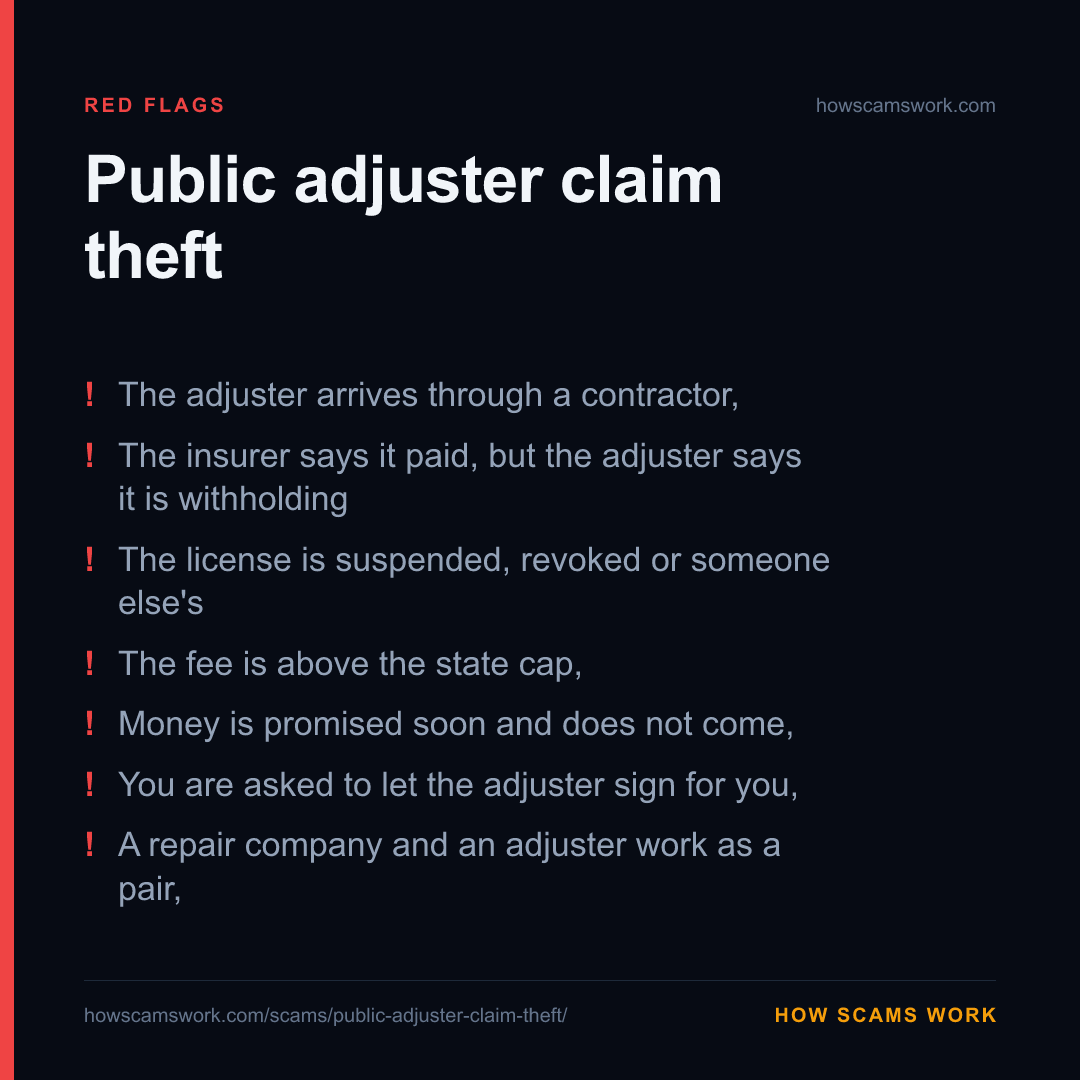
Red flags

  • The adjuster arrives through a contractor, as in the Georgia case, or asks that the insurer’s payment go to the adjuster’s account.
  • The insurer says it paid, but the adjuster says it is withholding. The insurer can state what it paid and when.
  • The license is suspended, revoked or someone else’s. Look the adjuster up with the state insurance department.
  • The fee is above the state cap, or is charged on a payment made before you signed. Florida caps it at 10 or 20 percent and bars a fee on earlier payments.
  • Money is promised soon and does not come, or a check to you bounces.
  • You are asked to let the adjuster sign for you, or to sign a check over.
  • A repair company and an adjuster work as a pair, and the repairs stall.

If it’s happening to you

  1. Ask your insurer, in writing, what it has paid on the claim, on what dates, in what amounts and to whom the checks were made out.
  2. Look up the adjuster’s license with your state insurance department, including any suspensions, and compare the license number on your contract with the person you are dealing with.
  3. Do not sign a check over or let anyone sign your name. In the Louisiana and Georgia cases, forged signatures were how the money was taken.
  4. Know your cancellation rights. In Florida a contract can be cancelled without penalty within 10 days, or within 30 days of the loss for a declared emergency. Other states differ.
  5. Report it to your state insurance department and its insurance fraud unit, and keep every contract, check image and message. See where to report for other countries.

Where the money goes

The documented money moves from the insurer to the adjuster, and then very little of it moves on. In Georgia the adjuster forwarded about a third of more than $6 million to the church. In the 2024 Florida case, according to an arrest affidavit, a $30,000 check to a homeowner was returned, out of $130,000 in insurer checks. In the charged 2026 Florida case, investigators say the money was depleted through online transfers, Zelle, wires, card purchases and cash withdrawals at casinos. In the California case it went to personal expenses and to other clients.

Recovery is partial. In Louisiana, almost $39,000 was forfeited against more than $200,000 taken from four victims. In California, $12,000 had been repaid and a further $52,311 ordered against more than $132,000 taken. In Maryland, $38,894 in restitution was ordered against $44,521. The federal court in Georgia ordered about $2.9 million and $1.1 million. The sources do not say how much has been collected.

The other half of this story

Our sibling site Clean on Paper explains how casino money laundering works. In the Florida case, investigators say casino withdrawals were how the settlement money was spent.

By the numbers

No published dataset breaks this scheme out as its own category yet, so there is no chart to show. The data page explains which agency categories exist and why some schemes are invisible in official statistics.

Sources

Every factual claim above traces to one of these. Statistics are reported losses; see methodology for what that does and does not measure.
  1. Public Adjuster, Already in Prison, Sentenced to Another 19 Years Concurrent. Insurance Journal (September 30, 2025). Accessed 2026-11-07. Supports: The 19-year federal sentence, the $2.9 million and $1.1 million in restitution, the Hurricane Michael church claim, the $183,208 first payment, the three checks totaling more than $6 million, the forged names, the one-third forwarded to the church and the withholding claim.
  2. Public Adjuster Pleads Guilty to Another Scam, This One on a Church in Georgia. Insurance Journal (March 31, 2025). Accessed 2026-11-07. Supports: The March 2025 guilty plea, the maximum penalty, the company names the adjuster was associated with and the Georgia non-resident license that expired in 2022.
  3. Public Adjuster Arrested for nearly $600,000 in Insurance Fraud; operated in the River Parishes. L'Observateur, from a Louisiana State Police release (January 13, 2023). Accessed 2026-11-07. Supports: The August 2022 referral from the Louisiana Department of Insurance, the seven victims in four parishes, settlement claims over $592,000 and the January 12, 2023 arrest.
  4. Texas man given 20-year sentence for Hurricane Ida fraud. L'Observateur, from a St. Charles Parish District Attorney's release (August 31, 2023). Accessed 2026-11-07. Supports: The guilty pleas, the 20-year sentence, more than $200,000 taken from four victims and the forfeiture of almost $39,000.
  5. Former Maryland Public Adjuster Sentenced for Theft, Insurance Fraud. Insurance Journal, from a Maryland Attorney General's Office release (December 16, 2021). Accessed 2026-11-07. Supports: The 2015 theft scheme against two homeowners, the $44,521 taken, the suspended sentence, the 60 days and the $38,894 in restitution.
  6. Former California Adjuster Hit With 180-day Sentence for Stealing $130K. Insurance Journal (September 20, 2019). Accessed 2026-11-07. Supports: The 180-day jail sentence, more than $132,000, the revoked license, the continued work under a spouse's license and the use of client money for other clients.
  7. Public Adjuster Accused of Swiping $600,000 in Hurricane Ian Insurance Payments. Claims Journal (April 6, 2026). Accessed 2026-11-07. Supports: The charges, the $611,473.39 owed to ten policyholders per a probable cause affidavit, the casino withdrawals, the license suspensions, the 10 percent contracts and the July 2024 arrest.
  8. Chief Financial Officer Blaise Ingoglia Announces Arrest of Public Adjuster After $703,000 Theft in Hurricane Ian Claims Funds. Florida Department of Financial Services, Office of the Chief Financial Officer (April 22, 2026). Accessed 2026-11-07. Supports: The arrest on March 30, 2026, the allegation of more than $703,000 belonging to 13 homeowners, the list of charges and the prosecuting office.
  9. Florida Statutes, section 626.854: Public adjuster defined; prohibitions. The Florida Senate (2024 statutes). Accessed 2026-11-07. Supports: The definition of a public adjuster, the fee caps of 10 and 20 percent and the cancellation rights.

Common questions

Is hiring a public adjuster a scam?

No. Public adjusters are licensed and regulated, and Florida's statute describes the job as preparing, filing or helping negotiate an insurance claim for a policyholder in return for money. The cases here are about licensed or formerly licensed adjusters who kept the settlement. This page is not advice on whether to hire one.

How much can a public adjuster charge?

It depends on the state. Florida's 2024 statute caps the fee at 10 percent of claim payments for claims arising from an event covered by a governor's emergency declaration during the year after the declaration, and 20 percent for other claims. It also bars a fee on payments the insurer made before the contract was signed. Check your own state's rule with its insurance department.

Can I cancel an adjuster's contract?

Under the Florida statute, an insured can cancel without penalty within 10 days of signing, or within 30 days after the date of loss if the claim arises from a governor-declared emergency, whichever is longer. Other states set their own rules, and this page does not give legal advice.

What if my adjuster says the insurer is withholding payment?

Ask the insurer, in writing, what it has paid on the claim, on what dates and to whom. In the Georgia case the court records, as reported, say the adjuster told church leaders the insurer was withholding complete payment, after the insurer had sent him three checks totaling more than $6 million.

Does a suspended or revoked license stop an adjuster working?

Not by itself. The California adjuster in the Schoon case kept acting after his license was revoked, using his wife's license and, on at least one occasion, a former colleague's license number, according to the report of the case. Check the current license status with the state insurance department before signing.

Who do I report a public adjuster to?

Report to your state's insurance department and its insurance fraud unit. Florida's financial services department takes reports at FraudFreeFlorida.com, and Louisiana State Police list an insurance fraud unit email address in the arrest release cited here. See where to report for other countries.

Where a settlement goes when the adjuster keeps itWhere a settlement goes when the adjuster keeps it. The insurer pays the adjuster, and the policyholder gets a share, or none. The sources do not say how much has been recovered. Where a settlement goes when the adjuster keeps itThe insurer pays the adjuster, and the policyholder gets a share, or none. The sources do not say how much has been recovered.The insurer that paidthe claimGeorgia: three checkstotaling more than $6million. Florida 2024case: checks totaling$130,000. Florida 2026case: $611,473.39 peran affidavit, or over$703,000 per thestate's financialofficerThe public adjusterand the account thechecks went intoGeorgia: about a thirdreached the church.Florida 2024 case: a$30,000 check returnedfor insufficientfunds. Louisiana: thepolice say the moneywas deposited and notpaid on. California:used for personalexpenses and to payother clientsThe homeowner orchurch the moneybelonged toReversibilityA recall is realistically possible only at the first hop, and only in the first hours. After the money is converted it becomes an investigation, not a refund.How casino money laundering works: Clean on Paper, our sibling sitehttps://cleanonpaper.com/techniques/casinos/Figures are from court and police reports, a state financial officer's release and a probable cause affidavit as quoted in the press, accessed 7 November 2026. The cases are separate and the flows are not one chain of payments. The Florida 2024 and 2026 cases are charges only, and the defendant is presumed innocent.howscamswork.com
Where the money goes after it leaves, and where it becomes hard to recover.

Report it

Reporting is what produces the enforcement data on this page. Find the right agency and phone number for your country on the report page. If money moved in the last few hours, call your bank first.