Also called: Section 8 fraud · Housing Choice Voucher fraud · HUD employee landlord fraud · public housing insider fraud · Section 8 self-dealing scheme
Section 8 insider fraud is when a HUD employee or local public housing authority official who administers the Housing Choice Voucher program secretly becomes a hidden landlord it pays, concealing ownership behind an alias, a relative's name, or a forged signature. Three federal cases since 2007 total more than $650,000 diverted, with sentences up to 66 months.
What it is
The Housing Choice Voucher program, still widely known as Section 8, pays a monthly rent subsidy on
behalf of a low-income, elderly or disabled household directly to the landlord of the unit they rent.
According to HUD’s own description, it is the federal government’s major program for providing this
kind of housing assistance, serving over 2.3 million American families. HUD funds it, but a local public
housing authority, a city or county agency, usually runs it day to day: approving applicants, inspecting
units and cutting the actual subsidy payments.
The scheme on this page is what happens when the person running that local process decides the subsidy
should land in their own pocket instead. In three documented federal cases since 2007, a HUD employee or
a local housing authority’s own senior staff member secretly became the landlord, or routed payments to
family members, while keeping their own name off the paperwork that would have disqualified them.
The common thread is not the dollar amount. It is who committed it. Every case documented here was
built and run by someone with inside authority over the exact program being defrauded, not an outside
applicant faking eligibility on a form.
How it actually works
A position of trust
The person at the center of each case either works for HUD itself or for the local public housing
authority that approves applicants, inspects units and issues Section 8 subsidy payments. That job gives
them direct, routine access to tenant files, landlord payment records and the program’s own rules.
The hidden landlord
Rather than simply steer benefits toward someone else, the employee becomes the landlord of record for
one or more voucher-holding units themselves, or has a relative do it. Chun Mei Tong, a former Honolulu
HUD employee, acted as property manager and landlord for five Section 8 rentals even though HUD employees
are barred from participating in the program and from the real estate business entirely.
The concealment
Ownership or control is hidden behind an alias, a relative’s name, or a forged signature, so the subsidy
payment appears, on paper, to be going to an independent landlord with no connection to the program’s own
staff. Tong used the alias “Debbie Kim.” Carla Carter, then deputy director of the Prince George’s County
Housing Authority in Maryland, had an employee change a property’s listed owner in the agency’s own
computer records from her name to her husband Raymond’s.
The redirected payment
The monthly Housing Choice Voucher subsidy, meant for an arm’s-length landlord, instead lands in a bank
account the insider or their family controls. Tong forged the signatures of the actual owners of three of
her five properties specifically so that the HUD payments due to them went straight to her own company’s
account instead.
The paper trail that holds it together
A required financial disclosure, ethics filing or ownership record is falsified to keep outside auditors
from connecting the insider to the properties receiving payment. Carter twice submitted a financial
disclosure statement to the county’s Board of Ethics that did not list her ownership of the properties.
Where it could have stopped
A financial disclosure or conflict-of-interest filing exists specifically to catch an employee who has a financial stake in the program they administer. Carter’s case shows the filing being falsified, not simply skipped, which means the control existed and was defeated on paper rather than never applied. A disclosure cross-checked against the agency’s own landlord-payment list, rather than taken on trust, is the single point where several of these schemes could have ended years earlier than they did.
The scheme widens
Once an insider controls approvals or payment records, the arrangement tends to grow rather than stay
contained to one unit. Lorena Loren, executive director of the St. Clair Housing Commission in Michigan,
entered into Section 8 contracts that, over an eight-year span, benefited nearly her entire immediate
family: her husband, her son and her son’s wife each later admitted receiving diverted funds.
The audit, the tip, or the trial testimony
Every documented case here was caught from outside the insider’s own chain of command. Tong’s case
followed a HUD Office of Inspector General investigation; the Loren family’s case also involved HUD-OIG
and the FBI. None of the three cases on this page describes an automated payment check catching the
diversion.
The prosecution, years after the money is spent
Federal wire fraud, aggravated identity theft, and federal program fraud charges follow, with sentences
and restitution calculated years after the scheme began. Tong was sentenced to 66 months; Loren to 37
months, with her husband, son and daughter-in-law later sentenced to 9, 11 and 11 months respectively.
Why it works
The job itself is the cover story. An employee who inspects units, approves landlords and signs off on
payments has a legitimate, everyday reason to be close to exactly the records a fraud like this needs
touched, which makes the self-dealing look, to a casual check, like ordinary work.
A program run locally by thousands of small agencies is hard to audit centrally. HUD funds the
Housing Choice Voucher program nationally, but day-to-day administration sits with local public housing
authorities. A conflict of interest at one local agency is the kind of thing a national-level HUD review
is unlikely to surface on its own.
An alias or a relative’s name defeats the one check most likely to catch it. A basic cross-reference
of “does any landlord of record share a name with program staff” fails completely once the landlord of
record is someone else’s name, forged or borrowed, rather than the employee’s own.
Family involvement spreads the paper trail across several people who each have a plausible, independent
reason to receive money. A spouse, an adult child, or a child’s spouse each can point to some ordinary
connection to the household, which is harder to flag automatically than a single employee paying
themselves directly.
And the per-transaction amounts look routine. A monthly Section 8 subsidy payment is an expected,
recurring line item for any landlord in the program. It does not look unusual on its own; it only becomes
a fraud when matched against who the landlord actually is.
Where it comes from
Entirely domestic, and carried out inside the exact government structure meant to prevent it, not a
separate criminal underworld.
Every documented case on this page is a US public employee defrauding a US federal housing program.
Tong worked at HUD’s own Honolulu field office. Carter was deputy director of a county housing authority
in Maryland. Loren was executive director of a county housing commission in Michigan. None of the three
cases involves an overseas call center, a cryptocurrency payment, or a cross-border wire.
The program’s federal funding and local administration create the exact gap this scheme exploits. HUD
sets the Housing Choice Voucher program’s rules and pays for it, but a local public housing authority runs
the application, inspection and payment process day to day, which is also where an insider with a
financial motive sits.
Enforcement is federal and criminal, not civil. Unlike some of the purchase-side schemes on this site,
every case documented here was prosecuted as a federal crime, wire fraud, aggravated identity theft, or
federal program fraud, rather than resolved through a civil settlement.
Real cases
2023 US Sentenced $336,340
Lorena Loren, executive director of the St. Clair Housing Commission in Michigan, entered into Section 8 Housing Choice Voucher contracts between August 2008 and August 2016 that benefited nearly her entire immediate family, falsely claiming relatives owned rental properties that belonged to others and issuing subsidy payments to them, while also misusing the commission's credit cards and petty cash for personal purchases. She was sentenced in March 2018 to 37 months in prison. Her husband Brian, her son Ryan and her son's wife Kayla each later pleaded guilty to receiving the diverted funds and were sentenced in January 2023 to 9, 11 and 11 months respectively. Total restitution across the prosecutions comes to about $336,000, reported as $336,240.62 in 2018 coverage of Lorena's own sentencing and as $336,340.22 in 2022 and 2023 coverage of the rest of the family's pleas and sentences.
Read the case file ·
3 sources
2020 US Sentenced $207,000
Chun Mei Tong worked at HUD's Honolulu field office from 2005 until she resigned in November 2015, a job that barred her from participating in the Housing Choice Voucher program and from the real estate business entirely. From 2014 to 2019 she used the alias "Debbie Kim" to act as property manager and landlord for five Oahu properties rented to Section 8 voucher holders anyway, forging the signatures of the actual owners of three of them so that HUD's rent payments went straight to her own company's bank account. A federal jury convicted her on five counts of wire fraud and three counts of aggravated identity theft after a trial in August and September 2019. She was sentenced in January 2020 to 66 months in prison and ordered to forfeit approximately $207,000.
Read the case file ·
2 sources
2015 US Convicted $112,000
Carla Carter, deputy director of the Prince George's County Housing Authority in Maryland, and her husband Raymond owned rental properties registered in HUD's Section 8 Housing Choice Voucher Program while concealing her role as landlord. From October 2007 through December 2012, the couple funneled about $112,000 in rental subsidy payments into bank accounts they controlled, using a co-conspirator listed as the owner of record and false financial disclosure statements filed with the county's own ethics board to keep Carla's ownership hidden. A federal jury convicted both Carters on October 2, 2015 of conspiracy to commit wire fraud, 13 counts of wire fraud, and conspiracy to commit money laundering.
Read the case file ·
2 sources
Red flags
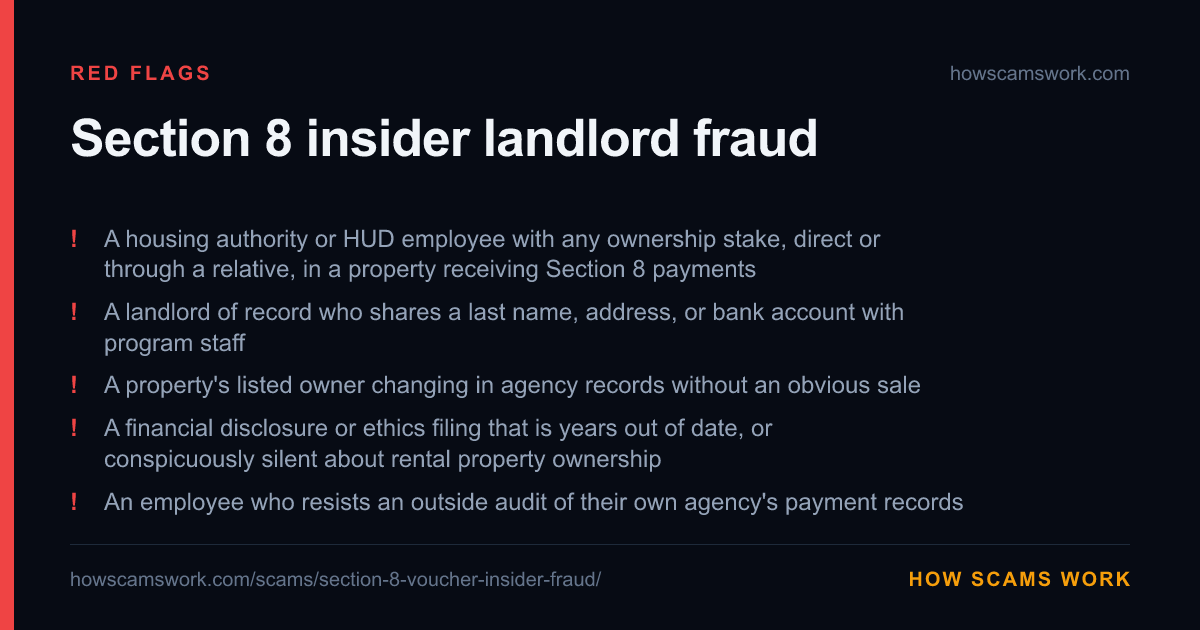
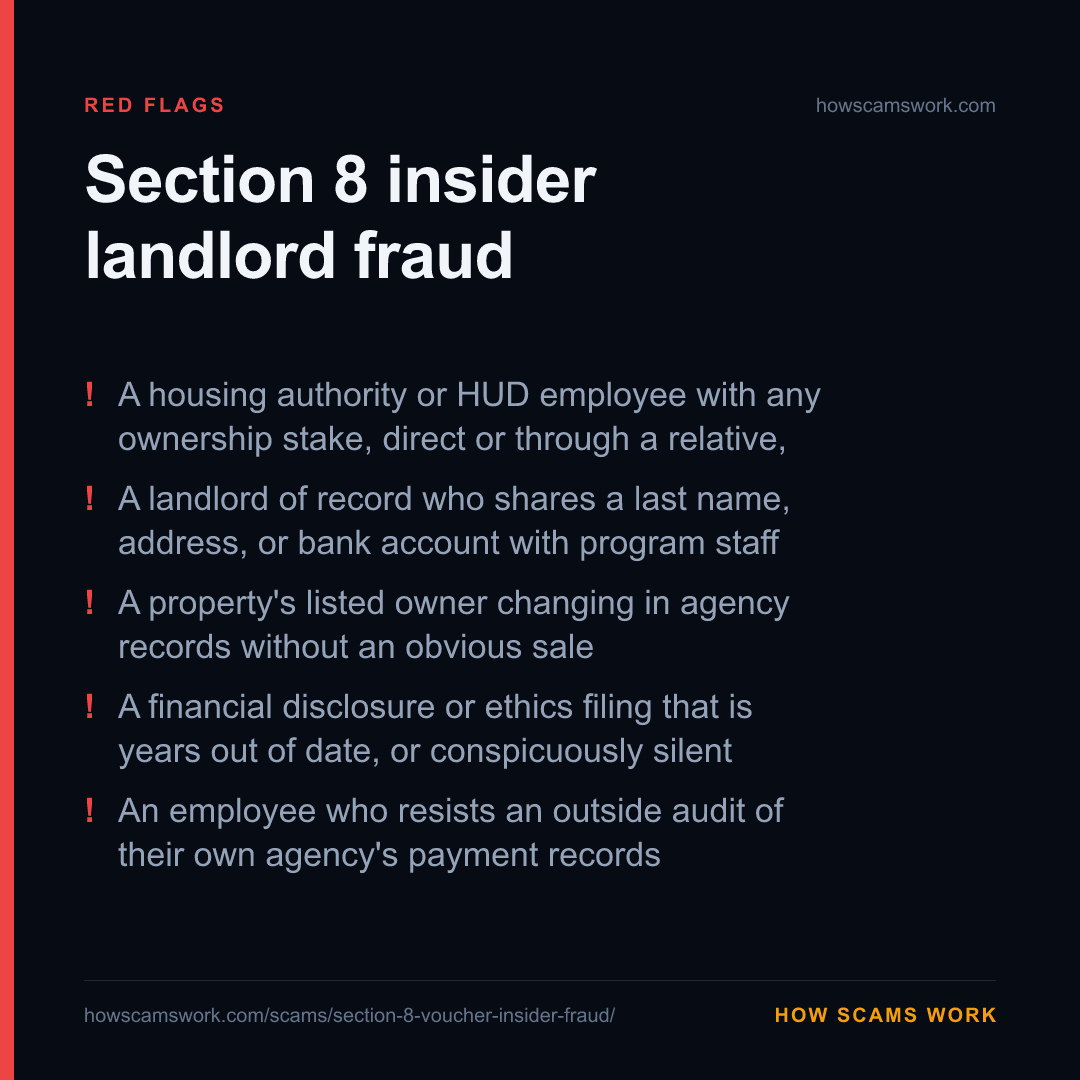
- A housing authority or HUD employee with any ownership stake, direct or through a relative, in a property receiving Section 8 payments. This is exactly the conflict every documented case here hid rather than disclosed.
- A landlord of record who shares a last name, address, or bank account with program staff. A shared joint bank account was the specific mechanism in the Loren family case.
- A property’s listed owner changing in agency records without an obvious sale. Carter’s case involved exactly this kind of record change.
- A financial disclosure or ethics filing that is years out of date, or conspicuously silent about rental property ownership. Both Carter disclosures on file omitted her ownership entirely.
- An employee who resists an outside audit of their own agency’s payment records, or who has unusual influence over which landlord applications get approved and how quickly.
If it’s happening to you
- If you suspect a housing authority employee has a financial stake in a voucher payment, report it to
HUD’s Office of Inspector General, which investigated two of the three cases documented on this page,
rather than only the local agency where the employee works.
- Ask for the landlord of record’s name and compare it against the property’s actual ownership
records, available through most county recorder or assessor offices, if something about a unit’s
paperwork looks inconsistent.
- If you are a genuine landlord and suspect your signature was used without your knowledge, as
happened to three property owners in the Tong case, request your own payment history directly from the
housing authority rather than relying on a property manager’s account of it.
- Report suspected fraud to HUD-OIG at 1-800-347-3735 or oig.hud.gov, and to the FTC at
ReportFraud.ftc.gov. See where to report for other countries.
- Keep your own copies of lease agreements, inspection reports and payment confirmations. Every case
on this page took years to surface; a tenant’s or a genuine landlord’s own paper trail can matter long
after the fact.
Where the money goes
Straight from a government subsidy account into an insider’s own household, with no overseas leg and
usually no stranger in the chain at all.
The money moves from the program to the insider in one step. A Housing Choice Voucher subsidy that
should go to an arm’s-length landlord instead lands directly in an account the employee, or a relative
acting on their behalf, controls, sometimes after a forged signature makes the payment look routine on its
face.
A relative’s name, not a stranger’s, is usually the closest thing to a second link in the chain.
Rather than laundering proceeds through an unrelated third party, the Loren family routed payments through
a joint bank account and relied on family members to receive and hold the money, which is also why the
case eventually spread across four defendants rather than staying contained to one.
Restitution, when ordered, is calculated years after the money is already spent. Tong’s roughly
$207,000 was ordered returned as a forfeiture money judgment at sentencing, in 2020, for a scheme that ran
from 2014 to 2019. Total restitution recorded across the Loren prosecutions comes to about $336,000, though
the two source articles differ on the exact last three digits ($336,240.62 in 2018 reporting, $336,340.22
in 2022 and 2023 reporting), for a scheme that ran from 2008 to 2016.
By the numbers
No published dataset breaks this scheme out as its own category yet, so there is no chart to show.
The data page explains which agency categories exist and why some schemes are
invisible in official statistics.
Every factual claim above traces to one of these. Statistics are reported losses; see
methodology for what that does and does not measure.