Also called: toxicology lab fraud · urinalysis billing fraud · medically unnecessary drug testing · standing order drug test fraud
Urine drug testing lab fraud is billing insurers for drug tests that were not medically necessary, with the specimens and orders obtained through payments or arrangements with sober homes, clinics and doctors. A Florida physician tied to more than 50 facilities was sentenced to 20 years after health plans were billed over $746 million.
What it is
A urine drug test is an ordinary laboratory service. The HHS Office of Inspector General describes drug testing as
generally used to detect drugs in patients being treated for pain or for a substance use disorder. Medicare and
Medicaid pay for it when it is medically necessary, and Medicare pays more as more drug classes are tested.
This scheme turns that into a billing machine. A lab, or a doctor working with a lab, arranges to receive urine samples
from people who have no medical need to be tested, for example residents of a sober home, people sent by a court,
or patients of a treatment center. The lab then bills Medicare, Medicaid or a private plan. In three of the four cases on
this page the Justice Department said the tests were not medically necessary; the fourth was a prosecution for
paying and taking kickbacks for referrals. In several, someone was paid for sending the tests.
The victims are mostly payers, not the person who gives the sample. This page says so plainly because the
sources describe the residents’ role (they were tested, sometimes as a condition of living somewhere) but not
individual harm to them.
How it actually works
A test that is paid for by the panel
Medicare payments for definitive drug testing increase with the number of drug classes tested, according to the
OIG. The code for 22 or more drug classes pays the most. Payers cover the tests only when they are medically
necessary.
The lab finds a source of specimens
In Kentucky, the Justice Department said the lab’s compliance officer solicited urine tests from recovery
programs that did not provide medical treatment, typically faith-based residential programs or homeless
shelters, and recruited a company to refer court-ordered tests. In Florida, the facilities were sober homes and
treatment centers.
The source is paid, or arranged with
The Kentucky lab put facility staff on its payroll and paid them by the number of tests sent. In Washington, labs
paid a physician-owned lab kickbacks of more than $3.7 million, described as marketing fees, for referrals of
Medicare and TRICARE tests. In Florida, treatment centers required patients to visit one doctor’s clinic in exchange for his
authorization of the tests.
Where it could have stopped
Paying for referrals of Medicare or TRICARE business violates the federal Anti-Kickback Statute, whether or not the tests were needed. In the Washington case the payments were called marketing fees and, the U.S. Attorney’s Office said, no marketing services were performed.
A doctor’s name on a standing order
The Justice Department said a Palm Beach County physician served as medical director or authorizing physician for over 50
sober homes, treatment facilities and testing labs and often signed standing orders for expensive urine drug
tests that were not medically necessary.
The same people are tested again and again
Evidence at a 2022 Florida trial, the Justice Department said, showed that residents of one sober home had to give
urine samples as a condition of residency, about three or four times a week. That meant hundreds of tests a week
and thousands a month.
The bill goes to the payer
The Justice Department said the Florida labs billed health plans often thousands of dollars for a single test, and
that tests at one sober home cost as much as $6,000 to $9,000 each. In the Palm Beach County case, plans were
billed over $746 million from 2011 to 2020 and paid approximately $127 million.
Enforcement arrives after the money has moved
The Kentucky lab billed from June 2019 to March 2021, and its owner was sentenced in December 2023. The
Florida sober home billed from September 2011 to December 2015, was indicted in June 2018 and reached a jury
verdict in February 2022. The Palm Beach County physician was sentenced in January 2023.
Why it works
The payment depends on the panel. Because Medicare pays more as more drug classes are tested, a lab
that routinely bills the largest panel is paid more per sample. The OIG found 1,062 providers that billed the highest-paying
code for at least 75 percent of their definitive tests, and that they appeared to have similar patients and testing
frequency as providers that did not.
A physician’s order makes the test look medical. A standing order lets a lab test every resident of a
facility without a new decision each time. The Justice Department said the Palm Beach County physician signed such orders for
over 50 facilities.
The person who controls the specimens is the one being paid. In Kentucky, facility staff were paid by the
number of tests they sent. In Washington, the referral payments were dressed as marketing fees.
The tested person has little say. The Justice Department said residents of the Florida sober home were required to
give samples as a condition of residency, and the Kentucky lab billed tests that courts, not clinicians, had ordered.
Enforcement is slow. The Florida sober home’s billing ran from 2011 to 2015, the indictment came in 2018 and the
trial in 2022. The medical director’s conviction was later followed by an order for a new trial, with the retrial
set for January 2027.
Where it comes from
A US scheme, documented here in Florida, Kentucky and Washington State. The Justice Department’s Criminal Division
Fraud Section and the U.S. Attorneys’ Offices for the Southern District of Florida and the Central District of
California lead its Sober Homes Initiative, begun in September 2020. By January 2023 it had produced charges, guilty
pleas or convictions for 28 defendants in those two districts, connected to over $1 billion in alleged false billings
for fraudulent tests and treatments.
Scale ranges widely. The Kentucky lab’s false payments came to about $3.5 million, the Washington case to
more than $6.5 million in government payments, the Florida sober home’s claims to $106 million and the Palm Beach
County case to over $746 million billed.
The payers differ. The Kentucky and Washington cases involved Medicare, Medicaid and TRICARE. The Florida cases
involved private plans, including employer-sponsored and union benefit plans, as well as federal programs.
Cases are from the 2010s. The conduct documented here ran from 2011 to 2021. This page does not claim to measure
current volume.
Real cases
2023 US Sentenced $3.5m
LabTox, LLC, of Lexington, Kentucky, billed Medicare and Kentucky Medicaid for urine drug tests that the programs do not pay for: tests ordered by courts, and tests from sober homes and shelters that were not done for any medical reason. The owner and the lab's compliance officer pleaded guilty in September 2023. In December 2023 they were sentenced to 46 months and 6 months, and in February 2024 they and the lab agreed to civil judgments totaling $10,458,933.
Read the case file ·
2 sources
2023 US Sentenced $127.0m
A Delray Beach, Florida physician served as medical director or authorizing physician for over 50 sober homes, treatment facilities and clinical testing laboratories in Palm Beach County and often signed standing orders for expensive urine drug tests that were not medically necessary. The Justice Department said that from 2011 to 2020 health care benefit programs were billed over $746 million and paid approximately $127 million for fraudulent urine drug tests and addiction treatments. He pleaded guilty in October 2022 and was sentenced on January 9, 2023.
Read the case file ·
1 source
2023 US Sentenced
Northwest Physicians Laboratory of Bellevue, Washington, was physician-owned and, the U.S. Attorney's Office said, could not test urine samples for patients covered by Medicare, Medicaid or TRICARE. Between January 2013 and July 2015 two other labs paid it more than $3.7 million in kickbacks, described as marketing fees, for referrals of Medicare and TRICARE business, resulting in government payments to those two labs of more than $6.5 million. A co-owner was convicted in March 2022 and sentenced on January 10, 2023 to two years.
Read the case file ·
2 sources
2022 US Sentenced
Good Decisions Sober Living, a West Palm Beach sober home, was at the center of a conspiracy to bill health plans for urine drug tests that were not medically necessary. The Labor Department said false claims of $106 million went to more than 80 private insurers and federal programs between September 2011 and December 2015, and the Justice Department's trial release put the billing at approximately $110 million. The owner and two employees pleaded guilty and were sentenced in April 2022. The medical director's 2022 conviction was followed in January 2025 by an order for a new trial, set for January 2027, so he is presumed innocent.
Read the case file ·
3 sources
Red flags
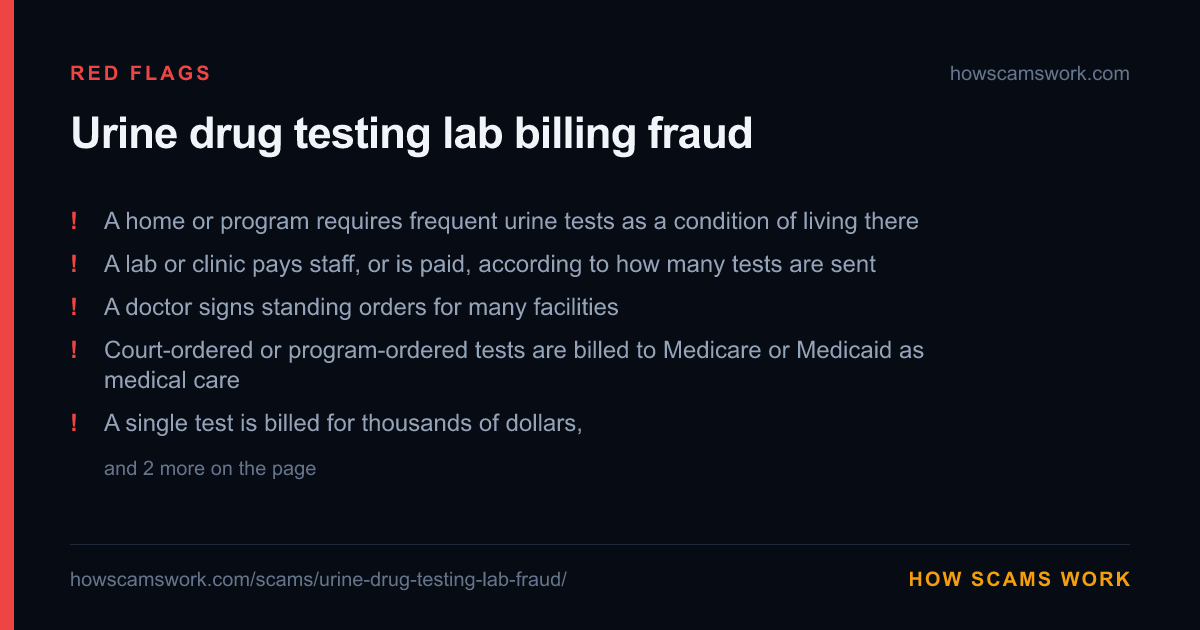
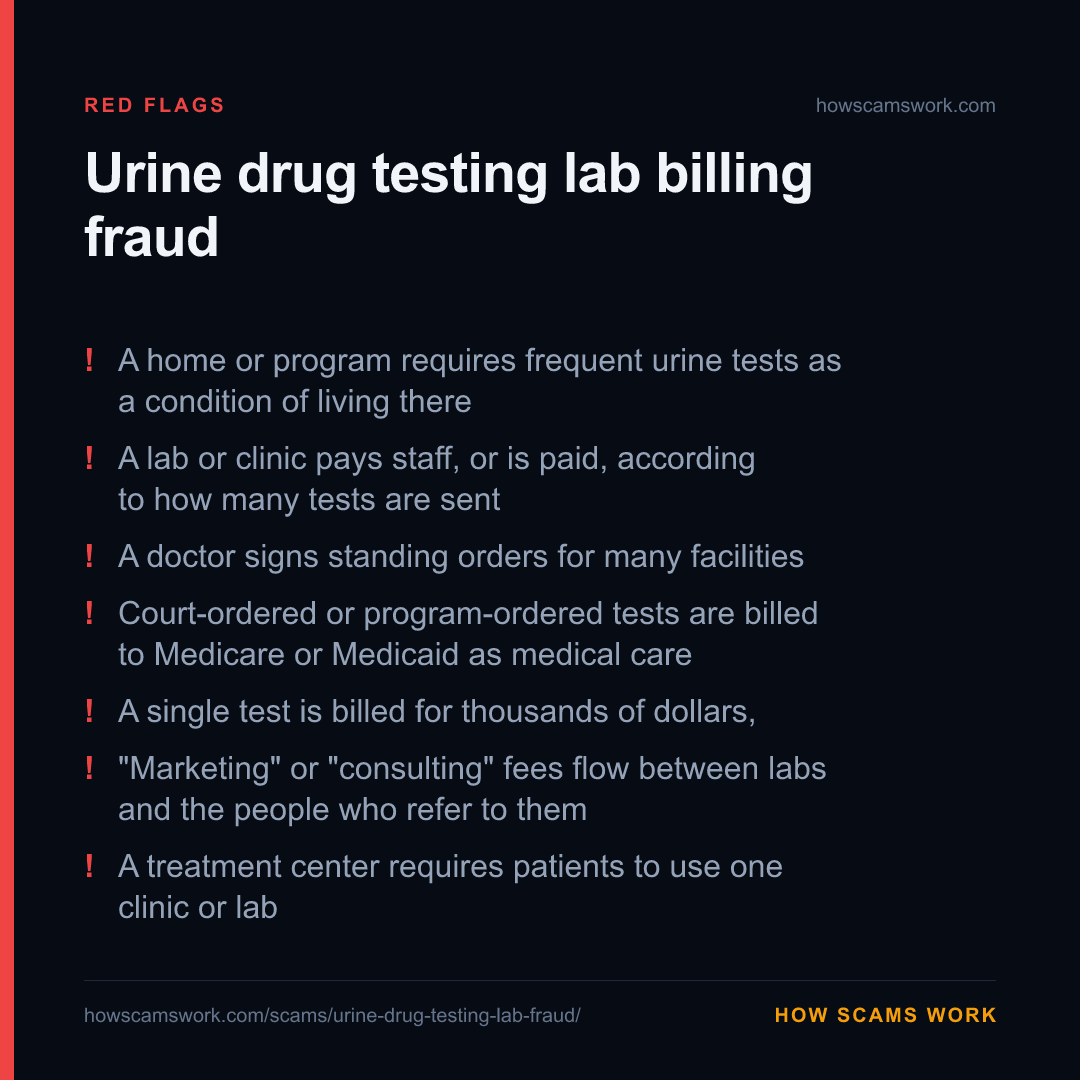
- A home or program requires frequent urine tests as a condition of living there. The Justice Department said one Florida sober home required them about three or four times a week.
- A lab or clinic pays staff, or is paid, according to how many tests are sent. The Kentucky lab paid facility staff by the number of tests.
- A doctor signs standing orders for many facilities. The Justice Department said one Palm Beach County physician did so for over 50.
- Court-ordered or program-ordered tests are billed to Medicare or Medicaid as medical care.
- A single test is billed for thousands of dollars, as in the Florida cases.
- “Marketing” or “consulting” fees flow between labs and the people who refer to them.
- A treatment center requires patients to use one clinic or lab in exchange for a doctor’s authorization.
If it’s happening to you
- Ask for an itemized statement from your insurer or benefit plan if a urine drug test appears that you do not
remember. Ask your treating clinician whether they ordered it.
- Do not confront the home, clinic or lab. These cases took years of investigation: the Florida sober home’s
billing ended in 2015 and its indictment came in 2018.
- Report it to your insurer’s fraud unit, to the HHS Office of Inspector General at 1-800-HHS-TIPS
(1-800-447-8477) or TIPS.HHS.GOV, or to your state Medicaid Fraud Control Unit. If it involves an employer
or union plan, the Department of Labor’s Employee Benefits Security Administration investigated the Good
Decisions Sober Living case. See where to report for other countries.
- Keep records: dates, intake paperwork, anything stating that testing was required, and the statements you
received.
- If you are choosing a sober home or program, ask whether testing is a condition of living there, who orders
it, and whether the home receives any payment tied to tests or referrals.
Where the money goes
Payers send money to the lab for each claim. The sources document where some of it went: payroll for facility
staff in Kentucky, “marketing” fees in Washington, a monthly fee for standing orders in Florida, and the owners’ own
income.
The Kentucky lab’s owner earned more than $1.5 million a year from it between 2017 and 2021, according to his plea, and
placed the business in his partner’s name; he owed $3,566,645 in income tax. In Washington, the sentencing memo said
a co-owner’s monthly distributions grew from $10,000 in 2013 to $50,000 in 2015.
Recovery comes by court order and settlement, years later: $10,458,933 in agreed civil judgments in Kentucky,
$8,114,417 in restitution in Washington, $31,041,938 in restitution in the Florida sober home case, and more than
$14 million paid to settle civil allegations in Washington. The sources do not say how much of these court-ordered
amounts has been collected.
By the numbers
No published dataset breaks this scheme out as its own category yet, so there is no chart to show.
The data page explains which agency categories exist and why some schemes are
invisible in official statistics.
Every factual claim above traces to one of these. Statistics are reported losses; see
methodology for what that does and does not measure.