Also called: fake ashes scam · cremation fraud · body brokering fraud · corpse abuse fraud · body donation fraud
Funeral home and body broker fraud happens when a business that holds the dead breaks the promise it made to the family. In the cases here, bodies promised a cremation were sold, left in storage or replaced with fake ashes, and donated bodies were diverted for resale. Four US cases brought sentences of 8 to 40 years.
What it is
A funeral home, a crematory or a morgue holds something no customer can inspect: the body of someone who has died. This scheme is the abuse of that trust. The family is promised a cremation and the return of ashes, or is promised that a donation will be used in a particular way, and what happens in the back of the building is something else.
The cases here are convictions, and they come in two kinds. In two of them, funeral home operators were said to have taken the money for a cremation and then sold the bodies, or left them in storage and handed over something that was not ashes. In the other two, remains that had been entrusted to a body supplier or a medical school were diverted into a resale market. This page does not say how common any of it is. It describes what the courts and prosecutors found, and it leaves out the graphic detail that the reports contain.
How it actually works
A family at its lowest point chooses a cremation or a donation
Prosecutors in Colorado said the Sunset Mesa funeral home met families seeking cremation for themselves or relatives who had died, and Reuters reported it offered some a free cremation in exchange for a body donation. The Return to Nature funeral home charged more than $1,200 per customer, according to prosecutors.
The promise is narrow and specific
The U.S. Attorney’s Office said Sunset Mesa told families it would cremate the dead and give back the remains. Where families agreed to a donation at all, it was often limited to small tissue samples, tumors or portions of skin.
What was promised is not what happens
In Colorado, prosecutors said the Sunset Mesa operators took body parts or whole bodies for sale, in many cases without asking the family and in some after the family had specifically refused. At Return to Nature, authorities said 189 bodies were stored in a building in Penrose from 2019 to 2023.
Where it could have stopped
The families in these cases could not see this stage. What changed afterwards was oversight: Colorado, which had not regulated funeral homes, adopted routine inspections and licensing of funeral directors after the Return to Nature case. A reasonable precaution is to ask in writing who will perform a cremation and where, and to check the provider’s license with your state regulator. These cases do not prove that would have caught the fraud.
An urn is handed over
Authorities believe the Return to Nature families were given dry concrete that resembled ashes, and in two cases the wrong body was buried. The U.S. Attorney’s Office said Sunset Mesa also delivered ashes represented as the deceased’s that frequently were not, and prosecutors said more than 200 families received ashes mixed from different people.
The remains reach a market
The Sunset Mesa operators sold remains to body broker services, and prosecutors said buyers, including surgical-training companies, did not know they were obtained fraudulently. At Harvard, prosecutors said the morgue manager sold organs, skin and other parts to collectors found online, including two dissected faces for $600 in one sale.
The U.S. Attorney’s Office said Sunset Mesa shipped remains that tested positive for, or came from people who died of, hepatitis B and C and HIV after certifying to buyers that they were disease free. The Michigan broker was convicted of supplying parts to medical associations without disclosing that they came from people with infections. No illness was reported in his case.
Discovery comes by investigation, not by families
A Reuters series from 2016 to 2018 led to the FBI raid on Sunset Mesa in 2018. In Michigan, an FBI agent described at trial a 2014 raid on the broker’s Detroit warehouse. Neighbors’ complaints of a foul odor in 2023 led to the Return to Nature bodies, and the Harvard morgue manager was arrested in 2023. Sentences followed, from 8 years to 40.
Why it works
The product cannot be checked. A family receives an urn and has no means of testing it. Authorities believe the Return to Nature families were given dry concrete that resembled ashes, and families learned only when bodies were found, in some cases years later.
The customer is grieving and does not shop around. Prosecutors described the Sunset Mesa victims as people at their lowest point after the loss of a loved one.
Oversight was thin. Colorado had been the only state that did not regulate funeral homes, according to the Associated Press, and the Associated Press quoted a prosecutor in the Michigan case calling body brokering “lightly regulated”. Reuters reported that selling parts for research or education is not regulated by federal law.
The harm is hidden by the business itself. The funeral home is the party that is supposed to be the check. In the Harvard case the person who took the remains was the morgue manager.
There is a buyer. Sunset Mesa’s remains were sold to body broker services and Harvard’s to collectors who resold them, so the diversion had a customer and a price.
Where it comes from
A United States scheme in the cases found here, with the earliest period in the Sunset Mesa plea, 2010 to 2018. Cases from 2018 to 2026 are on this page: a Michigan broker raided in 2014, convicted and sentenced in 2018, the Colorado funeral homes and a Harvard morgue manager sentenced in 2023, 2025 and 2026.
The loss per family was small. The harm was not measured in dollars. Reuters reported Sunset Mesa charged up to $1,000 for cremations that never occurred, and prosecutors said Return to Nature charged more than $1,200 per customer. The $130,000 that Carie Hallford was said to take from families is the only total, and prosecutors said the Hallfords also cheated the government out of nearly $900,000 in pandemic aid. The money is secondary to what the families describe: the discovery that the ashes they scattered or kept were not their relative’s.
What this page could not find. It did not read the court records, the U.S. Attorney’s Office releases for Sunset Mesa or the Michigan case (one was behind a bot check), or any state regulator’s guidance. The red flags below come from the cases.
Real cases
2025 US Sentenced $130,000
Jon and Carie Hallford, who ran the Return to Nature Funeral Home in Colorado Springs, each pleaded guilty to federal wire fraud conspiracy and to state corpse abuse charges. Authorities said the couple stored 189 bodies in a building in Penrose from 2019 to 2023 while giving families fake ashes, and took $130,000 from families. Jon Hallford was sentenced to 20 years federally (June 2025) and 40 years in state court (February 2026). Carie Hallford was sentenced to 18 years federally (March 2026) and 30 years in state court (April 2026).
Read the case file ·
4 sources
2025 US Sentenced
On December 16, 2025 a federal judge in Pennsylvania sentenced Cedric Lodge, 58, the former Harvard Medical School morgue manager, to eight years (96 months), and his wife Denise Lodge, 65, to a year and a day. Each had pleaded guilty to one count of interstate transport of stolen goods. Prosecutors said that from 2018 through at least March 2020 he took organs, brains, skin, hands, faces and dissected heads of donated bodies without the knowledge of the school, the donor or the family, and sold them to buyers who often resold them.
Read the case file ·
2 sources
2023 US Sentenced
On January 3, 2023 a federal judge in Colorado sentenced Megan Hess to 20 years and her mother, Shirley Koch, to 15 years in prison. Both had pleaded guilty to one count of mail fraud and aiding and abetting. The U.S. Attorney's Office said that from 2010 through 2018, under the name of Sunset Mesa Funeral Directors in Montrose, they told families they would cremate their relatives and return the ashes, and instead took body parts or whole bodies for sale through body broker services, often without any authorization.
Read the case file ·
2 sources
2018 US Sentenced
On May 22, 2018 Arthur Rathburn of Grosse Pointe Park, Michigan, 64, was sentenced to 108 months (nine years) in federal prison. A jury had convicted him in January of crimes including fraud and illegally transporting hazardous material. Investigators said he supplied body parts to medical associations for training seminars without telling them they came from people with hepatitis B, HIV or other infections. Families whose relatives' bodies went to the Biological Resource Center, which supplied him, sued, saying they had not known of the arrangement.
Read the case file ·
2 sources
Red flags
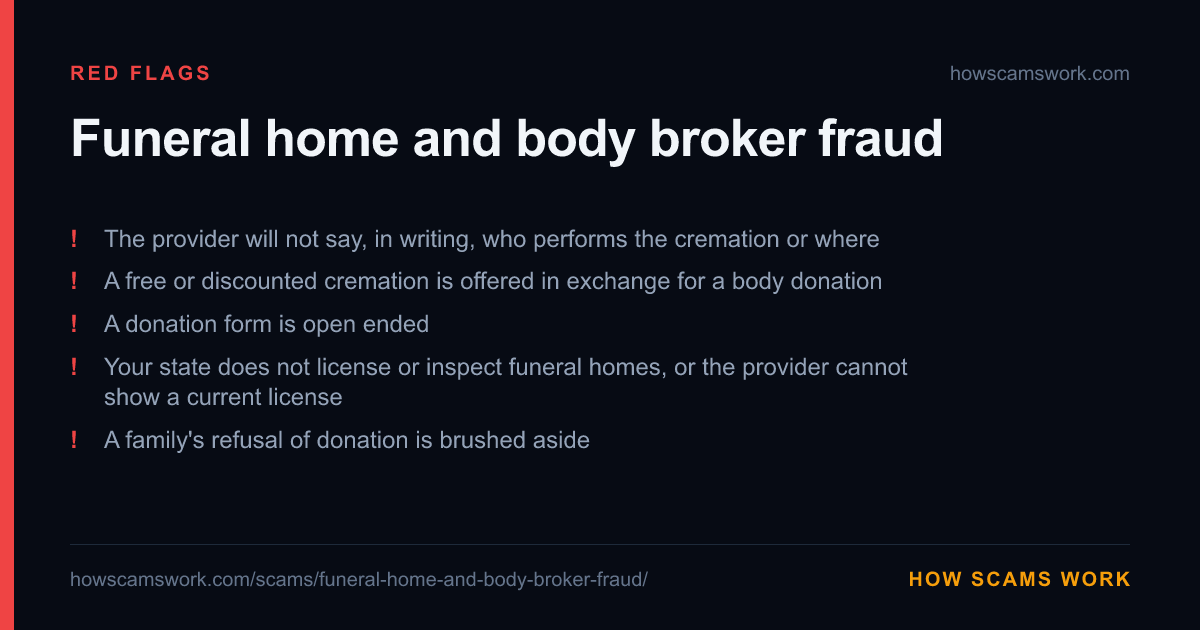
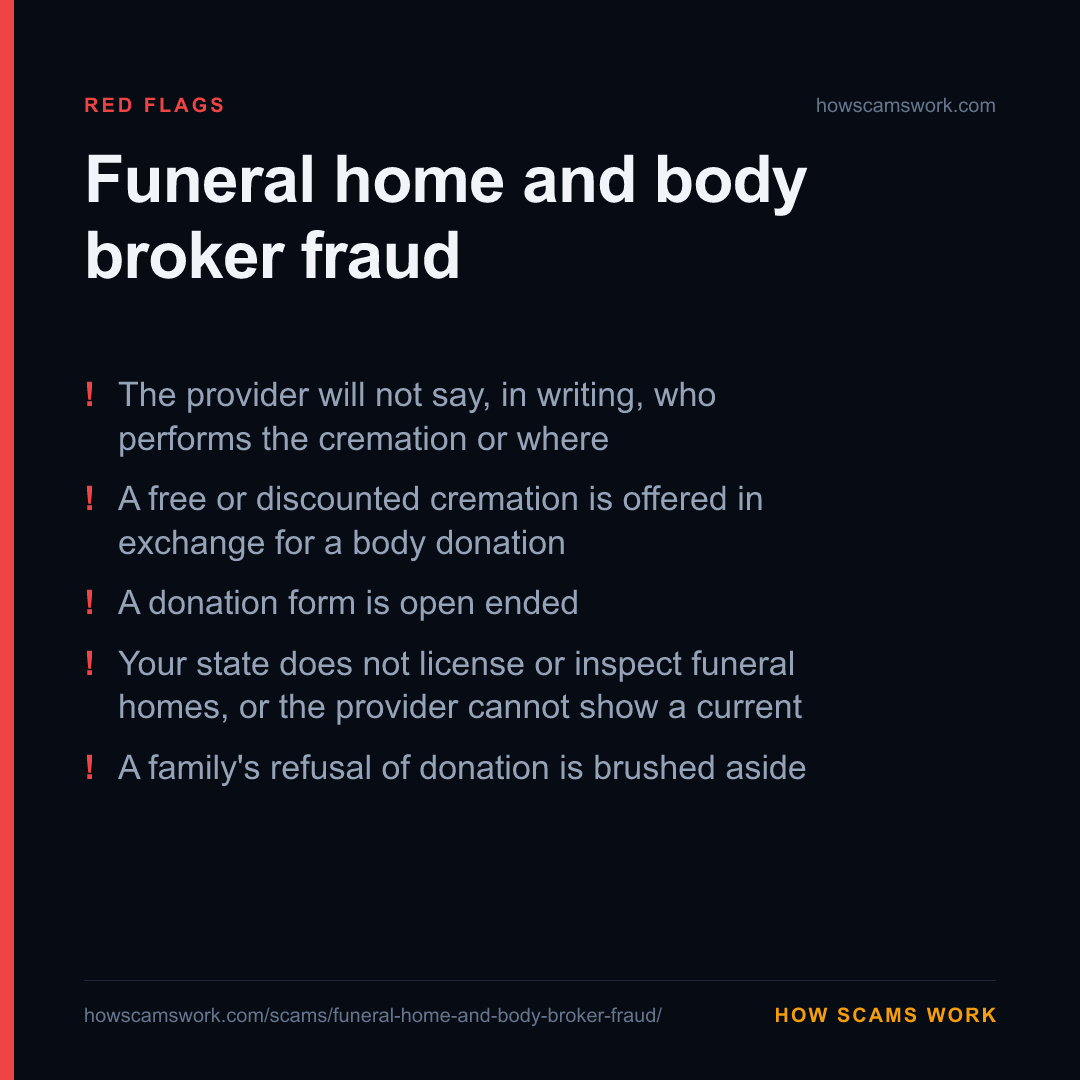
- The provider will not say, in writing, who performs the cremation or where. Sunset Mesa and Return to Nature were funeral homes, and the cremations were the part families did not see.
- A free or discounted cremation is offered in exchange for a body donation. Reuters reported Sunset Mesa made that offer to some families.
- A donation form is open ended. The U.S. Attorney’s Office said Sunset Mesa’s agreed donations were often limited to small samples and the remains sold went beyond them.
- Your state does not license or inspect funeral homes, or the provider cannot show a current license. Colorado had no such system until after the Return to Nature case.
- A family’s refusal of donation is brushed aside. The office said that in some cases a family specifically rejected donation and the remains were taken anyway.
Most of what went wrong in these cases was out of sight. The Harvard families gave a body to a school in good faith, and nothing a family did would have caught it.
If it’s happening to you
If you think a relative’s remains were mishandled or the ashes are not real:
- Keep every document: the contract, the cremation authorization, the receipts and any certificate or identification that came with the ashes.
- Contact your state’s funeral or cemetery regulator and the state attorney general’s consumer protection office. Ask whether the provider is licensed and whether there are other complaints.
- Report it to the police, and to the FBI if you believe remains were stolen or sold, and say how the remains were handled. In the cases here it was investigators, not families, who found what happened.
- Look for support. Families in these cases described nightmares and guilt long after the discovery, and a grief counselor or your doctor can help.
- Report it through your local authorities. See where to report for other countries.
Where the money goes
The documented money moves from the family to the business as a cremation fee, up to $1,000 at Sunset Mesa and more than $1,200 per customer at Return to Nature. In Colorado, prosecutors said the Hallfords spent money on luxury goods that would have covered the cost of cremating all of the bodies many times over, and court documents listed a GMC Yukon and an Infiniti worth over $120,000 combined and $31,000 in cryptocurrency. Remains were also sold: prosecutors estimated the Harvard couple earned $40,000 to $95,000 over at least four years.
By the numbers
No published dataset breaks this scheme out as its own category yet, so there is no chart to show.
The data page explains which agency categories exist and why some schemes are
invisible in official statistics.
Every factual claim above traces to one of these. Statistics are reported losses; see
methodology for what that does and does not measure.
Common questions
Is it common for funeral homes to do this?
This page cannot say. The four cases here are criminal prosecutions, from 2018 to 2026, and they describe individual businesses and one medical school employee, not the industry.
How can a family tell if the ashes are real?
In the cases here, families could not tell. Authorities believe the Return to Nature ashes were dry concrete that resembled ashes, and families only learned when bodies were found. The 2023 Sunset Mesa sentencing described ashes mixed from different people's remains. A family cannot test ashes on its own, which is why the cases turned on investigations rather than on families spotting a problem.
Is selling body parts illegal?
Selling organs for transplant is illegal in the United States, and Reuters reported that selling parts such as heads, arms and spines for research or education is not regulated by federal law. In the cases here, the crimes were fraud, stolen goods, hazardous material shipping and, in Colorado state court, corpse abuse. Taking and selling remains without authorization was part of the fraud.
What happened to the people responsible?
All the defendants in the four cases were sentenced: 20 and 15 years in the Sunset Mesa case, in the Return to Nature case 20 years federal and 40 state for Jon Hallford and 18 federal and 30 state for Carie Hallford (served concurrently), 9 years for the Michigan broker and 8 years and a year and a day for the Harvard morgue pair.
Did the law change?
In Colorado, which had not regulated funeral homes, the Return to Nature case prompted laws requiring routine inspections and a funeral director licensing system, according to the Associated Press.
Where do I report a funeral home?
Your state's funeral or cemetery regulator and the state attorney general's consumer protection office, and the police or FBI if you think remains have been stolen or mishandled. See where to report for other countries.