Also called: Medicaid dental mill · pediatric dental Medicaid fraud · unnecessary baby root canal scheme · corporate dental chain fraud
Pediatric Medicaid dental fraud is a dental chain or dentist billing Medicaid for procedures on children, often baby root canals, crowns or extractions, that were never medically necessary or never actually performed. A federal settlement and three sentenced dentists show the same pattern: a production bonus tied to procedure volume, and a government payer that only checks the bill, not the child's mouth.
What it is
A dental chain, or an individual dentist, bills Medicaid for pediatric dental work, root canals on baby
teeth, stainless steel crowns, tooth extractions, that was never medically necessary or never actually
performed. The children are real Medicaid patients. The claims describe real-sounding procedures. What is
missing is the thing Medicaid’s billing system has no reliable way to check from a distance: whether the
child’s mouth actually needed any of it.
This is not a fringe problem. In January 2018, the dental management company Benevis and its
affiliated Kool Smiles clinics paid $23.9 million to settle federal allegations covering more than
130 clinics across 17 states. Eight years earlier, the chain then known as Small Smiles, at the
time the country’s largest pediatric Medicaid dental chain, paid $24 million for the same underlying
pattern. Individual dentists have gone to federal prison for it, in Texas and elsewhere, for sentences the
companies themselves never faced.
How it actually works
The pitch to parents
A clinic markets free or low-cost pediatric dental care directly at Medicaid households, sometimes
through recruiters paid a fee for every Medicaid-insured child they bring in.
A quota disguised as dentistry
Inside the clinic, dentists are placed on a cash bonus system that rewards “productive” providers,
meaning high procedure volume, and penalizes “unproductive” ones. The 2018 federal settlement against
Benevis and Kool Smiles alleged exactly this structure, and that dentists who reported overuse of
procedures by colleagues were ignored.
Where it could have stopped
Federal Medicaid law requires a procedure to be medically necessary before it can be billed at all, under the program’s own child health screening and treatment standard. A bonus tied to volume rather than diagnosis is already in conflict with that requirement before a single claim is filed.
The unnecessary procedure
Pulpotomies, commonly called baby root canals, extractions and stainless steel crowns are the
procedures named in every federal case on this page, performed on teeth that a later review found
did not need them.
Billing for work that was never done
In the Houston case, prosecutors say children were seen for exams and cleanings by various staff but
rarely by the clinic’s only licensed dentist, and the clinic then billed Medicaid as if that dentist
had performed hundreds of cavity fillings that were never done at all.
A license borrowed, not earned
The same Houston clinic operator employed his own son, who held no dental license, to treat
Medicaid-insured children, then submitted the claims under the licensed dentist’s name.
Kickbacks close the loop
The clinic paid patient recruiters a kickback for every Medicaid child referred; the recruiters, in
turn, passed part of that money to the parents who brought their children in.
Caught by outlier detection, or a whistleblower
Companies get caught two ways in these cases: a federal audit flags a provider as a statistical
outlier against thousands of peers, or a former employee files a whistleblower lawsuit. Three former
Kool Smiles employees did exactly that before the 2018 settlement, as did whistleblowers inside
FORBA before the 2010 one.
Settlement or sentence, years later
Corporate settlements have run from $4 million to $24 million, paid without an admission of guilt.
Individual dentists and clinic operators, where prosecutors can tie specific false claims to a
specific person, have been criminally sentenced to federal prison instead.
Why it works
The patient cannot object. A child, especially a toddler or young grade-schooler, cannot describe
pain precisely, cannot consent to or refuse a procedure in any meaningful way, and will not be the one
reading the bill afterward. The only adult in the room with full information is the dentist deciding what
to do.
Medicaid pays the claim, it does not watch the chair. A government payer processes an enormous volume
of claims from a code, a diagnosis, a tooth number, with no routine way to verify any of it against the
child’s actual mouth. The HHS Office of Inspector General’s own 2014 review of Louisiana found 27
providers flagged as statistical outliers, paid $12.4 million by Medicaid in 2012 alone, only by
comparing their billing patterns against their peers, after the fact, not by catching anything in real
time.
A corporate bonus turns a clinical judgment into a sales target. Once a dentist’s pay depends on
procedure volume rather than a patient’s actual need, the clinical decision and the financial incentive
point the same direction on every single visit.
Low-income families have the least leverage to question it. Parents recruited by a free-care pitch, or
a cash kickback, are the least likely to have a second dentist’s opinion to compare against, and the most
likely to need the service enough not to ask.
Chains concentrate the pattern. The HHS Inspector General found that almost a third of the Louisiana
providers it flagged worked for just two dental chains, consistent with the federal government’s broader
finding that a shared corporate structure, and a shared bonus policy, can spread the same practice across
many clinics and many children at once.
Where it comes from
Entirely domestic, and entirely civil or criminal under US federal and state law, not an offshore
operation of any kind.
The clinics are real businesses, openly operating. Small Smiles, later renamed Church Street Health
Management, and its successor-brand competitor Kool Smiles under Benevis, were two of the largest
pediatric dental chains serving Medicaid patients in the country, with real storefronts, real licensed
staff, and marketing budgets, not a hidden operation.
Scale runs from a single clinic operator to a 130-clinic national chain. The Houston case involved
three clinic locations and one operator; the 2018 federal settlement covered more than 130 Kool Smiles
locations across 17 states.
Both civil and criminal enforcement appear on this page, for different conduct. The corporate
settlements against Benevis, Kool Smiles and the earlier FORBA/Small Smiles entity resolved civil False
Claims Act allegations, with no individual criminally charged in either settlement as sourced on this
page. The Houston clinic operator and the Abilene dentist, by contrast, were criminally charged and
sentenced to federal prison, because prosecutors could tie specific false claims directly to them.
Real cases
2024 US Sentenced $4.9m
Rene Fernandez Gaviola, 68, operated three Floss Family Dental Care locations in the Houston area from 2018 to April 2021. Prosecutors said children were seen for exams and cleanings by various employees but rarely by the clinic's only licensed dentist, while Gaviola billed Medicaid as if that dentist had personally performed hundreds of cavity fillings that were never done. He also employed his own son, who held no dental license, to treat Medicaid-insured children, and billed those services under the licensed dentist's name. He pleaded guilty on January 26, 2024, was sentenced in June 2024 to 10 years in federal prison, and was ordered to pay $4,908,957.89 in restitution to Medicaid plus a separate $2,996,092 personal money judgment.
Read the case file ·
1 source
2018 US Settled $23.9m
Dental management company Benevis LLC, formerly NCDR LLC, and more than 130 of its affiliated Kool Smiles clinics agreed on January 10, 2018 to pay the United States and participating states $23.9 million, plus interest, to resolve False Claims Act allegations that between January 2009 and December 2011 they knowingly submitted claims to state Medicaid programs in 17 states for medically unnecessary pediatric dental services, including baby root canals, tooth extractions and stainless steel crowns. The settlement grew out of five whistleblower lawsuits filed by former Kool Smiles employees; three of them split a combined $2.4 million share of the recovery. Both the government and Benevis stated the settlement resolves allegations only and is not an admission of liability.
Read the case file ·
2 sources
2014 US Sentenced
Dr. Tuan Truong, also known as "Terry Truong," practiced pediatric dentistry at a Kool Smiles clinic in Abilene, Texas. He pleaded guilty in August 2013 to one count of making a false statement in connection with a health care matter. On February 5, 2014, US District Judge Jorge A. Solis sentenced him to 18 months in federal prison and ordered him to pay $57,969 in restitution to Kool Smiles itself, the company whose name had been used on the false claims.
Read the case file ·
1 source
2012 US Convicted $288,529
Kristi Ayn Liebau, 39, of Fairview, Pennsylvania, pleaded guilty in federal court on fourteen counts of making false statements relating to health care matters. Prosecutors said that from January 2008 through March 2011 she billed health care benefit programs for different procedures than she had actually performed, up-coded claims to more expensive services, billed for medically unnecessary procedures, billed for work on teeth that were not present, billed for procedures that were never performed, and billed for more procedures than could have fit in the surgery time she claimed. As part of the plea, she agreed to pay $288,528.89 in restitution.
Read the case file ·
1 source
Red flags
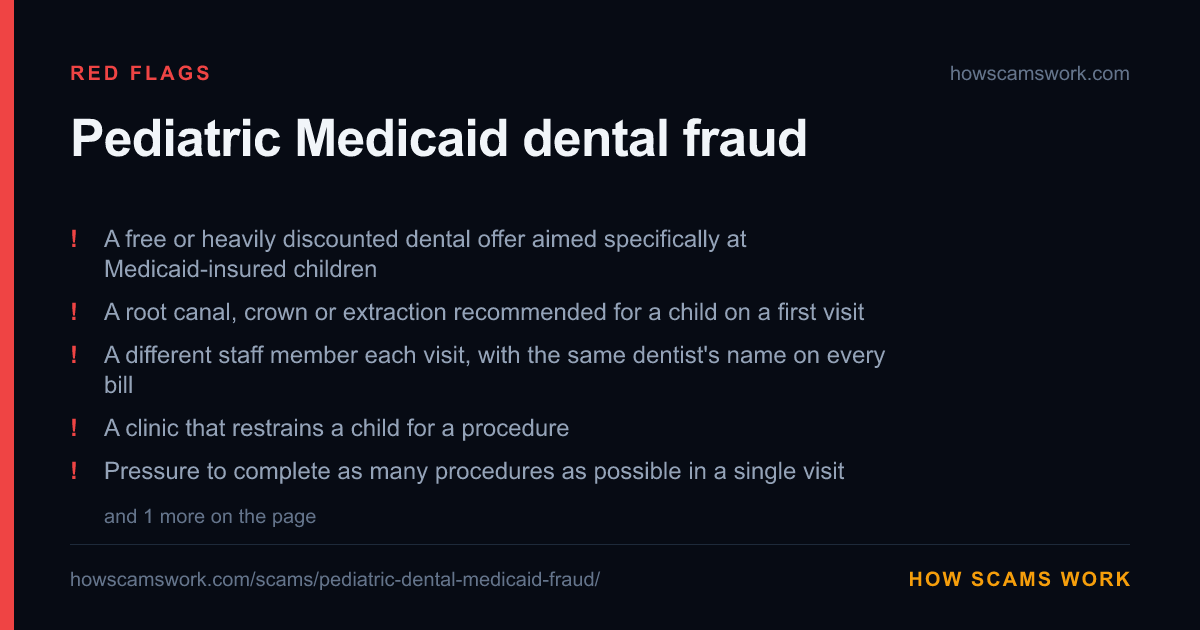
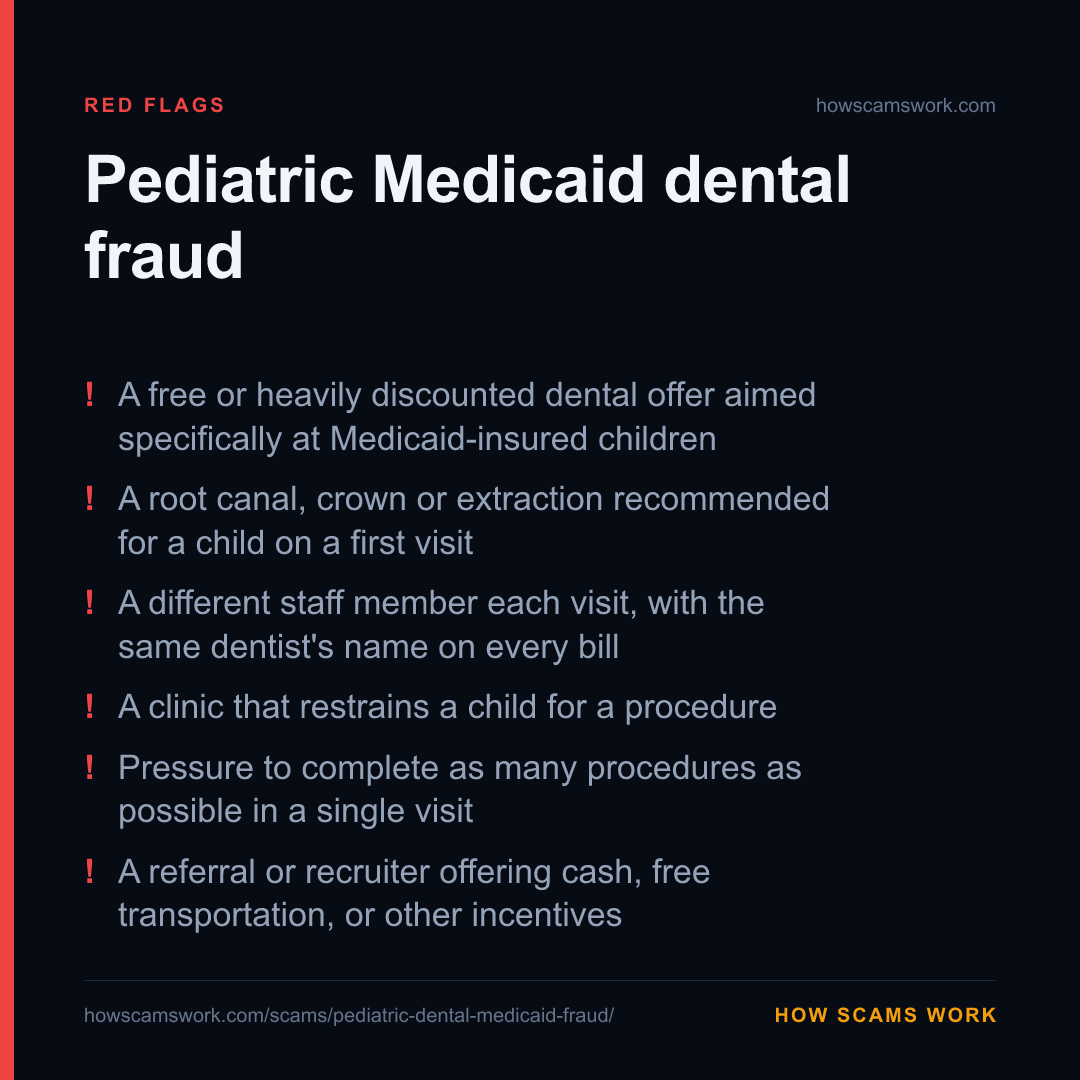
- A free or heavily discounted dental offer aimed specifically at Medicaid-insured children. Legitimate Medicaid dental benefits do not need a kickback-funded recruiter to find patients.
- A root canal, crown or extraction recommended for a child on a first visit, with no second opinion offered or welcomed.
- A different staff member each visit, with the same dentist’s name on every bill. This was the exact pattern prosecutors described in the Houston case.
- A clinic that restrains a child for a procedure without walking a parent through exactly why, and getting their informed agreement, first.
- Pressure to complete as many procedures as possible in a single visit, rather than scheduling follow-ups based on need.
- A referral or recruiter offering cash, free transportation, or other incentives to bring a child in for Medicaid-covered dental work.
If it’s happening to you
- Ask for the specific diagnosis behind any recommended procedure, in plain language, and ask what
happens if you wait or get a second opinion first. A legitimate dentist can explain this without
pressure.
- Get your child’s dental records and billing statement from the clinic and from your state Medicaid
office. Compare what was billed against what you actually remember happening at the visit.
- Ask your state’s Medicaid program directly whether the billed procedures match its own records of
what that provider has billed for your child historically; an unusually high number of procedures per
visit is one of the exact patterns the HHS Inspector General’s own audits look for.
- Report suspected fraud to the HHS Office of Inspector General at oig.hhs.gov/fraud or
1-800-HHS-TIPS, and to your state’s Medicaid Fraud Control Unit. See where to
report for other countries.
- If you worked inside a clinic and saw this happen, a False Claims Act whistleblower lawsuit is how
three of the cases on this page were first uncovered; a lawyer experienced in qui tam cases can explain
the process and the protections it carries.
- Consider a second dental opinion for your child before agreeing to any further treatment at the
same clinic, especially if a prior visit there involved a procedure you were not clearly consulted
about in advance.
Where the money goes
Straight from a state Medicaid program to the clinic’s own account, with the clinic then splitting a
share of it back out to the people who kept the patients coming.
There is no overseas transfer and no cryptocurrency in any case on this page. The money moves in a short,
domestic loop: Medicaid pays the clinic for each procedure billed, whether or not it was needed or
actually performed; the clinic pays a kickback to a patient recruiter for every Medicaid child
referred, a federal Anti-Kickback Statute violation on top of the billing fraud itself; and the
recruiter passes part of that kickback on to the parent who brought the child in, closing the loop that
keeps new patients arriving. None of this required a shell company or a money mule network; a licensed
dental business was itself the entire structure.
By the numbers
No published dataset breaks this scheme out as its own category yet, so there is no chart to show.
The data page explains which agency categories exist and why some schemes are
invisible in official statistics.
Every factual claim above traces to one of these. Statistics are reported losses; see
methodology for what that does and does not measure.