Also called: capping · capper fraud · patient capping · cosmetic surgery insurance fraud · unnecessary surgery insurance fraud
A "rent-a-patient" scheme pays someone, through a recruiter known as a capper, cash or a free cosmetic surgery to undergo a real, medically unnecessary procedure. A surgery center then bills the person's commercial PPO health plan, union benefit fund or workers' comp insurer for it, sometimes under a different billing code entirely. One California network recruited 2,841 people this way before it collapsed.
What it is
A capper, sometimes called a body broker, finds someone and offers them something: cash, free
housing, or a free or discounted cosmetic surgery, tummy tuck, breast augmentation, liposuction, in
exchange for one thing. They have to become a “patient” at a particular surgery center and undergo a
procedure they do not actually need.
The surgery happens. It is real surgery, with real risk, performed by a licensed doctor. What is fake is
the medical necessity: the colonoscopy nobody’s digestive system called for, the cortisone shot nobody’s
joint required, the Naltrexone implant inserted into someone who was never asked if they wanted it. The
surgery center then bills the person’s health coverage, usually a commercial PPO plan or union
benefit fund, sometimes a workers’ compensation insurer, for the procedure. Sometimes it bills for
something else entirely: a tummy tuck coded and billed as a hernia repair.
This is not a rare or marginal scheme. A single Orange County, California network, Unity Outpatient
Surgery Center, recruited more than 5,000 patients from 45 states between 2002 and 2003 alone,
and the broader case against it eventually totaled $154 million in fraudulent billings. A separate
Beverly Hills surgeon billed insurers roughly $600 million using the same mechanism against patients
recruited from sober living homes.
How it actually works
The recruitment
A capper approaches someone directly: outside a low-wage workplace, at a sober living home, through a
coworker who has already done it. The pitch is simple. Go through a procedure, and get paid, housed, or
given a free cosmetic surgery you could not otherwise afford.
The target: PPO, union or workers’ comp coverage
Cappers specifically seek out people with commercial PPO coverage or union health benefits, because PPO
claims, unlike HMO claims, usually do not require insurer pre-approval before a procedure is billed. A
separate strain of the scheme targets people already inside the workers’ compensation system.
A licensed doctor signs off
A physician at the surgery center examines the recruited “patient” and documents a diagnosis that
justifies the procedure on paper, even though no genuine medical need exists.
Where it could have stopped
An insurance claim cannot be billed without a licensed provider personally attesting that the procedure was medically necessary. Every documented case on this page involved a doctor who signed that attestation anyway; a surgery center cannot run this scheme without at least one physician willing to participate, which is why prosecutions almost always charge a doctor alongside the cappers.
The procedure
The surgery or procedure takes place: an endoscopy, a colonoscopy, a cystoscopy, a cortisone shot, a
Naltrexone implant, sometimes a genuinely elective cosmetic procedure bundled in as the patient’s reward.
It is medically real and medically unnecessary at the same time.
The billing
The surgery center submits the claim to the patient’s PPO plan, union fund or workers’ comp insurer. In
at least one documented case, the code submitted did not match the procedure performed at all: a tummy
tuck billed as a hernia repair, a non-covered cosmetic procedure billed as a covered one.
The payout
Once the insurer pays, the patient receives whatever was promised, cash, free housing, or the cosmetic
surgery. The capper takes a commission per patient recruited, documented as high as $1.7 million for a
single capper in one case. The surgery center and its doctors keep the balance of what the insurer paid.
Scale, then collapse
The economics reward volume: one network billed $90 million and collected $16 million from a few hundred
recruited patients; another collected $154 million from thousands. Every concluded case on this page
ended the same way, an insurance fraud investigation by a state Department of Insurance or a US
Attorney’s Office, built from the billing pattern itself rather than any single patient’s complaint.
Why it works
Both sides of the transaction want it to happen. The recruited patient gets something they value,
money, housing, or an expensive cosmetic procedure they could not otherwise afford. The surgery center
gets an insurance payout. Nobody in the room has an incentive to report it, which is exactly why these
schemes run for years before an insurer’s own fraud unit catches the billing pattern rather than a
complaint.
PPO coverage removes the one checkpoint that could have stopped it early. Unlike an HMO, a PPO
typically does not require pre-approval before a procedure is performed, so the first time anyone outside
the scheme reviews the claim is after the surgery has already happened and the money has already moved.
A real procedure is harder to disprove than a fake one. Billing for a service that was never
performed at all is a comparatively simple fraud to detect. Here, the colonoscopy really happened; what
is fraudulent is whether anyone needed it, a medical judgment call that takes a specialist’s chart review
to unwind, not a glance at a billing code.
It preys on people with the fewest alternatives. Sober living residents trying to rebuild their
lives, low-wage employees who need cash now, people far from home with no local support, all describe
the population cappers specifically target, people for whom the trade, a real but unnecessary surgery for
a real and immediate benefit, looks reasonable in the moment.
Where it comes from
Entirely domestic in every documented case on this page. There is no overseas call center, no
cryptocurrency, no foreign bank account; the entire operation is a licensed US medical facility, often
operating under a name change after the first conviction.
California accounts for every case this page documents, driven by its large PPO-insured and
unionized workforce and its workers’ compensation system, though nothing about the mechanism is specific
to one state; any jurisdiction with commercial PPO coverage or a workers’ comp program is structurally
exposed to the same scheme.
The same facility often survives its own first conviction. Unity Outpatient Surgery Center’s
investigation grew to implicate a second, related facility, St. Paul Outpatient Surgery Center, and the
Empire Surgical Center case documents the same location operating at different times under three
different names, Princess Cosmetic Surgery, Vista Surgical Center and Empire Surgical Center.
Real cases
2022 US Sentenced $38.0m
Dr. Randy Rosen, a Beverly Hills surgeon, hired body brokers to find and pay patients at Southern California sober living homes to undergo medically unnecessary Naltrexone implant surgeries, cortisone shots and other procedures. Insurance companies, mostly through California's workers' compensation system, were fraudulently billed approximately $600 million and paid out approximately $50 million. Rosen pleaded guilty in August 2022 to eight felony counts of insurance fraud and was sentenced to 10 years in state prison, called by the Orange County District Attorney's Office the largest prison sentence for a provider in California workers' compensation insurance fraud. His girlfriend, Liza Visamanos, who owned the lab that processed the patients' drug tests, was sentenced separately to home confinement and probation.
Read the case file ·
1 source
2015 US Sentenced $71.0m
A surgery center in Orange, California, operating at different times as Princess Cosmetic Surgery, Vista Surgical Center and Empire Surgical Center, billed union and PPO health plans for more than $71 million in medical procedures performed on people who, in exchange, received free or discounted cosmetic surgery. Cappers lured patients with the promise of a tummy tuck, breast augmentation or liposuction if they first underwent medically unnecessary endoscopies, colonoscopies and cystoscopies, which were billed to the patients' union or PPO benefit plans. Tummy tucks were then billed as hernia repairs. Two defendants, Theresa Fisher and Lindsay Hardgraves, were convicted at trial and sentenced to federal prison in June 2015; a third, Vi Nguyen, pleaded guilty separately.
Read the case file ·
1 source
2009 US Sentenced $154.0m
Unity Outpatient Surgery Center in Buena Park, California, operated from June 2002 to October 2003, recruiting more than 5,000 healthy people from 45 states and the District of Columbia to undergo unnecessary and dangerous surgeries in exchange for money or low-cost cosmetic surgery. The Orange County District Attorney's Office, working with the California Department of Insurance, eventually charged 19 defendants in a case described as the largest medical fraud prosecution in the nation, over a scheme that fraudulently billed medical insurance companies $154 million. Capper Sue Nanda, who personally recruited over 90 of those patients, was sentenced in August 2009 to 10 years in state prison.
Read the case file ·
4 sources
Red flags
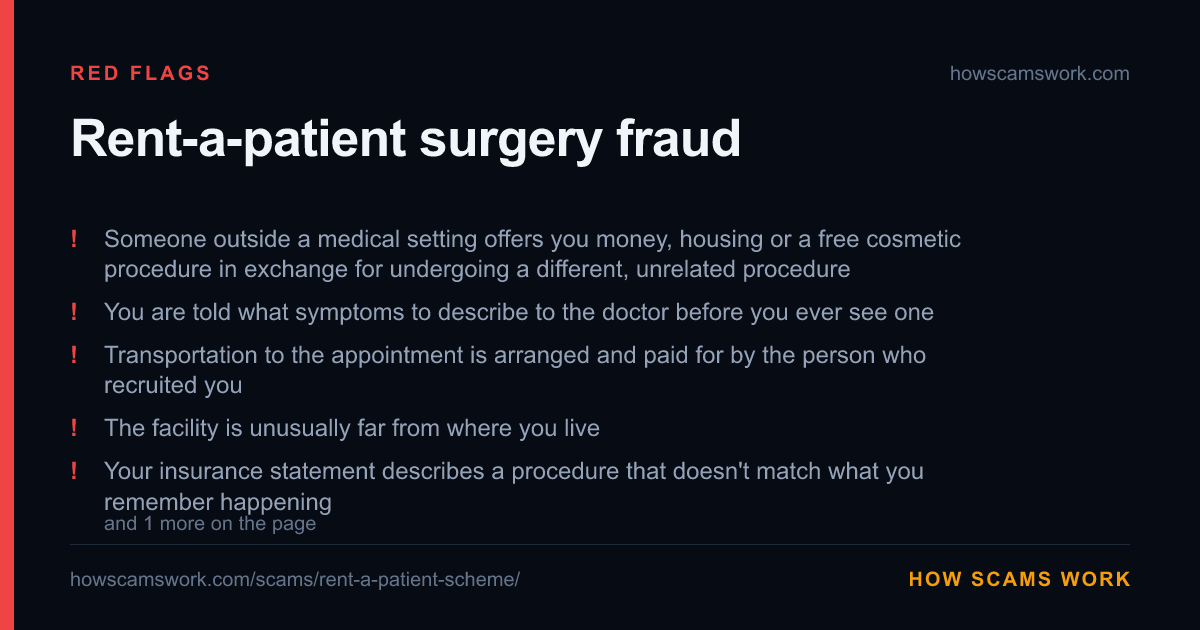
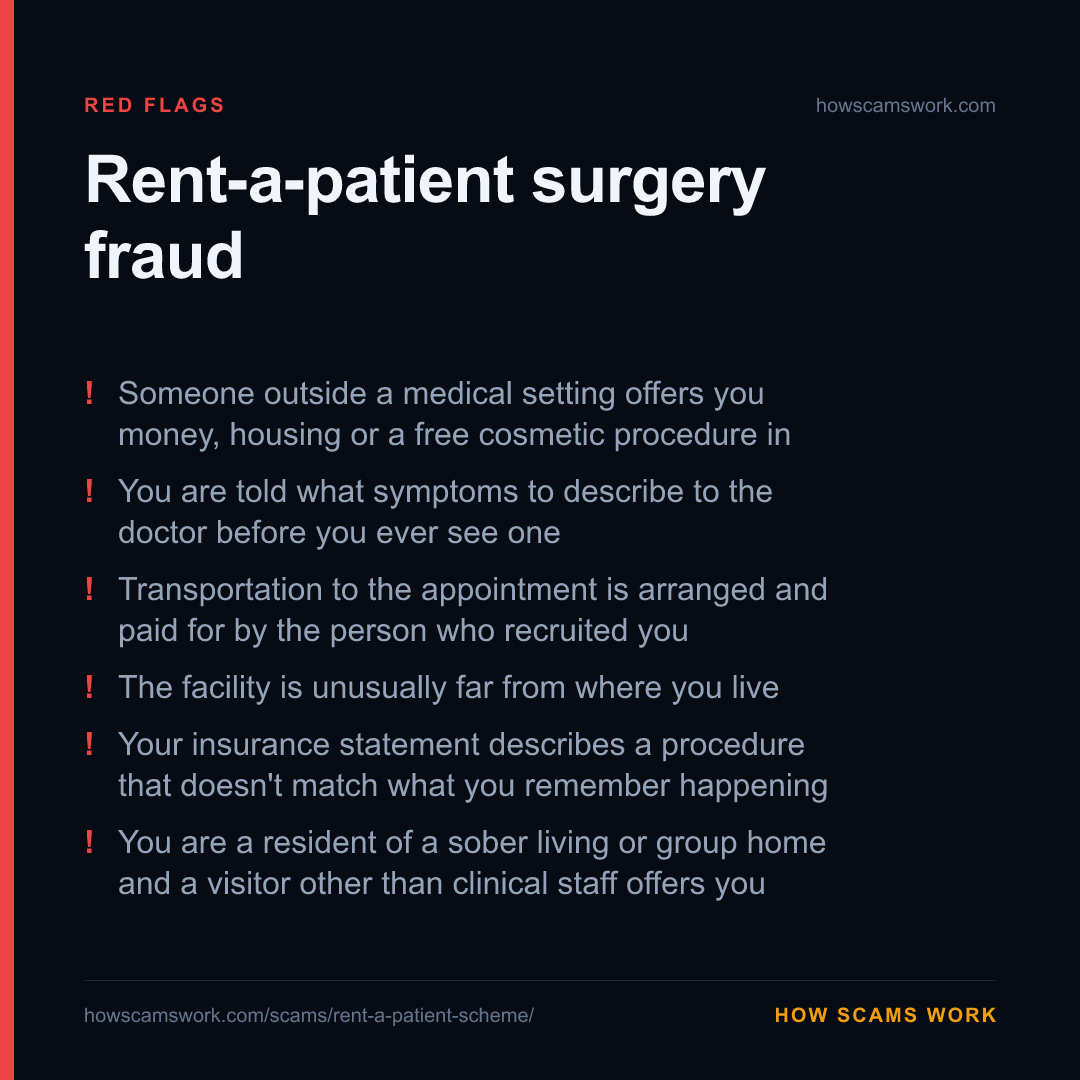
- Someone outside a medical setting offers you money, housing or a free cosmetic procedure in exchange for undergoing a different, unrelated procedure. Legitimate medicine never bundles payment to the patient with a referral for surgery.
- You are told what symptoms to describe to the doctor before you ever see one. A capper “coaching” a patient on what to say is a documented pattern in these cases.
- Transportation to the appointment is arranged and paid for by the person who recruited you, not by you or your insurer.
- The facility is unusually far from where you live, for a routine procedure you could have had done locally.
- Your insurance statement describes a procedure that doesn’t match what you remember happening, including a diagnosis code you don’t recognize.
- You are a resident of a sober living or group home and a visitor other than clinical staff offers you money to see a particular doctor.
If it’s happening to you
- Stop before any procedure happens if you have been offered money or a free surgery in exchange for
a different one. You are being recruited as billing material, not treated as a patient.
- Request a copy of every claim your insurer paid in your name. Compare the billed procedure and
diagnosis code against what you actually remember being done.
- Report it to your insurer’s own fraud unit directly, most large PPO plans, union funds and
workers’ comp carriers have one, and to your state’s Department of Insurance fraud division.
- If you are a sober living resident or recently out of treatment, tell your case manager or
treatment provider if anyone outside clinical staff has offered you money to see a specific doctor;
this is a documented recruitment pattern, not an isolated offer.
- Keep every document: appointment confirmations, any cash or in-kind payment you were promised or
received, and the name of whoever recruited you. Prosecutors in every case on this page relied on
this kind of paper trail.
- Report it to the FTC at ReportFraud.ftc.gov, or see where to report
for your country’s insurance fraud authority.
Where the money goes
No laundering chain to trace in most documented cases, the money moves between a handful of licensed
businesses and individuals, not through shell companies or overseas transfers.
An insurer pays a claim directly to the surgery center or physician’s practice. The surgery center pays
the capper a commission for each patient delivered, documented as high as $1.7 million for one capper
across one case. The capper, in turn, pays or rewards the recruited patient with whatever was promised:
cash, housing, or the cosmetic procedure that was the actual reason the patient agreed to any of it. What
laundering does appear is usually simple: one Unity defendant pleaded guilty to a single money laundering
count alongside the capping and fraud charges, not a separate structured network.
By the numbers
No published dataset breaks this scheme out as its own category yet, so there is no chart to show.
The data page explains which agency categories exist and why some schemes are
invisible in official statistics.
Every factual claim above traces to one of these. Statistics are reported losses; see
methodology for what that does and does not measure.
Common questions
If the patient got paid or got free surgery, who's actually the victim?
The insurer that pays the claim, and everyone else paying premiums into that PPO plan, union fund or workers' comp pool, who covers the cost afterward through higher premiums. The recruited patient is not financially out of pocket, but prosecutors and insurers still treat them as exploited: they are usually people with few other options, undergoing a real surgical procedure, with real medical risk, that they do not actually need, because someone offered them money or a free cosmetic surgery to do it.
Is this the same as workers' comp kickback fraud?
No, though both defraud insurers through unnecessary treatment. Workers' comp kickback fraud pays an injured worker's own treating doctor or chiropractor a fee for referring that worker to a specific hospital or imaging lab. A rent-a-patient scheme pays the patient, or a recruiter who pays the patient, directly, often someone who was never injured or sick to begin with, to become a patient in the first place.
Is this the same as sober home patient brokering?
No. Sober living home and patient brokering fraud pays a sober home operator a kickback to refer a resident's Medicaid ID to a behavioral-health clinic, which bills Medicaid for addiction counseling that is thin or fictional. A rent-a-patient scheme bills commercial PPO plans, union funds or workers' comp insurers, not Medicaid, and the money goes to the recruited patient directly, in cash or a free procedure, not to the home operator.
Why would a surgery center's own doctor sign off on surgery nobody needs?
Because a share of the insurance payout funds the doctor's own fee, and because a doctor willing to participate is the one person in the chain who can make a fabricated diagnosis look clinically legitimate on paper. Every documented case on this page involved a licensed physician who personally performed or authorized the unnecessary procedures; this is why prosecutions almost always include at least one doctor, not just the cappers.
How do insurers even notice, if everyone involved agreed to it?
Billing patterns give it away: the same facility submitting an unusual volume of the same high-reimbursement procedures (endoscopies, colonoscopies, cosmetic-adjacent repairs), for patients who traveled an improbable distance for routine care, coded in ways that do not match what was actually done. Every concluded case on this page followed an insurance fraud investigation, not a patient complaint.